
Dark, Milk and White Chocolate: The Real Differences
Walk down any chocolate aisle and you will find three main families: dark, milk and white. They look different, taste different and behave differently in the kitchen, yet they all start from the same place, the seeds of the cacao tree. The differences come down to what is added, what is left out, and how much of the bar comes from cacao. This guide explains each type, what the percentages mean, how they taste, and when to use which.
The quick comparison
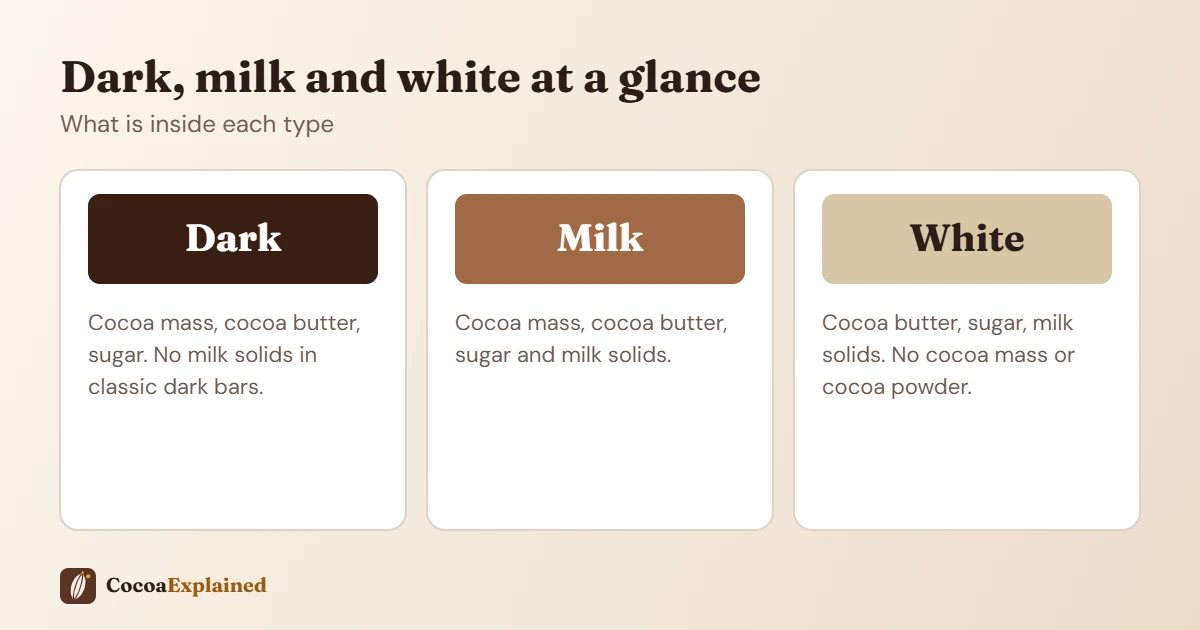
| Dark chocolate | Milk chocolate | White chocolate | |
|---|---|---|---|
| Made from | Cocoa mass, cocoa butter, sugar | Cocoa mass, cocoa butter, sugar, milk | Cocoa butter, sugar, milk |
| Contains cocoa solids (non-fat) | Yes, the most | Yes, less | No |
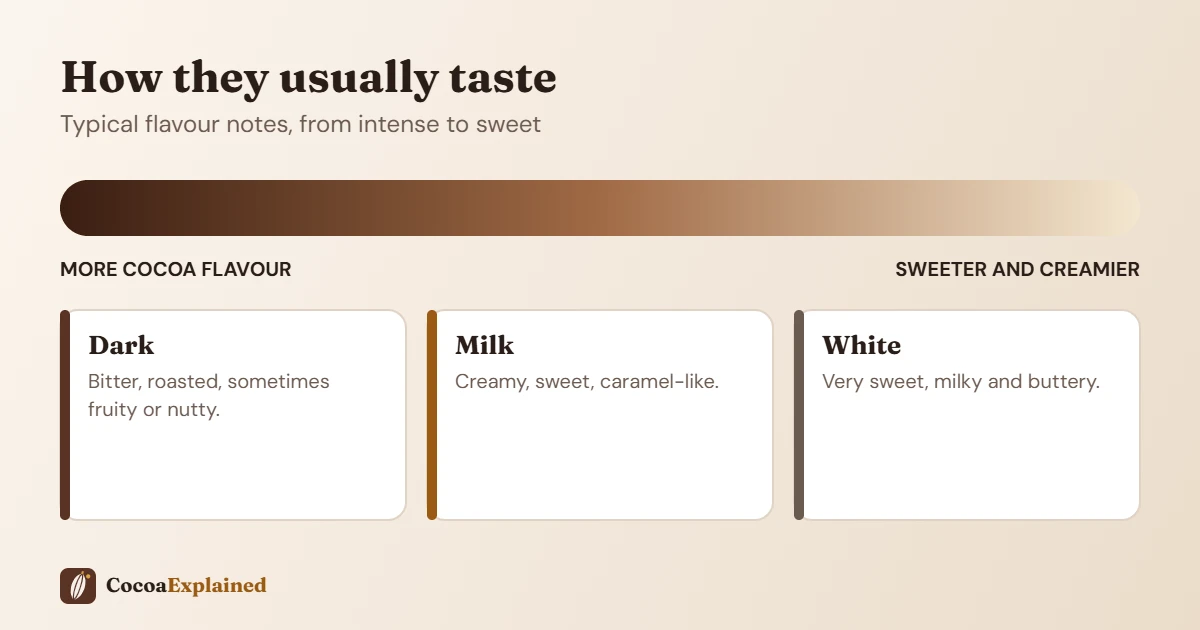
| Typical taste | Bitter, deep, sometimes fruity or earthy | Sweet, creamy, caramel-like | Very sweet, creamy, vanilla notes |
| Colour | Dark brown | Light to medium brown | Ivory or cream |
| Common use | Eating, baking, ganache | Eating, candy bars, drinks | Coatings, desserts, pairing with fruit |
Dark chocolate
Dark chocolate contains cocoa mass and cocoa butter with sugar, and usually no milk ingredients. Because it has the highest share of cacao, it tastes the most like the bean itself: a little bitter, sometimes with notes of fruit, nuts, coffee or spice.
You will see percentages such as 55%, 70% or 85% on the label. As we explain in our guide to what chocolate is, the number tells you how much of the bar by weight comes from cacao ingredients. A 55% bar is sweeter and gentler. A 70% bar is the classic “dark” taste for many people. An 85% bar or higher is very intense and has little sugar.
Two small points are worth knowing. First, “dark chocolate” is not always a formal legal term. In the United States, official standards use names such as sweet, semisweet and bittersweet chocolate, with minimum amounts of chocolate liquor. In the European Union, chocolate must contain at least 35% total cocoa solids. Second, the terms “semisweet” and “bittersweet” are not strictly defined from brand to brand, so a recipe that calls for one can usually use the other if you check the percentage.
Milk chocolate
Milk chocolate adds milk, usually as milk powder or condensed milk, and more sugar. It has less cocoa than dark chocolate, so the flavour is milder, creamier and sweeter. Many people associate it with caramel and malt flavours.
Legal minimums are lower for milk chocolate. In the EU, milk chocolate must contain at least 25% total dry cocoa solids and 14% dry milk solids. In the United States, it must contain at least 10% chocolate liquor and 12% milk solids. Many everyday bars sit close to those minimums, while premium milk chocolates may go to 40% cocoa or more and taste noticeably richer.
White chocolate
White chocolate is different in a way that surprises many people: it contains cocoa butter but no cocoa solids from the dry part of the bean. That is why it is ivory in colour and does not taste like cocoa. Its flavour comes from cocoa butter, sugar, milk and usually vanilla.
Under U.S. standards, white chocolate must contain at least 20% cocoa butter, 14% total milk solids and 3.5% milkfat, with no more than 55% sweeteners. The EU also requires at least 20% cocoa butter and 14% dry milk solids. If the first fat in the ingredient list is not cocoa butter, the product is likely a white-coloured coating rather than white chocolate.
How they taste and why
Flavour in chocolate comes from three things: the cacao beans, how they were fermented, dried and roasted, and what else is in the bar. Dark chocolate lets the beans speak, so a bar made from beans of one origin can taste very different from another. Milk and white chocolate add dairy and sugar, which mellow and sweeten the flavour but hide some of those subtle notes. That is why many tasting guides begin with dark chocolate when they want to explain differences in origin.
Which one should you choose?
- For eating on its own: it is a matter of taste. If you like sweet and creamy, milk chocolate is a natural choice. If you want something more complex, try a 60–70% dark bar first, then go higher gradually.
- For baking cookies and brownies: semisweet or dark chocolate between about 50% and 70% works well, because it keeps the sweetness in balance.
- For ganache, sauces and mousse: dark chocolate sets firmer and gives a stronger flavour. Milk and white chocolate need more chocolate relative to cream because they are softer.
- For drinks: milk chocolate gives a sweet, creamy cup. Dark chocolate makes a richer, less sweet one.
- For decorating and contrast: white chocolate is useful for drizzling and for pairing with tart fruit such as raspberries.
Is white chocolate real chocolate?
It is made from cocoa butter, so it comes from the cacao seed, and many countries have official standards for it. But it does not contain the cocoa solids that give dark chocolate its colour and bitterness, which is why people often have different opinions about whether it “counts.”
Is a higher percentage always better?
Not necessarily. A higher percentage means more cacao and less sugar, but quality also depends on the beans and how the chocolate was made. A well-made 60% bar can be better than a poorly made 90% one. Choose the percentage you enjoy.
Does dark chocolate have more caffeine?
Cacao naturally contains small amounts of caffeine and a related compound called theobromine, and dark chocolate generally has more of both than milk or white chocolate because it has more cocoa solids. The amounts in a normal portion are small compared with a cup of coffee, but if you are sensitive to caffeine, check with your doctor.
Can I swap one type for another in a recipe?
Sometimes, but not one-for-one. Milk and white chocolate have more sugar and milk, and they are softer, so a recipe built for dark chocolate may turn out sweeter and looser. If you want to substitute, make a small test batch first.
Key points to remember
- Dark chocolate has the most cocoa and the most intense flavour. Milk chocolate adds milk and sugar. White chocolate has cocoa butter but no cocoa solids.
- The percentage shows how much of the bar comes from cacao ingredients, not how good it tastes.
- The ingredient list is the best way to tell real chocolate from coatings.
If you want to see how these differences begin on the farm and in the factory, read our guide to how cacao beans become a chocolate bar.
Sources
- U.S. eCFR, Title 21, Part 163: Cacao Products
- EU Directive 2000/36/EC on cocoa and chocolate products (EUR-Lex)
- Encyclopaedia Britannica: Chocolate
- International Cocoa Organization (ICCO)
Last updated: October 14, 2026. Written by Jessu Rignesh Nadar. This guide is for general information and is not medical or nutrition advice.
