
What Is Chocolate, Exactly?
Chocolate is a food most of us have eaten for as long as we can remember, yet very few people could say exactly what is in it. A bar can taste bitter, creamy or sweet, and the label can list anything from two ingredients to a dozen. This guide explains, in plain language, what chocolate actually is, what it is made from, and how to read what is on the wrapper.
The short answer
Chocolate is a food made from the seeds of the cacao tree, Theobroma cacao. The seeds are fermented, dried, roasted and ground into a thick paste. That paste is then blended with other ingredients, usually sugar, and sometimes milk, to make the bars, drinks and baking chocolate we buy.
The name of the tree gives a hint about its history: Theobroma comes from Greek and is usually translated as “food of the gods.” Cacao has been grown and used in Central and South America for thousands of years, long before it was ever sweetened or moulded into bars.
The four building blocks of chocolate
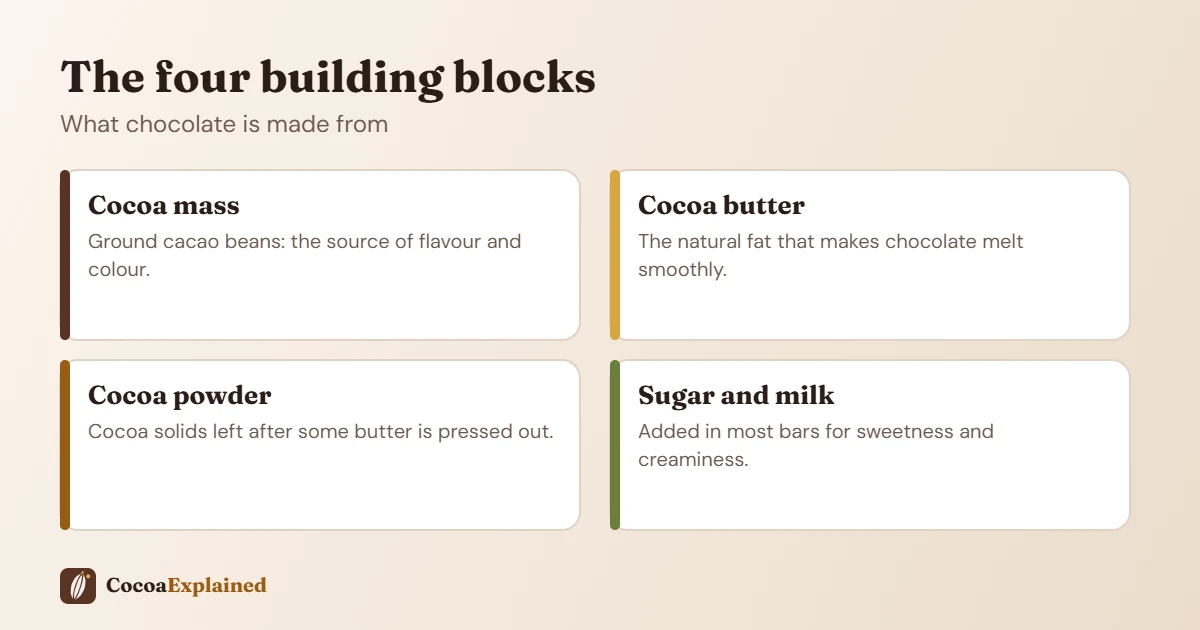
Almost every chocolate product is built from a small set of ingredients. Understanding them makes labels much easier to read.
1. Cocoa mass (also called cocoa liquor)
When roasted cacao seeds, called nibs, are ground, the heat of grinding melts the natural fat and produces a smooth, dark liquid. This is cocoa mass or chocolate liquor. Despite the name, it contains no alcohol. It carries both the deep chocolate flavour and the natural cocoa butter of the bean.
2. Cocoa butter
Cocoa butter is the pale, natural fat found in the cacao seed. It can be pressed out of the cocoa mass. It melts close to body temperature, which is why good chocolate melts in your mouth but stays firm in your hand. White chocolate gets its colour and texture from cocoa butter.
3. Cocoa powder (cocoa solids)
What remains after most of the cocoa butter is pressed out is a dry cake that is ground into cocoa powder. Together, cocoa mass, cocoa butter and cocoa powder are often described as “cocoa solids,” and this is the number behind the percentages you see on dark chocolate.
4. Sugar, milk and other additions
Sugar balances the natural bitterness of cacao. Milk chocolate adds milk powder or condensed milk. Many bars also include an emulsifier, most commonly soy or sunflower lecithin, which helps the ingredients blend smoothly, and flavourings such as vanilla. Some manufacturers add other vegetable fats; whether that is allowed to be called chocolate depends on the country, as explained below.
What the percentage on the bar means
When a bar says “70% cocoa,” it means that 70% of the bar by weight comes from cacao ingredients: cocoa mass, cocoa butter and cocoa powder together. The remaining 30% is mostly sugar plus small amounts of other ingredients. A higher number usually means a more bitter, more intense bar with less sugar, but it does not by itself tell you about quality. Bean variety, growing conditions and how the chocolate was made matter just as much.
It is also worth knowing that the percentage does not say how much of that is cocoa butter and how much is cocoa mass. Two bars that both say 70% can feel quite different on the tongue for that reason.
Does the law decide what can be called chocolate?
Yes, in many places. Rules differ by country, which is why the same product can be labelled differently when it is sold in different markets. Two well-known examples are the United States and the European Union.
| Type | United States (FDA standards) | European Union (Directive 2000/36/EC) |
|---|---|---|
| Chocolate (dark) | Semisweet or bittersweet chocolate must contain at least 35% chocolate liquor. Sweet chocolate must contain at least 15%. | Chocolate must contain at least 35% total dry cocoa solids, of which at least 18% is cocoa butter and 14% is fat-free cocoa solids. |
| Milk chocolate | At least 10% chocolate liquor, 12% milk solids and 3.39% milkfat. | At least 25% total dry cocoa solids and 14% dry milk solids. |
| White chocolate | At least 20% cocoa butter, 14% total milk solids and 3.5% milkfat, with no more than 55% sweeteners. | At least 20% cocoa butter and 14% dry milk solids. |
These figures are minimums taken from the official texts listed under Sources, and the rules do change, so check the current wording if you need it for business or labelling purposes. The main takeaway is that “chocolate” on a label is not just a marketing word. It usually has a legal minimum for the cacao-based ingredients.
Chocolate versus “chocolate-flavoured” products
If a product says “chocolate flavoured,” “chocolatey” or “compound coating,” it may not meet the legal definition of chocolate. Compound coatings often replace cocoa butter with other vegetable fats, such as palm or shea, because they are cheaper and easier to work with. That can be fine for a cake coating or an ice cream shell, but it will not melt or taste the same as real chocolate. The ingredient list is the best place to check. In a bar made with real chocolate, cocoa butter appears near the top and you will not see other fats listed as the main fat.
How to read a chocolate label
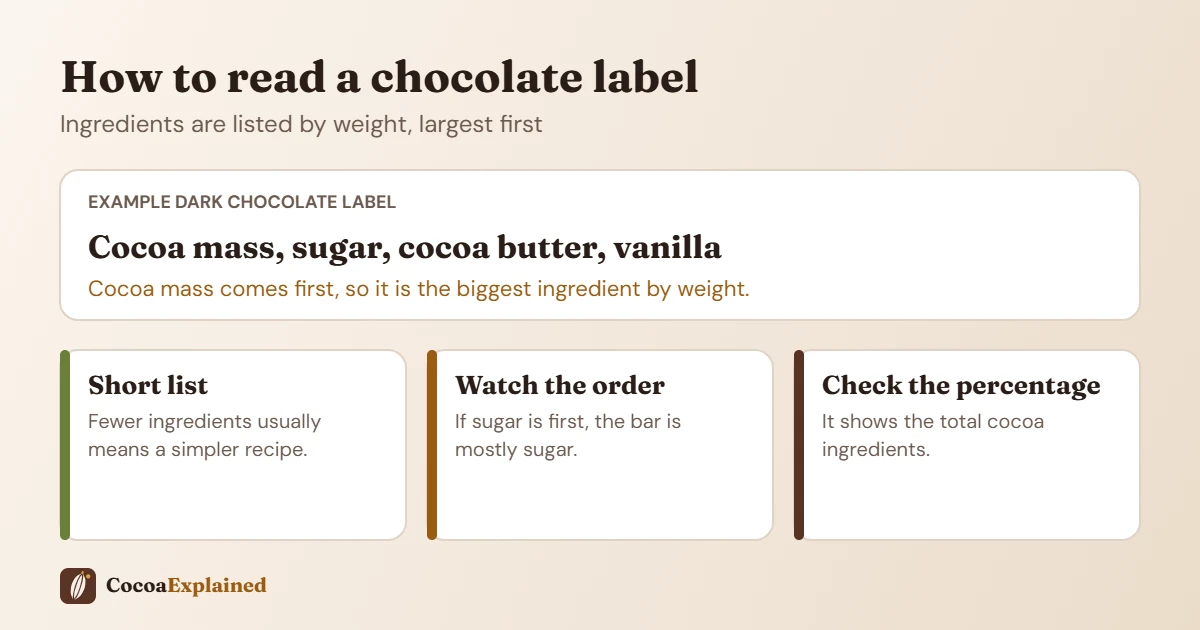
- Look at the first ingredient. Ingredients are listed from the largest amount to the smallest. In dark chocolate, cocoa mass (or “cocoa beans”) should come first. If sugar comes first, the bar is mostly sugar.
- Check for cocoa butter. Real chocolate usually lists cocoa butter. Be cautious if you see other vegetable fats instead.
- Note the percentage. It tells you about intensity and sweetness, not about overall quality.
- Read the allergen line. Milk, soy, nuts and gluten are common allergens, and many bars are made on shared equipment. If you have an allergy, follow the allergen advice on the pack and speak to a doctor or dietitian about your needs.
- Look for the origin. Some bars name the country or region where the beans were grown. That is a helpful clue about flavour, though it is not required everywhere.
Is chocolate a health food?
Chocolate is a treat, and the honest answer is that it depends on what is in it and how much you eat. Dark chocolate contains cocoa solids, which naturally contain compounds called flavanols, and these are studied by researchers. But chocolate also contains sugar, fat and calories, and the amount of flavanols varies a lot between products. On this site we avoid health claims that cannot be supported by reliable sources. If you have a health condition or a special diet, ask your doctor or a registered dietitian what is right for you.
Where chocolate comes from
Cacao trees grow in a narrow band of warm, humid regions near the equator. Today a large share of the world’s cacao is grown in West Africa, with other important producers in Latin America and Southeast Asia. Most cacao is grown by smallholder farmers, which is why questions about fair pay and sustainability come up so often when people talk about chocolate. We will cover how the beans become a bar, step by step, in our guide to how cacao beans become a chocolate bar.
Key points to remember
- Chocolate comes from the seeds of the cacao tree, which are fermented, dried, roasted and ground.
- Its main building blocks are cocoa mass, cocoa butter, cocoa powder, and usually sugar and milk.
- The percentage on a bar shows how much comes from cacao ingredients, not how good it is.
- In many countries the word chocolate has legal minimums, and the ingredient list shows what you are really buying.
Next, read our guide to the real differences between dark, milk and white chocolate, or see how cacao beans become a chocolate bar.
Sources
- U.S. eCFR, Title 21, Part 163: Cacao Products
- EU Directive 2000/36/EC on cocoa and chocolate products (EUR-Lex)
- Encyclopaedia Britannica: Chocolate
- International Cocoa Organization (ICCO)
Last updated: October 14, 2026. Written by Jessu Rignesh Nadar. This guide is for general information and is not medical or nutrition advice.
