What Is Single-Origin Chocolate? Meaning and How to Buy
Stro
Madagascar cacao is often described as bright and tangy with red berry, citrus and tropical fruit notes. The flavour comes from the bean variety, the growing conditions and how it is fermented, dried and roasted. Not exactly. Weather, harvest and fermentation change from year to year, so the same origin can taste slightly different between batches.Why does Madagascar chocolate taste fruity?
Does single-origin chocolate taste the same every year?
This guide explains what the term means and what it does not, how single-origin chocolate compares with blends, what shapes the flavour beyond the country on the label, and how to choose a bar without being misled. It follows naturally from how to taste chocolate, since single-origin bars are the ones that reward careful tasting the most.
What single-origin means
Single-origin chocolate is made from cacao beans grown in one defined place. How defined depends on the maker. It might be:
- A single country, such as Ecuador or Madagascar. This is the most common meaning.
- A region within a country, for example a particular valley or growing area.
- A single estate or farm, sometimes called single-estate or single-plantation.
- A cooperative of growers who share a fermentation and drying centre.
The term is not tightly regulated in most places, so the more specific the claim, the more you are trusting the maker’s honesty and transparency. A bar that names a cooperative, a harvest year and a fermentation approach is saying more, and is easier to check, than one that simply prints a country name.
Be careful not to confuse where the beans came from with where the chocolate was made. “Made in Belgium” or “Swiss chocolate” tells you where the factory is, not where the cacao grew.
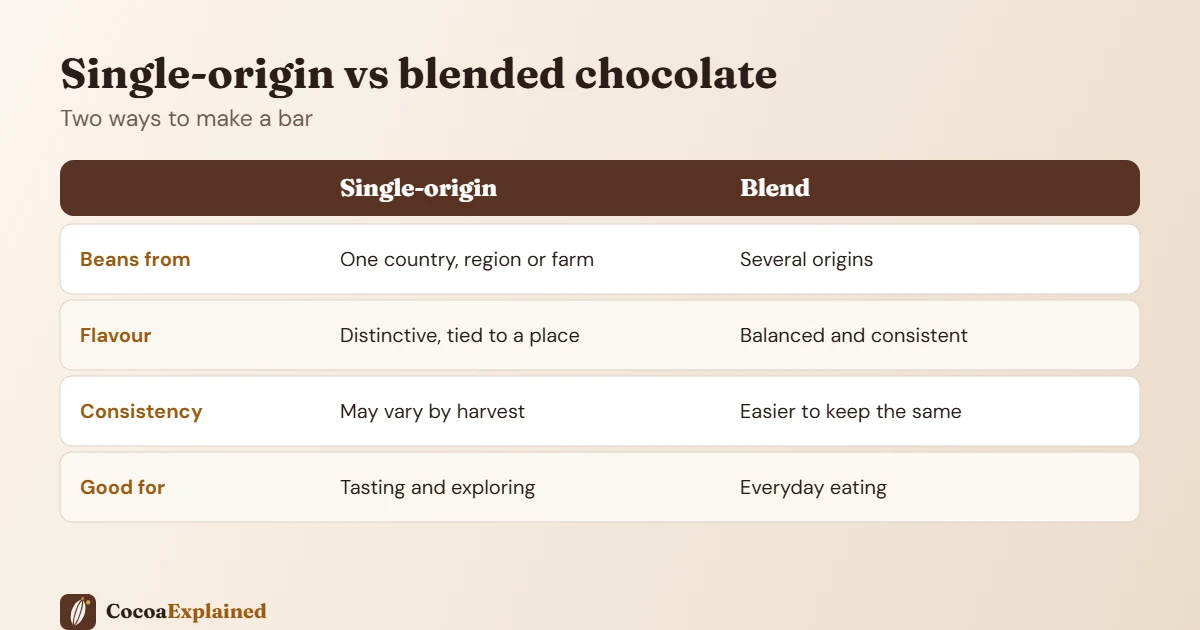
Single-origin vs blended chocolate
Most chocolate in the world is a blend. Makers combine beans from several countries to create a consistent flavour that tastes the same year after year, which is exactly what large brands need. A blend can also balance weaknesses in one origin with strengths from another, adding body here and acidity there.
Single-origin chocolate takes the opposite approach. It aims to show what one place and one harvest taste like, including the quirks. That makes it more interesting to taste, and also more variable. The same bar from the same maker can taste a little different from one year to the next.
| Single-origin | Blend | |
|---|---|---|
| Beans from | One country, region or farm | Several origins |
| Flavour | Distinctive, tied to a place | Balanced and consistent |
| Consistency | May vary by harvest | Easy to keep the same |
| Good for | Tasting and exploring | Everyday eating and baking |
| Typical price | Often higher | Often lower |
What actually shapes the flavour
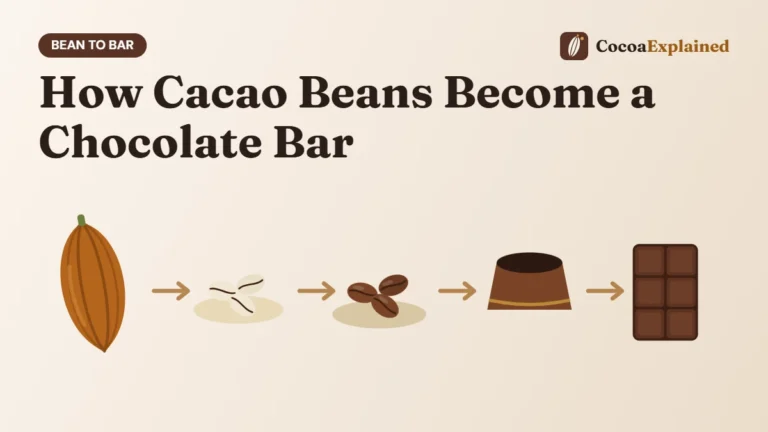
The country on the label matters less than people think. Flavour comes from a long chain of decisions, as you can see in how cacao beans become a chocolate bar:
- The type of cacao. There are three main groups. Forastero is the most widely grown and gives hardy, robust trees with strong, classic cocoa flavour. Criollo is rare and prized, with delicate, nutty and floral notes, but it is fragile and low-yielding. Trinitario is a hybrid of the two, which arose in Trinidad, and often combines robustness with more complex flavour.
- Climate and soil. Rainfall, sunshine, altitude and soil all affect the beans.
- Harvest and fermentation. How the pods are opened, how long the beans ferment, and how they are dried can change flavour as much as the origin does.
- Roasting and grinding. A light roast keeps fruity acidity; a dark roast pushes towards coffee and toasted notes.
- The recipe. The cocoa percentage, how much sugar is added, and whether there is milk all change what you taste. See what the cocoa percentage means.
Makers and tasters often describe origins with generalisations, such as bright, red-fruit acidity from some Madagascan bars or floral notes from some Ecuadorian ones. These are tendencies, not guarantees. Treat them as starting points for your own tasting.

Typical flavour notes by origin
Flavour notes are always general, because harvests, farms and makers differ. Even so, many tasters describe some origins in broadly similar ways. Use this as a starting map, not a rulebook.
| Origin | Notes often described |
|---|---|
| Ecuador | Roasted nuts, brown sugar, gentle florals, ripe fruit |
| Peru | Red fruit, honey, citrus, warm spice |
| Venezuela | Rounded texture with nuts, caramel, dried fruit and delicate flowers |
| Madagascar | Bright, tangy fruit such as red berries, citrus and tropical fruit |
| West Africa (Ghana, Cote d’Ivoire, Nigeria) | Classic cocoa, biscuit, roasted nuts, malt, caramel and dried fruit |
| Dominican Republic | Raisins, red fruit, toasted almond, honey and soft spice |
| Indonesia, Papua New Guinea, Philippines | Earthy, woody, smoky or savoury notes alongside fruit and cocoa |
Why the same origin can taste different
Two bars from Ecuador can taste quite different. Soil, rainfall, altitude and cacao variety shape the bean, but so do harvesting and fermentation, which can produce noticeably different cacao even within one region. Then the maker’s roasting and conching choices add their own signature.

Run your own single-origin tasting
- Choose three bars with the same cocoa percentage but different origins, for example Ecuador, Madagascar and a West African bar.
- Taste them at room temperature, starting with the mildest.
- Smell first, then let a small piece melt on your tongue. Note fruit, nut, spice or earthy flavours.
- Drink water between bars.
- Write a line about each one so you can compare them later.
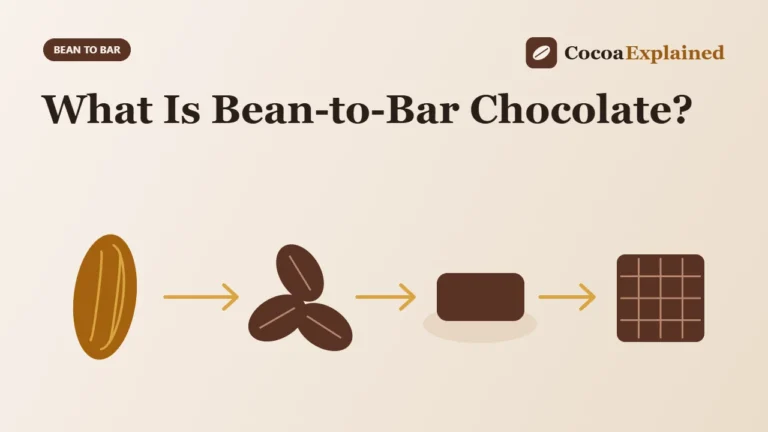
Our guide on how to taste chocolate explains the method in more detail, and bean-to-bar chocolate shows which makers usually label origins clearly.
Is single-origin better?
Not automatically. A well-made blend can taste better than a mediocre single-origin bar. Single-origin chocolate is more of a flavour exploration than a quality guarantee, and many people find the variety of tastes more interesting than a uniform bar.
Quality depends on the beans, the fermentation, the roast and the skill of the maker. A single-origin label tells you where the beans came from, not how well everything else was done.
Does single-origin mean ethical?
This is a common assumption, and it is not safe. Single-origin does not mean the farmers were paid fairly, that child labour was avoided, or that the farm is environmentally friendly. Origin and ethics are separate questions.
If these matter to you, look for specific evidence: makers who publish where they buy beans and what they pay, direct or traceable trade relationships, and recognised certifications. A label that names a cooperative and explains its relationship with growers is usually more informative than the single-origin claim alone.
How to choose a good single-origin bar
- Look for a specific origin. A country is a start; a region, cooperative or farm is better.
- Check the ingredients. A short list, ideally cacao beans (or cocoa mass), cocoa butter and sugar, lets the flavour of the bean show. Lots of additives or flavourings can hide it.
- Look at the cocoa percentage and think about what you enjoy. A very high percentage is not always better. See what the cocoa percentage means.
- Look for maker detail. Harvest year, tasting notes, fermentation details and roast level suggest a maker who is proud of the process.
- Taste and compare. Try two origins side by side and write short notes. You will learn quickly what suits you.
Single-origin chocolate and cooking
Single-origin bars are often best eaten as they are, rather than baked into a cake where the subtle flavours will be lost. For baking, a good blended chocolate or baking bar is cheaper and works just as well. If you do want to use a special bar in a recipe, choose something where the chocolate is front and centre, such as a ganache, a mousse or a simple sauce.
The short version
Single-origin chocolate is made from beans grown in one place, whether a country, a region or a farm. It lets you taste the character of that place, but it is not automatically better than a blend and it is not automatically ethical. Flavour depends on the cacao variety, climate, fermentation, roasting and the maker’s skill. Look for a specific origin, a short ingredient list and some maker detail, taste a few side by side, and you will soon find what you like.
Frequently asked questions
Is single-origin chocolate better?
Not necessarily. It shows the character of one place, which many enthusiasts enjoy, but quality depends on the beans and how they were handled and made into chocolate.
What does single-estate mean?
It means the beans come from one farm or estate, a narrower claim than single country or region.
Is single-origin chocolate fair trade?
Not automatically. Origin and ethical sourcing are separate. Look at the maker’s sourcing information and recognised certifications.
Why does single-origin chocolate cost more?
Smaller batches, careful sourcing and often higher-quality beans raise the cost, although price alone does not prove quality.
What are the main types of cacao?
Forastero is the most widely grown, Criollo is rare and prized, and Trinitario is a hybrid of the two.
Key points to remember
- Single-origin chocolate uses beans from one place: a country, region or farm.
- Blends combine origins for consistency; single-origin shows the character of a place.
- Flavour depends on variety, climate, fermentation, roasting and the maker.
- Single-origin does not guarantee better quality or ethical sourcing.
- Check origin, ingredients and maker detail when you buy.
Related guides
- How to Taste Chocolate Like a Pro: A 5-Step Guide
- How Cacao Beans Become a Chocolate Bar
- What Does Cocoa Percentage Mean on Chocolate?
- Cacao vs Cocoa: What Is the Difference?
- What is bean-to-bar chocolate
- Start here: a beginner’s guide to chocolate
- Browse all chocolate guides
Sources
- International Cocoa Organization (ICCO)
- Wikipedia: Chocolate
- Wikipedia: Theobroma cacao
- Cacao origin flavor guide for better tasting, Chocolaterie Brussels.
Last updated: October 2026. This guide is educational and is not medical or nutrition advice. See our editorial policy for how we research and write.