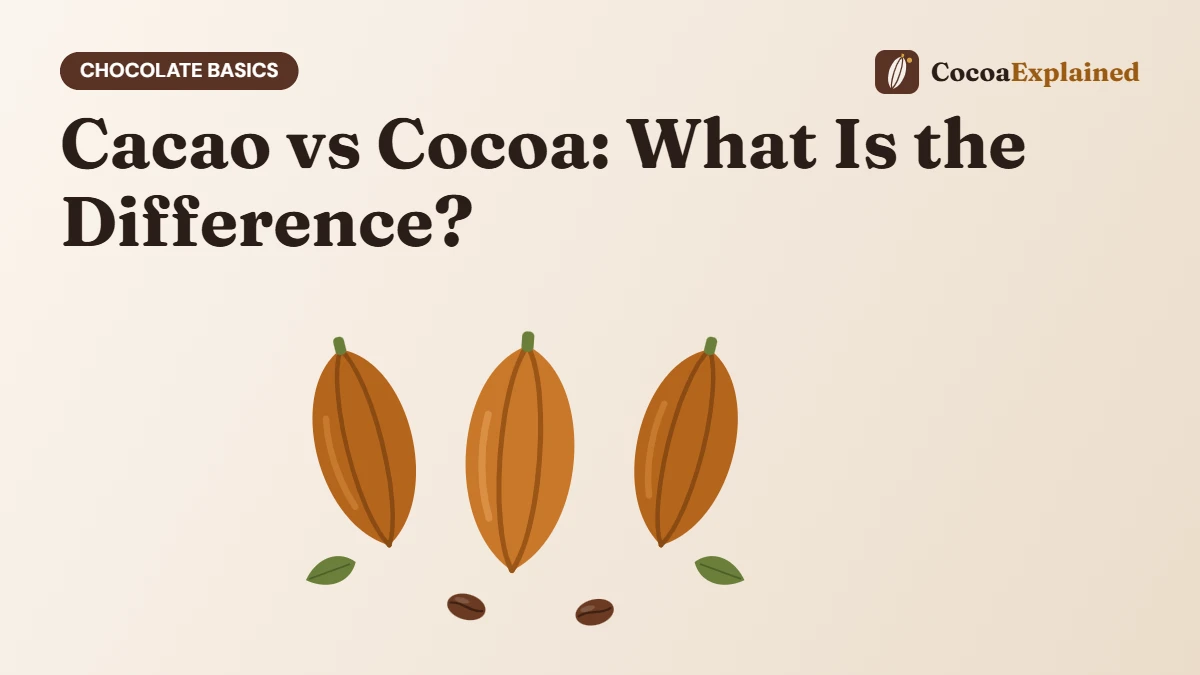
Cacao vs Cocoa: What Is the Difference?
Walk into a health food shop and the shelf says cacao powder and cacao nibs. Walk down the baking aisle of a supermarket and the tin says cocoa powder. Both come from the same tree, so why two words, and does the difference actually change anything in your kitchen or on your plate?
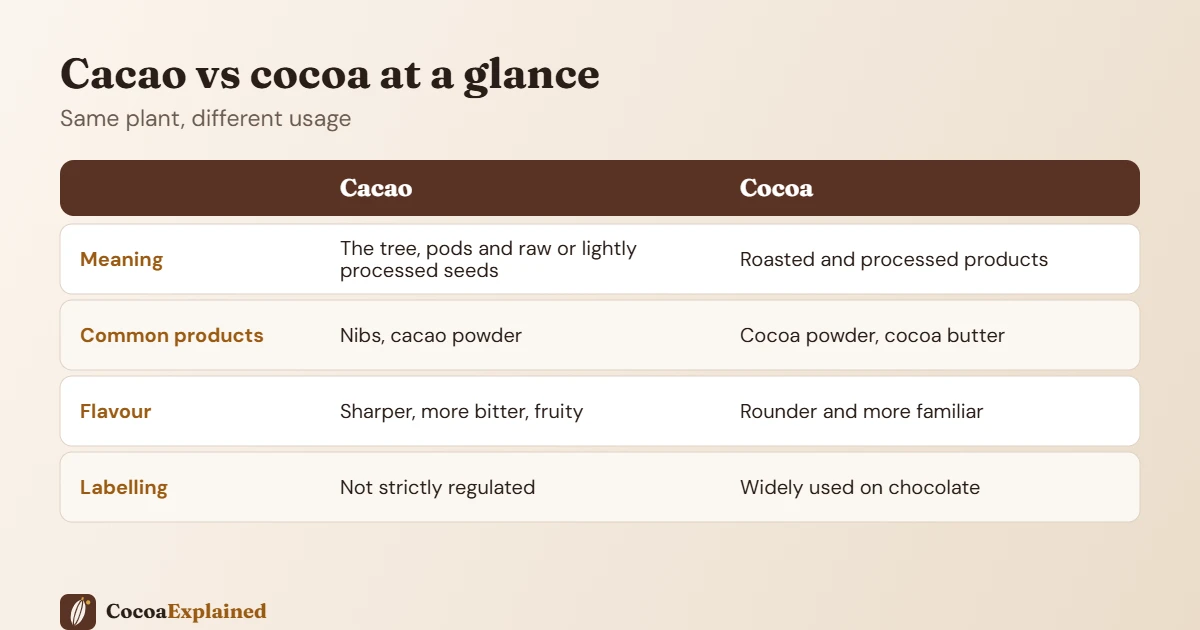
The short version: cacao is the older word, and today it usually points to the tree, its seeds, or products that have been handled as little as possible. Cocoa is the everyday English word for the roasted, processed stuff. The catch is that the split is a habit, not a rule. Nobody checks whether a product marked “cacao” really is less processed, so the useful skill is reading what is done to the bean rather than trusting the spelling. This guide walks through where the words came from, what shops mean by them now, and how to decide which one to buy. If you want the bigger picture first, start with what chocolate is made of.
Where the two words come from
The tree is Theobroma cacao, which grows in a narrow band of tropical country on either side of the equator. The name “cacao” reaches us through Spanish from the languages of Mesoamerica, where the seeds were ground and drunk long before anyone made a chocolate bar. The botanist Linnaeus gave the tree its scientific name in the 1700s, and Theobroma is Greek for “food of the gods”.
“Cocoa” appears to be an English slip. The usual explanation is that the word got tangled up with “coco”, the old spelling of the coconut palm, and the muddled spelling stuck. Whatever the exact route, by the time cocoa became an everyday drink in Britain the two spellings were already living side by side, and they never fully merged back.
This matters because it explains why there is no clean dictionary line between them. Even the trade bodies mix them. The International Cocoa Organization, which tracks the global market, uses “cocoa” for the whole commodity trade, beans included. The United States rules that define chocolate products sit under a part of the federal code titled “Cacao Products”, and inside it they define things like cocoa and cocoa powder. Two spellings, one tree, no single authority.
How the words are used in shops today
Over the last couple of decades the wellness and craft-chocolate worlds started using “cacao” as a signal. A brand that writes cacao on the front of the pack is usually telling you one of three things: the beans were processed gently, the product is closer to the raw seed, or the brand wants to sound more artisan. Sometimes all three are true. Sometimes it is only marketing.
“Cocoa”, meanwhile, is what the large food industry and most baking recipes use. It is the word on the tin, the word in the ingredient list, and the word in a recipe that asks for “30 g cocoa powder”.
| Where you see it | What it usually means | Typical examples |
|---|---|---|
| Wellness and specialty shops | The raw or gently processed seed, or something marketed that way | Cacao nibs, cacao powder, cacao butter wafers |
| Supermarket baking aisle | Roasted, ground cocoa solids | Natural cocoa powder, Dutch-process cocoa powder |
| Chocolate bar labels | Either word, depending on the maker | “Cocoa solids 70%”, “cacao 70%” |
| Industry and trade data | Cocoa for the whole commodity | Cocoa beans, cocoa butter, cocoa mass |
Is cacao powder really different from cocoa powder?
Sometimes, and for reasons that have nothing to do with the spelling. The difference lies in how the beans were treated after harvest.
Most cocoa powder starts with beans that are fermented, dried and roasted. The roasted beans are cracked, the nibs are ground into a paste, and most of the cocoa butter is pressed out. What is left is milled into powder. Some cocoa powder is then treated with an alkali, which is called Dutch processing. That makes it darker and milder. We cover that step properly in natural vs Dutch-process cocoa.
Products sold as raw cacao powder follow a similar path, but the makers say the beans are not roasted at high heat, or are kept below a stated temperature. In practice “raw” is a loose claim. Beans are fermented and dried in the sun, which is already a process, and there is no strict legal definition of how raw “raw” has to be. The result tends to taste a little sharper, more acidic and more fruity than standard cocoa. Some people love that, others find it harsh in a brownie.
So if you ask whether cacao powder and cocoa powder are different products, the honest answer is “often, a little”. If you ask whether the word guarantees it, the answer is no.
Cacao nibs, cacao butter and cocoa butter
The same split shows up all over the shelf, so it helps to know what each item physically is.
- Cacao nibs are pieces of the bean after it has been fermented, dried and cracked, with the husk removed. They are crunchy, bitter and a bit like coffee beans. Some are roasted, some are not, and the pack should say which.
- Cocoa mass (also called cocoa liquor or cocoa paste) is nibs ground until the fat melts and the whole thing becomes a thick liquid. It contains both the dark solids and the fat.
- Cocoa butter is the pale, natural fat pressed out of that mass. It is what makes chocolate melt in your mouth, and it is the main ingredient in white chocolate. You will see it called “cacao butter” on specialty products. It is the same substance.
- Cocoa powder is what remains after most of the butter has been pressed out and the cake of solids is ground fine.
If you ever feel lost, picture the bean being taken apart: solids and fat, then put back together in different ratios. Dark chocolate uses lots of both, milk chocolate uses less, and white chocolate keeps the fat and drops the solids. How cacao beans become a chocolate bar shows that journey step by step.
What about health claims?
Cacao is often sold as the “healthier” version. It is true that cocoa solids contain plant compounds called flavanols, and that heavy processing, especially alkalizing and strong roasting, can reduce how many survive. That is the real kernel behind the raw cacao pitch.
But the amount in any serving varies a lot between brands and batches, and a food label rarely tells you. Cacao powder is also still a concentrated, bitter ingredient that people usually mix with sugar, milk or fruit. Treat it as an ingredient with its own flavour, not as a supplement. If you have a medical reason to watch what you eat, a doctor or dietitian is the right person to ask, and nothing on this page is medical advice.
Can you swap one for the other in baking?
Usually yes, with a few cautions.
- By weight, you can generally swap cacao powder and cocoa powder one for one in cakes, brownies and drinks.
- Raw cacao powder is typically more acidic, so it behaves like natural cocoa. If a recipe depends on baking soda reacting with acidity, that is fine. If the recipe was written for Dutch-process cocoa and baking powder, the rise can change slightly.
- Expect a stronger, sharper taste. You may want a little more sugar or a touch of vanilla to round it off.
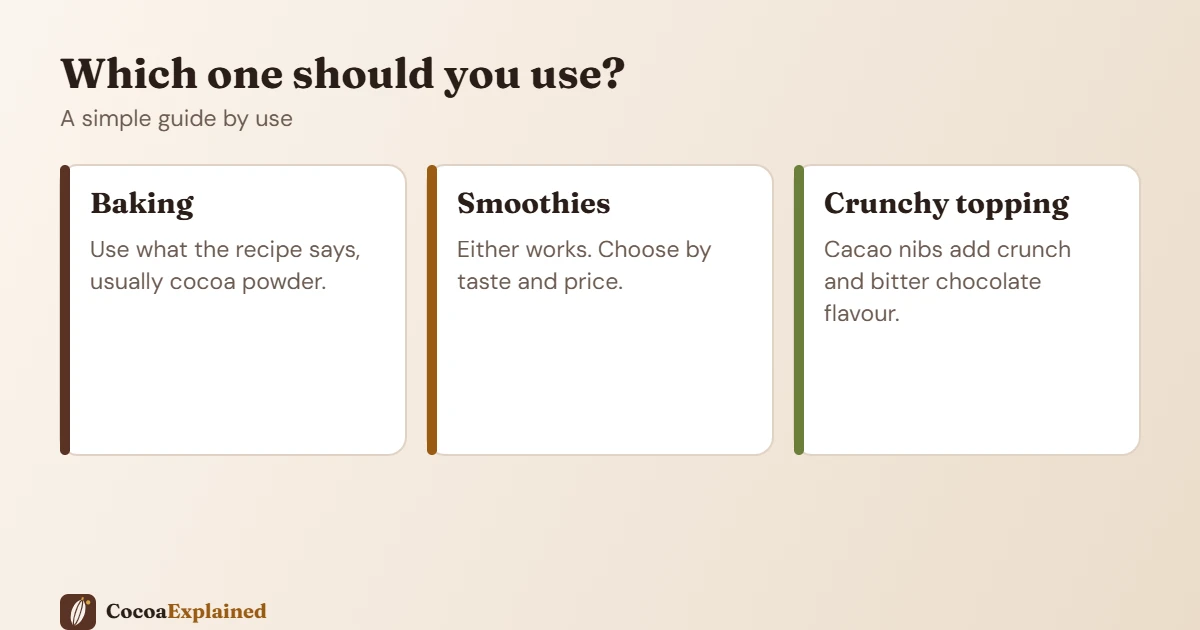
- Do not swap cacao nibs for cocoa powder. They are a crunchy topping, not a powder.
If a result tastes harsher than you hoped, that is usually the acidity and not a mistake in your recipe. Adding a pinch more sugar, or using half cacao and half regular cocoa, is an easy way to dial it back.
How to read a label when the wording is confusing
Ignore the spelling for a moment and look for the facts that actually describe the product.
- Read the ingredient list. A good cocoa or cacao powder should list one ingredient, possibly with “processed with alkali” if it is Dutch-process.
- Look for words like roasted, raw, unroasted, cold-pressed or alkalized. These tell you what happened to the bean.
- Check the cocoa butter content if the pack gives it. A higher fat percentage means a richer, creamier powder.
- For chocolate bars, look at the percentage and what makes up the rest. Our guide on what the cocoa percentage means explains why that number is less simple than it looks.
So which should you buy?
It depends on the job. For everyday baking, ordinary cocoa powder is cheaper, widely available, and what most recipes assume. For smoothies, energy balls or a drink where you want a more assertive flavour, cacao powder is a fine choice if you like that sharper taste. For nibs, buy small and see whether you enjoy the crunch before committing to a big bag.
The two words are not enemies. They are two names for products from the same tree, separated mostly by how they were handled and how they are sold. Once you start reading the process words on the label instead of the spelling on the front, the confusion largely goes away.
Frequently asked questions
Is cacao healthier than cocoa?
There is no firm evidence that cacao is dramatically healthier in a normal diet. Raw and lightly processed products may keep more of some natural compounds, but the benefit is not well established, and chocolate remains a treat. We cover the evidence carefully in our section on whether chocolate is a health food.
Are cacao and cocoa from the same plant?
Yes. Both come from the seeds of the cacao tree, Theobroma cacao. The difference is mainly in how the seeds are processed and what the product is called.
Can I substitute cacao powder for cocoa powder?
In most recipes you can swap them in equal amounts. Cacao powder can taste sharper and more bitter, so you may want a little more sugar.
Is cacao powder always raw?
No. “Raw” is a marketing term, not a regulated standard. Check the label and the maker’s description of how the beans were processed.
What are cacao nibs?
Cacao nibs are pieces of cacao beans that have been fermented, dried and crushed, and are sometimes roasted. They taste bitter and chocolatey and have a crunchy texture.
Is chocolate made from cacao or cocoa?
Both words apply. Chocolate starts with cacao beans, which are roasted and ground into cocoa mass, then combined with ingredients such as cocoa butter and sugar.
Key points to remember
- Cacao and cocoa come from the same plant, the cacao tree.
- Cacao usually means the tree and raw or lightly processed seeds; cocoa usually means roasted, processed products.
- The words are not legally fixed, so check how the product was made.
- Cacao powder and cocoa powder can usually be swapped, with small differences in taste.
- Be cautious about strong health claims for raw cacao.
Related guides
- Natural vs Dutch-Process Cocoa Powder: Which to Use?
- How Cacao Beans Become a Chocolate Bar
- What Does Cocoa Percentage Mean on Chocolate?
- What Is Chocolate, Exactly?
- Hot Chocolate vs Hot Cocoa: What Is the Difference?
- Start here: a beginner’s guide to chocolate
- Browse all chocolate guides
- A Short History of Chocolate: From Bitter Drink to Bar
- What Is Cocoa-Free Chocolate?
Sources
- Wikipedia: Theobroma cacao
- Milk Street: Cocoa powder, Dutch-process cocoa and cacao powder
- Texanerin Baking: Cacao vs cocoa
- International Cocoa Organization (ICCO)
Last updated: October 2026. This guide is educational and is not medical or nutrition advice. See our editorial policy for how we research and write.