What Does Cocoa Percentage Mean on Chocolate?
Pick up almost any dark chocolate bar and there is a number on the front: 55%, 70%, 85%. It looks like a score, and plenty of people treat it like one, assuming a higher number means better, healthier or more serious chocolate. It does not quite work that way.
The cocoa percentage is a useful clue, but it measures something specific and leaves a lot unsaid. This guide explains exactly what the number counts, what makes up the rest of the bar, how it affects taste, what typical ranges feel like, and why two bars with the same percentage can taste completely different. If you are brand new to the subject, what chocolate is made of is a gentle starting point.
What the percentage actually measures
The cocoa percentage tells you what proportion of the bar, by weight, comes from the cacao bean. That includes:
- Cocoa mass (also called cocoa liquor or cocoa paste), which is ground cacao nibs.
- Cocoa butter, the natural fat pressed from the bean, which may be added on top.
- Cocoa powder, in some recipes.
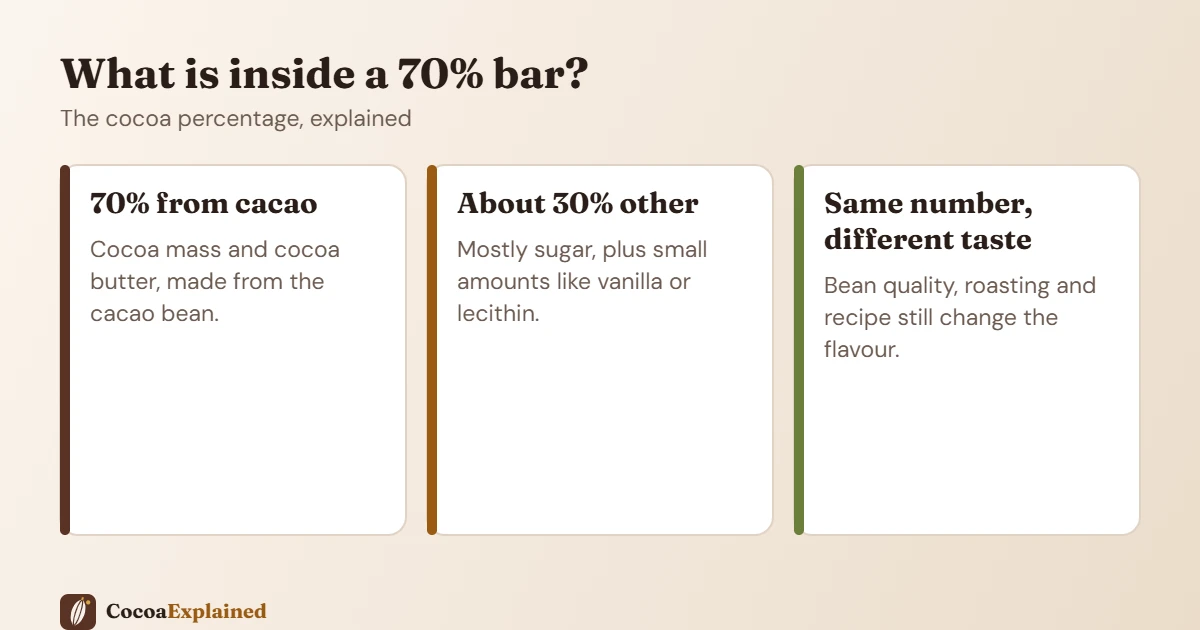
So in a 70 per cent bar, 70 per cent of the weight is cocoa in one form or another. The remaining 30 per cent is everything else, mostly sugar, plus small amounts of ingredients such as vanilla and an emulsifier like lecithin. In milk chocolate it also includes milk solids.
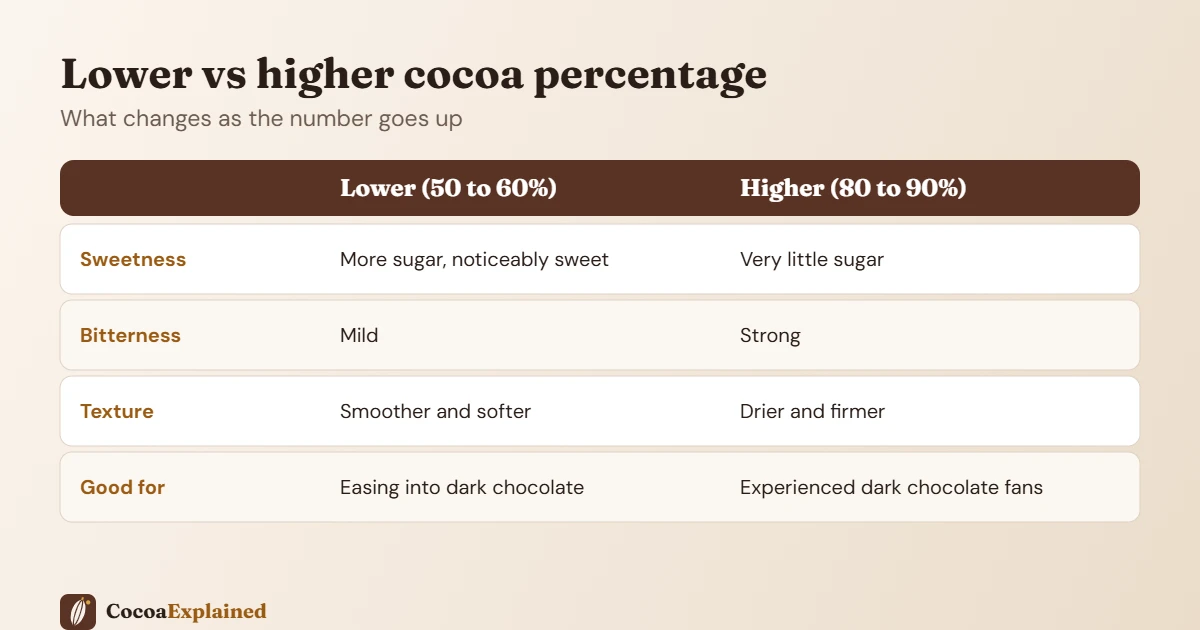
It is worth noticing what this means for sweetness. A 70 per cent bar contains roughly 30 per cent non-cocoa ingredients, and most of that is sugar. A 90 per cent bar has only about 10 per cent. The number is effectively a rough guide to how bitter or sweet the chocolate will be.
| Cocoa % | Typical type | What to expect |
|---|---|---|
| About 30 to 45% | Milk chocolate | Sweet, creamy and mild |
| About 50 to 60% | Semisweet or mild dark | Balanced sweetness with some bitterness |
| About 65 to 75% | Classic dark | Rich, with moderate bitterness and fruit or roast notes |
| About 80 to 90% | Intense dark | Bitter, less sweet, strong and dry |
| 100% | Unsweetened | No sugar; very bitter, often used for baking |
What the number does not tell you
Because the percentage lumps everything from the bean together, it misses some important details.
- The split between cocoa solids and cocoa butter. Two 70 per cent bars can have very different amounts of each. A bar with more cocoa butter will taste creamier and less intense than one with more solids, even at the same percentage.
- The quality of the beans. A percentage says nothing about whether the beans were well fermented, dried and roasted.
- How it was made. Roast level, grinding and conching all shape flavour, as described in how cacao beans become a chocolate bar.
- The origin and variety. Different beans taste very different at the same percentage. See what single-origin chocolate is.
- What the other ingredients are. A bar might use cane sugar, coconut sugar, or even sweeteners. Milk, nuts, or flavourings change the picture too.
This is why a 70 per cent bar from one maker may taste smooth and fruity while another tastes harsh and bitter.
Does a higher percentage mean better chocolate?
No. It means more cocoa and less sugar. That makes the chocolate more intense and more bitter, which some people love and others find unpleasant. It does not mean higher quality.
A well-made 55 per cent bar can be wonderful, and a poorly made 90 per cent bar can be harsh and chalky. Some makers make excellent high-percentage bars by using flavourful beans that do not need much sugar to taste good. Others use a high percentage to disguise poor beans under sheer intensity. The only way to know is to taste.
What about health?
Dark chocolate is often presented as healthier than milk chocolate. It is true that cocoa solids contain plant compounds called flavanols, and that a high-percentage bar has less sugar. But chocolate is still energy-dense, containing fat and calories, and the benefits are modest. It is best seen as a treat. Higher percentage bars also contain more caffeine and theobromine, which we cover in does dark chocolate have caffeine?. This is general information, not medical advice.
The rules on minimums
Legal definitions vary between countries. As examples, in the European Union, “chocolate” must contain at least 35 per cent total cocoa solids, and milk chocolate at least 25 per cent. In the United States, the rules for milk chocolate require a minimum of 10 per cent chocolate liquor, which is much lower, while “bittersweet” and “semisweet” chocolate need at least 35 per cent. This is one reason why a milk chocolate from one country may taste more or less chocolatey than another.
How to choose the right percentage
A practical way to think about it:
- If you like sweet and creamy, try milk chocolate in the 35 to 45 per cent range, or a mild dark at 50 to 55.
- If you are moving from milk to dark, start at around 55 to 65 per cent and work up. Jumping straight to 85 per cent is often too bitter.
- If you enjoy dark chocolate, 70 to 75 per cent is the sweet spot for many people.
- If you want an intense experience, try 80 to 90 per cent, preferably from a maker known for good beans, and eat a small piece slowly.
- For baking, follow the recipe. Substituting a much higher percentage for a lower one changes sweetness and texture.
When you taste, do it carefully. How to taste chocolate gives a simple method for comparing bars at different percentages.
Reading the rest of the label
- Look at the ingredient order. In a good dark bar, cocoa mass or cocoa butter should come first, then sugar.
- Check for added fats. Vegetable oils instead of cocoa butter suggest a cheaper recipe.
- Look for how the percentage is described. Some bars say “cocoa solids” and some “cocoa”, which can differ in what is counted. If it matters, check the maker’s website.
- Notice any extras. Flavourings, milk powder or nuts change what the percentage means for taste.
The short version
The cocoa percentage is the share of the bar by weight that comes from the cacao bean, with the rest being mostly sugar (plus milk in milk chocolate). A higher number means more intensity and less sweetness, not automatically better quality, and two bars at the same percentage can taste very different. Use it as a guide to sweetness, choose the level that suits your taste, and let tasting, not numbers, be your final judge.
Frequently asked questions
Is 70% cocoa chocolate healthy?
No percentage turns chocolate into a health food. Higher-percentage bars have less sugar and more cocoa solids, but they are still energy-dense. Enjoy chocolate as a treat, and see our section on whether chocolate is a health food for a careful look at the evidence.
What is the difference between 70% and 85% chocolate?
The 85% bar has less sugar and more cocoa ingredients, so it tastes more bitter, drier and more intense. The 70% bar is sweeter and smoother. Quality depends on the beans and how the chocolate is made, not only the number.
Does a higher cocoa percentage mean less sugar?
Usually yes, because most of the remaining share in dark chocolate is sugar. Check the ingredient list to be sure, since the order shows what the bar contains most of.
Can milk chocolate have a cocoa percentage?
Yes. Many milk bars state a percentage, often somewhere between 30 and 50%. Some brands sell a darker style of milk chocolate with a higher figure.
What does 100% cocoa chocolate mean?
It means the bar contains only cocoa ingredients, with no added sugar. It is very bitter and is mostly used for baking or by people who enjoy intense flavours.
Key points to remember
- The cocoa percentage is the share of the bar by weight that comes from the cacao bean.
- The rest is mostly sugar, plus milk solids in milk chocolate.
- A higher number means more intensity and less sweetness, not automatically better quality.
- Two bars with the same percentage can taste different.
- Choose the percentage that suits how you will eat or bake with it.
Related guides
- Dark, Milk and White Chocolate: The Real Differences
- Cacao vs Cocoa: What Is the Difference?
- What Is Chocolate, Exactly?
- Natural vs Dutch-Process Cocoa Powder: Which to Use?
- How to choose good chocolate
- Is Dark Chocolate Actually Healthy?
- Start here: a beginner’s guide to chocolate
- Browse all chocolate guides
- Free cheat sheet: how to read any chocolate label
- Semisweet vs Bittersweet Chocolate: Which Should You Use?
- Is Dark Chocolate Vegan?
Sources
- U.S. eCFR: Title 21, Part 163, Cacao product standards
- EUR-Lex: Directive 2000/36/EC relating to cocoa and chocolate products
- Hotel Chocolat: What does cocoa percentage actually mean?
- Theo Chocolate: Understanding cocoa percentages
Last updated: October 2026. This guide is educational and is not medical or nutrition advice. See our editorial policy for how we research and write.