How to Make Chocolate Ganache: Ratios for Glaze, Frosting and Truffles
Ganache is one of the easiest things to make with chocolate, and one of the most useful. It is just chocolate and cream, but the amounts decide whether you get a pourable glaze, a soft frosting or a firm truffle centre. Once you know the ratio, you can use the same method for everything.
Short answer: chop the chocolate, heat the cream until it just starts to bubble, pour it over the chocolate, wait a few minutes and whisk slowly until smooth. For a pourable glaze, use about 1 part chocolate to 1.5 or 2 parts cream by weight. For a thicker glaze or frosting, use 1 to 1. For truffles and fillings, use 2 parts chocolate to 1 part cream.
What is ganache?
Ganache is a smooth mixture of chocolate and cream. The hot cream melts the chocolate, and stirring blends the fat in the cream with the cocoa butter in the chocolate into one glossy mixture. It sets softer than plain chocolate because cream is mostly water and fat. The more cream you add, the softer and thinner it is. The more chocolate you add, the firmer it sets.
Ganache ratios by use
Most bakers measure ganache by weight, with chocolate first and cream second. Three sources we checked, Baker Bettie, Live Well Bake Often and Crazy for Crust, agree on the same three main ratios.
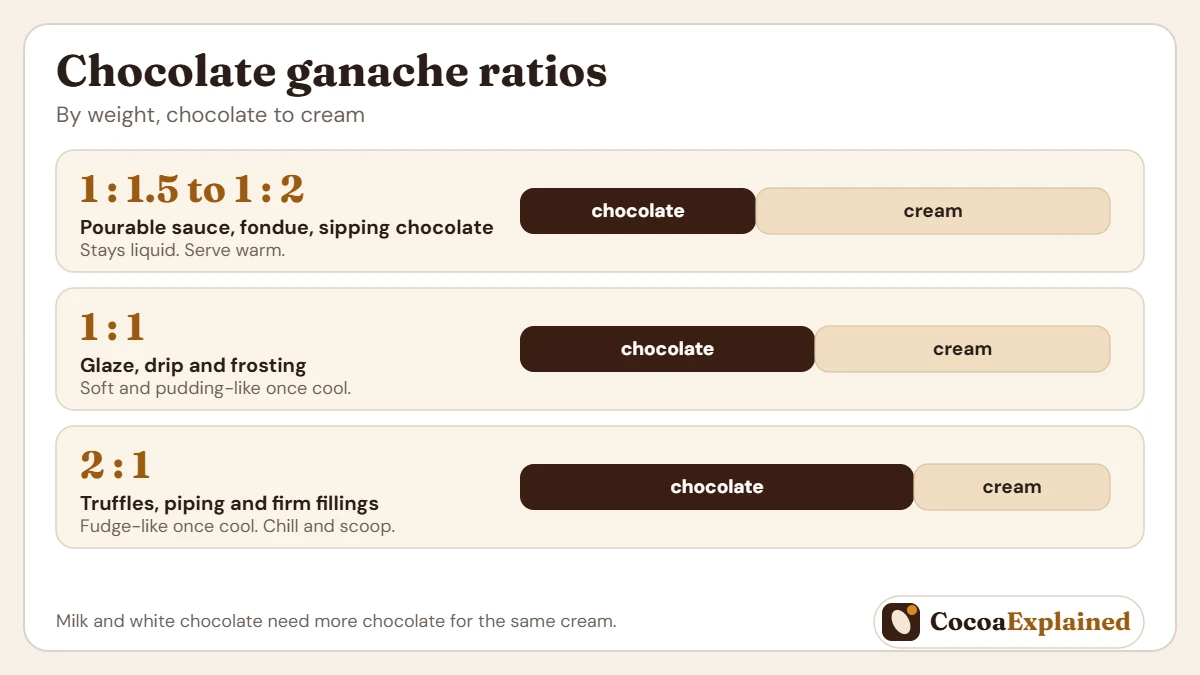
| Use | Chocolate : cream | What you get |
|---|---|---|
| Pourable sauce, fondue, sipping chocolate | 1 : 1.5 or 1 : 2 | Stays liquid and runs. Serve warm. |
| Glaze, drip, frosting | 1 : 1 | Pours while warm, then cools to a soft, pudding-like texture. |
| Truffles, piping, firm filling | 2 : 1 | Cools to a fudge-like texture. Chill and scoop for truffles. |
For example, a thick glaze can use 8 oz (225 g) of chocolate and 8 oz of cream, which is 1 cup. For truffles, 8 oz of chocolate with 4 oz (½ cup) of cream. Ratios are easier to get right if you use a kitchen scale, because chocolate and cream measure differently in cups.
Which chocolate should you use?
Baker Bettie recommends semisweet or dark chocolate of about 40% to 60% cocoa, or bittersweet. Very dark chocolate can taste too bitter once it is mixed with cream, and milk chocolate does not set as well. Use chocolate you enjoy eating, because it is the main flavour. If you are not sure which bar to buy, our guide on semisweet vs bittersweet chocolate explains the difference.
Chopped bars usually work better than chips. Live Well Bake Often points out that chips contain stabilizers, which can affect how they melt. For the cream, use heavy cream, with at least 36% fat. See our guide on chocolate chips vs baking chocolate if you are deciding between them.
Milk chocolate and white chocolate contain more milk solids and sugar, so they need more chocolate for the same amount of cream. One source suggests about 2 to 2.5 parts milk chocolate to 1 part cream for a filling or frosting, and about 3 parts white chocolate to 1 part cream for a ganache that sets. If you try these, start with a small batch.
How to make chocolate ganache step by step
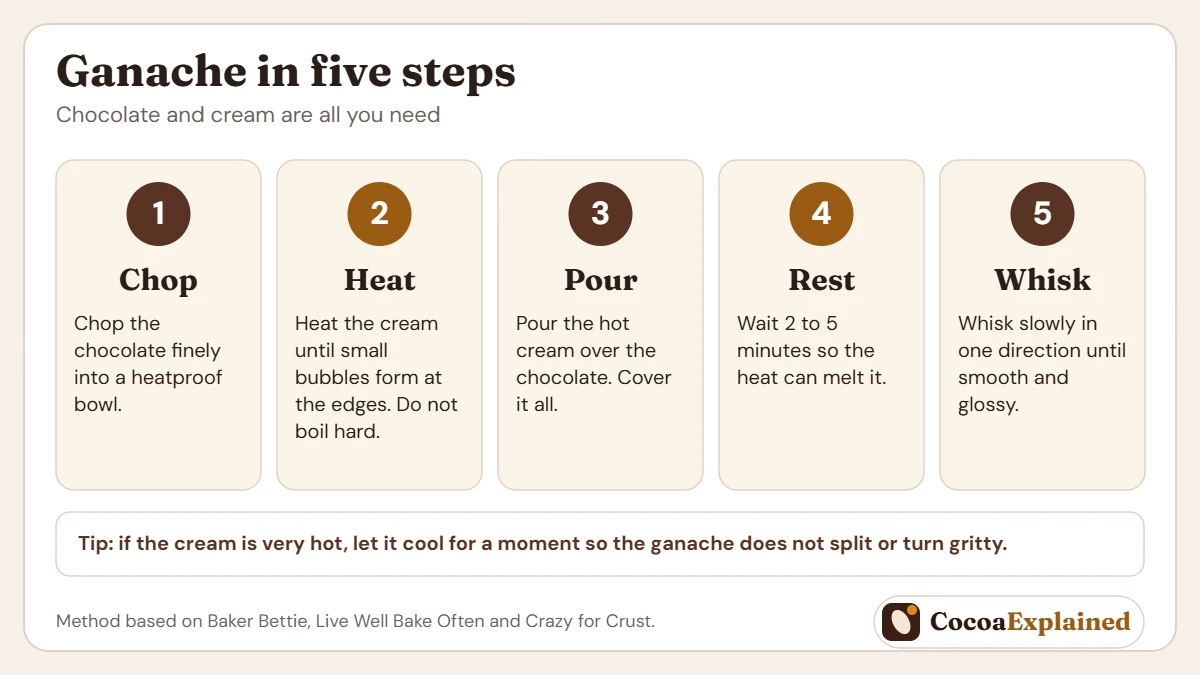
- Chop the chocolate finely and put it in a heatproof bowl. Small pieces melt evenly.
- Heat the cream in a pan until small bubbles form at the edges. Do not let it boil hard. You can also use a microwave in short bursts and watch it so it does not boil over.
- Pour the hot cream over the chocolate. Make sure all the chocolate is covered.
- Wait 2 to 5 minutes. The sources we checked suggest 2 to 3 minutes for small batches and up to 5 for larger ones. This lets the heat melt the chocolate on its own.
- Whisk slowly from the centre outwards, in one direction, until smooth and glossy. Add a pinch of salt if you like.
Let the ganache cool before you use it. A glaze should be slightly warm and pourable. A truffle mix should be cool and firm. If you whisk while the cream is too hot, the ganache can split or turn gritty, so let very hot cream cool for a moment first.
How to turn ganache into frosting
Make a 1 to 1 ganache, cool it, then chill it for about an hour until thick. Beat it with an electric mixer until it turns lighter in colour and fluffy. This is called whipped ganache. Live Well Bake Often and Baker Bettie both describe this method, and Baker Bettie notes that a lighter version can use a 1 to 1.5 ratio.
How to fix ganache problems
| Problem | What may have happened | Fix |
|---|---|---|
| Oily or split | The cream was too hot or boiled, which can split the cocoa butter. | Heat 1 tablespoon of milk or water until steaming and whisk it in slowly. An immersion blender can also help. |
| Grainy | Cold chocolate, or stirring too soon. | Warm it gently over a double boiler and whisk in about 1 teaspoon of room-temperature cream. |
| Clumpy | The cream was not hot enough, or it did not rest long enough. | Microwave for 15 to 20 seconds, then whisk again. |
| Too thin | Too much cream. | Whisk in more chocolate, or chill it. Use a higher chocolate ratio next time. |
| Too thick | Too much chocolate, or it is too cold. | Warm some extra cream and stir it in a little at a time. |
A different problem happens when a few drops of water get into melted chocolate. That makes it stiff and grainy, and it is a separate issue. See our guide on why chocolate seizes for the cause and the rescue. For gentle melting methods in general, read how to melt chocolate.
How to store ganache
Press plastic wrap right onto the surface to stop a skin from forming. Storage times vary between sources, so use them as a guide and trust your nose and eyes.
| Where | How long | Tip |
|---|---|---|
| Room temperature | Up to about 2 days | Keep it covered. |
| Fridge | About 4 days to 1 week (one source says up to 2 weeks) | Let it come back to room temperature, then warm it gently and stir. |
| Freezer | 1 to 3 months | Thaw it overnight in the fridge. |
Chilled ganache gets very firm. To soften it, leave it at room temperature or warm it in 15-second bursts in the microwave, stirring between each one. Cream is a dairy product, so if ganache smells sour or looks off, throw it out.
What can you make with ganache?
- Cake glaze or drip: use 1 to 1 ganache, slightly warm.
- Frosting: chill 1 to 1 ganache and whip it until fluffy.
- Truffles: use 2 to 1 ganache. Chill, scoop and roll in cocoa.
- Brownie topping or tart filling: use a 1 to 1 or 2 to 1 ganache, depending on how firm you want it.
- Dessert sauce or dipping chocolate: use 1 to 2 and serve warm.
Frequently asked questions
What is the ratio for chocolate ganache?
It depends on the use. By weight, use about 1 part chocolate to 1.5 or 2 parts cream for a pourable sauce, 1 to 1 for a glaze or frosting, and 2 to 1 for truffles and fillings.
What kind of chocolate is best for ganache?
Semisweet or dark chocolate of about 40% to 60% cocoa works well, and bittersweet is also fine. Chopped bars are often preferred over chips. Milk and white chocolate need more chocolate for the same amount of cream.
How long do you leave ganache before stirring?
The sources we checked suggest 2 to 5 minutes after pouring the hot cream over the chocolate. Then whisk slowly until smooth.
Why did my ganache split or turn oily?
Often the cream was too hot or boiled, which can split the cocoa butter. Whisking in a tablespoon of hot milk or water, a little at a time, can bring it back together.
How long does ganache last?
About 2 days at room temperature and about 4 days to 1 week in the fridge, though one source says up to 2 weeks. In the freezer it keeps for 1 to 3 months.
Can you make ganache without cream?
The sources we checked use cream. One notes that whole milk gives a thinner result, so it is not a direct swap.
Key points to remember
- Ganache is chocolate and cream. The ratio decides how thick it is.
- Use about 1 : 1.5 or 1 : 2 for sauce, 1 : 1 for glaze and frosting and 2 : 1 for truffles, by weight.
- Pour hot cream over chopped chocolate, wait a few minutes and whisk slowly.
- Do not let the cream boil hard, and do not whisk while it is too hot.
- Store it covered, and warm it gently before using it again.
Related guides
- How to Melt Chocolate
- Why Does Chocolate Seize? How to Fix It
- Semisweet vs Bittersweet Chocolate
- Chocolate Chips vs Baking Chocolate
- How to Thicken Hot Chocolate
Sources
- Chocolate Ganache 101: Technique, Ratios, Uses, Baker Bettie.
- How To Make Chocolate Ganache, Live Well Bake Often.
- How to Make Chocolate Ganache, Crazy for Crust.
Last updated: October 2026. This guide is educational and is not medical or nutrition advice. See our editorial policy.