Can Dogs Eat Chocolate? What to Do If Your Dog Ate Some
It is a common moment. A bar falls off the table, a bag of Halloween sweets is left open, or a brownie disappears from the counter. Then you look at your dog and wonder if chocolate is really that bad. It is. Chocolate is a well-known danger for dogs, and the risk depends on the type of chocolate, how much was eaten and how big the dog is.
Short answer: no, dogs should not eat chocolate. Cocoa contains theobromine and caffeine, which dogs clear from their bodies much more slowly than people do. Darker chocolate is more dangerous than milk chocolate, and Pet Poison Helpline says there is no safe amount. If your dog has eaten chocolate, call your vet or an animal poison helpline now, even if your dog seems fine.
If your dog has just eaten chocolate: call your vet or your local emergency animal hospital straight away. In the US, Pet Poison Helpline lists (855) 764-7661 on its website. Have the wrapper, your dog’s weight and a rough time ready. Do not wait for symptoms.
Why is chocolate toxic to dogs?
The U.S. Food and Drug Administration (FDA) explains that cocoa contains two stimulants, theobromine and caffeine. They act on the nervous system and the heart. Theobromine is the main problem, because chocolate has more of it than caffeine. People break these compounds down quickly. Dogs break them down much more slowly, so the effects last longer and can build up.
Chocolate also has a lot of fat and sugar. This can upset a dog’s stomach and, in some dogs, cause pancreatitis, which is a painful swelling of the pancreas. So even a type of chocolate with very little theobromine is not a safe snack. If you want to know more about the compounds in cocoa, read our guide on whether dark chocolate has caffeine.
Which chocolate is the most dangerous?
The more cocoa in the product, the more theobromine it contains. The FDA lists the amount of theobromine in 1 ounce (about 28 grams) of different chocolates. Milk chocolate has 57 mg. Semisweet chocolate chips have 136 mg. Dark chocolate with 70% to 85% cacao has 227 mg. Unsweetened baking chocolate has 364 mg.
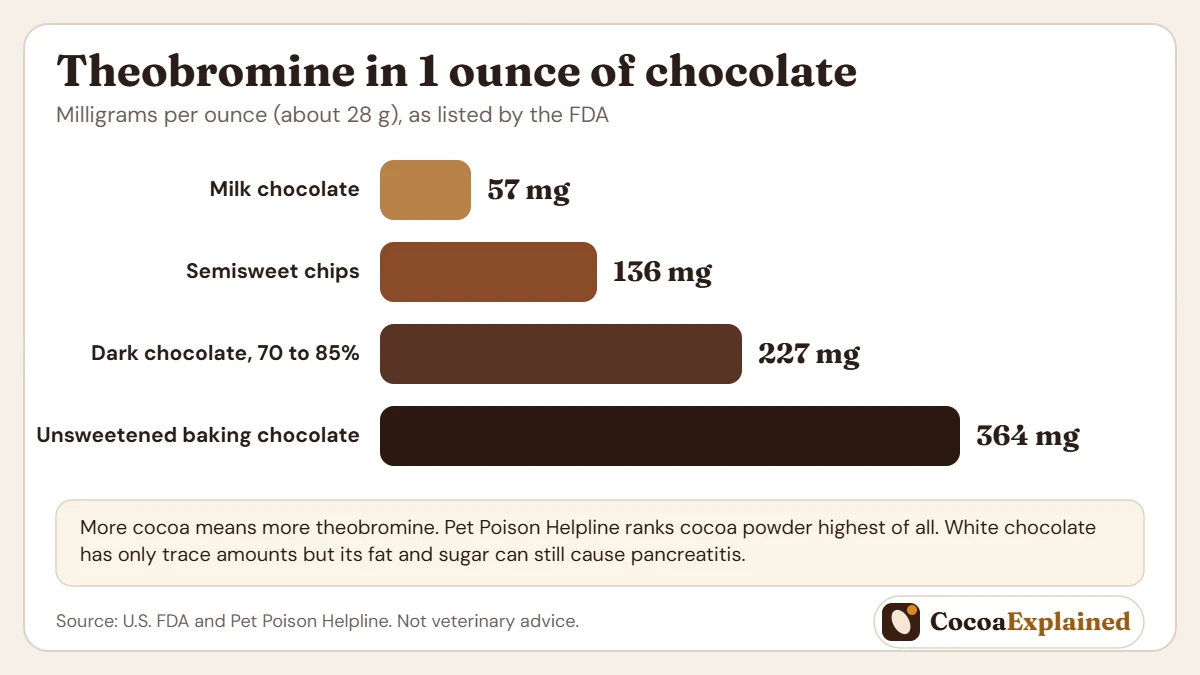
Pet Poison Helpline gives the same order of risk, with cocoa powder at the top, then baking chocolate, then dark, semisweet and bittersweet chocolate, then milk chocolate. White chocolate has only trace amounts of theobromine, but its fat and sugar can still cause pancreatitis, and some products contain xylitol, which is also dangerous for dogs.
| Type | Theobromine risk | Notes |
|---|---|---|
| Cocoa powder | Highest | Very concentrated. Often found in baking. |
| Unsweetened baking chocolate | Very high | 364 mg per ounce (FDA). |
| Dark chocolate (70% to 85%) | High | 227 mg per ounce (FDA). |
| Semisweet chips | Medium to high | 136 mg per ounce (FDA). |
| Milk chocolate | Lower, still harmful | 57 mg per ounce (FDA). |
| White chocolate | Trace | High fat and sugar. May contain xylitol. |
If you are not sure how to read cocoa percentages, our guide on what cocoa percentage means explains it. As a rule, a higher percentage means more cocoa solids and more theobromine.
How much chocolate is too much?
There is no single number that fits every dog. The FDA says risk depends on the amount eaten, the size of the dog and how sensitive the dog is to theobromine. Mild signs can appear at about 9 mg of theobromine per pound of body weight, and severe signs can start around 18 mg per pound. The American Kennel Club (AKC) gives similar figures in metric units: mild signs around 20 mg per kg, heart problems around 40 to 50 mg per kg and seizures above 60 mg per kg.
The FDA gives an example. About 6 ounces of semisweet chips would be roughly 13.6 mg per pound for a 60 lb dog, which can cause mild to moderate signs. The same amount in a 6 lb dog would be about 136 mg per pound, which could be fatal without veterinary care. That is why small dogs are at the highest risk from a small amount of chocolate.
Please do not try to work out a safe amount yourself. Your vet or a poison helpline can use the type of chocolate, the amount and your dog’s weight to tell you what to do. The AKC adds that puppies, older dogs and dogs with heart conditions are at higher risk, and that a tiny crumb of chocolate cake is less likely to cause harm, especially in a large dog. Even so, it is always best to call.
What are the signs of chocolate poisoning in dogs?
Signs can appear within a few hours. The AKC says they usually show up 6 to 12 hours after eating chocolate and can last up to 72 hours. Pet Poison Helpline notes that there may be no signs right after your dog eats it, so waiting to see what happens is not a good plan.
- Mild: vomiting, diarrhea, increased thirst, increased urination, restlessness and panting.
- Moderate: a fast heart rate, fast or hard breathing, tremors, tiredness and belly discomfort.
- Severe: an abnormal heart rhythm, severe agitation, high temperature, seizures and collapse.
- Later: pancreatitis from fatty or sugary sweets can take 2 to 4 days to appear, according to Pet Poison Helpline.
What to do if your dog ate chocolate
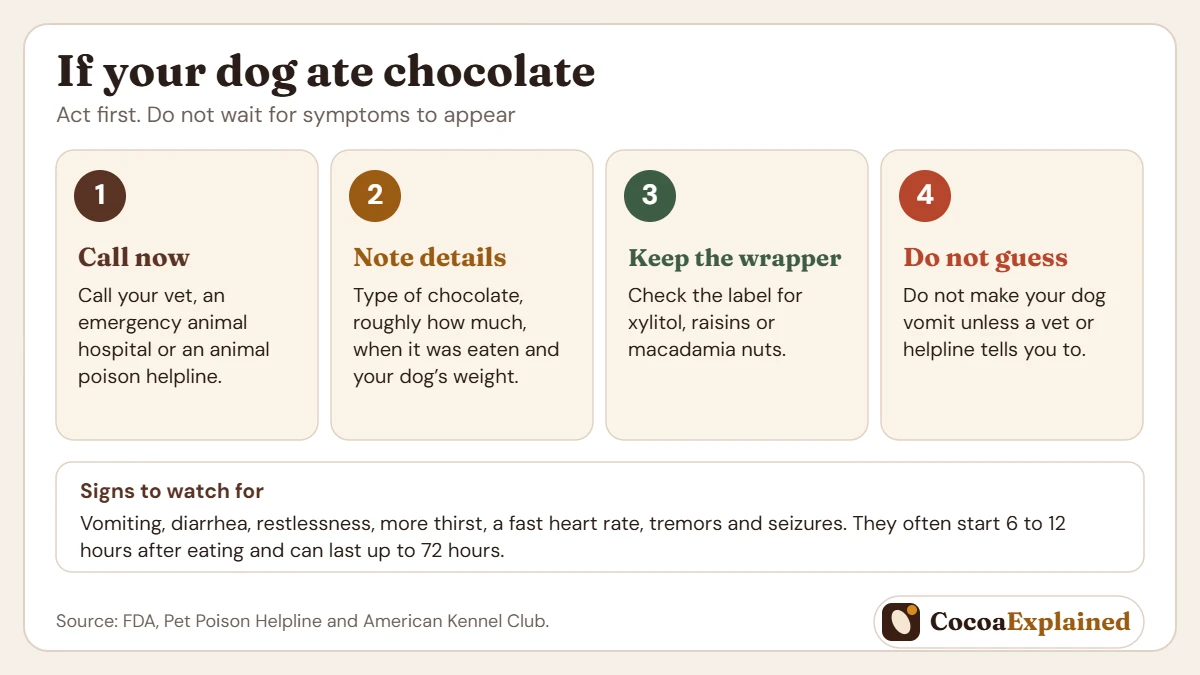
- Call right away. Phone your vet. If the clinic is closed, call a local emergency animal hospital or an animal poison control service.
- Note the details. Write down the type of chocolate, roughly how much, when your dog ate it and your dog’s weight.
- Keep the packaging. The ingredient list helps, because some products also contain xylitol, raisins or macadamia nuts.
- Do not make your dog vomit unless a vet or helpline tells you to.
- Follow the advice you are given. You may be told to watch your dog at home or to bring your dog in.
The AKC explains that, if the chocolate was eaten less than two hours ago, a vet may make your dog vomit, then give activated charcoal to reduce how much toxin is absorbed. Severe cases may need medicine or fluids through a drip. Dogs that have seizures may need to stay overnight for monitoring.
What about brownies, cake and cocoa powder?
Cocoa powder and baking chocolate are the most concentrated forms, so a small amount can be a bigger problem than the same weight of milk chocolate. Brownies, chocolate cake and cookies also contain butter, sugar and sometimes nuts. Some sweets contain xylitol, so always check the label and tell the vet what the product was. Our guide to natural vs Dutch-process cocoa explains what cocoa powder is, which helps you understand why it is so strong.
How to keep chocolate away from your dog
- Store chocolate and baking supplies in a high cupboard or a closed container, not on a counter or low table.
- Take extra care during Halloween, Easter, Christmas and birthdays, when chocolate is easy to leave around. The FDA has a guide on leaving chocolate out of pet celebrations.
- Tell guests and children not to share chocolate with the dog, even a small piece.
- Put bags, coats and handbags with sweets inside out of reach.
- Throw chocolate wrappers and leftovers in a bin with a secure lid.
Not sure how to store chocolate properly in your own kitchen? Our guide to storing chocolate covers temperature, humidity and containers, and a closed container is also a good barrier against a curious nose.
Frequently asked questions
Can dogs eat chocolate?
No. Chocolate contains theobromine and caffeine, which dogs process slowly. Pet Poison Helpline says there is no safe amount. Darker chocolate is the most dangerous.
How much chocolate is toxic to a dog?
It depends on the type of chocolate and your dog’s weight. The FDA says mild signs can appear at about 9 mg of theobromine per pound and severe signs from about 18 mg per pound. Call a vet or poison helpline for advice instead of working it out yourself.
Is milk chocolate safe for dogs?
No. Milk chocolate has less theobromine than dark chocolate, about 57 mg per ounce according to the FDA, but it can still harm a dog, especially a small one. Its fat and sugar can also cause stomach upset and pancreatitis.
Is white chocolate safe for dogs?
White chocolate has only trace amounts of theobromine, but it is still not safe. The fat and sugar can cause pancreatitis and some products contain xylitol. Call your vet if your dog ate some.
My dog ate chocolate but seems fine. Should I still call a vet?
Yes. Pet Poison Helpline says signs may not appear right away, and the AKC says they usually show up 6 to 12 hours after eating. Call your vet or a poison helpline as soon as you can.
Should I make my dog vomit after eating chocolate?
Not unless a vet or poison helpline tells you to. They can judge how long ago your dog ate it, how much and whether making your dog vomit is safe in your dog’s case.
Key points to remember
- Chocolate is toxic to dogs because of theobromine and caffeine, which dogs clear slowly.
- Darker chocolate and cocoa powder are the most dangerous. Milk and white chocolate are not safe either.
- Risk depends on the type, the amount and your dog’s size, so call a vet or poison helpline instead of guessing.
- Signs often appear 6 to 12 hours after eating, and can last up to 72 hours.
- Do not make your dog vomit unless a vet tells you to, and keep the wrapper.
- Store chocolate where dogs cannot reach it.
Related guides
- Does Dark Chocolate Have Caffeine?
- What Is Chocolate, Exactly?
- What Does Cocoa Percentage Mean?
- How to Store Chocolate Properly
Sources
- Leave Chocolate Out of Rover’s Celebrations, U.S. Food and Drug Administration.
- My Dog Ate Chocolate: What To Do (Even If They Seem Fine), Pet Poison Helpline.
- What Happens if Your Dog Ate Chocolate: How to Care for Your Pet, American Kennel Club.
Last updated: October 2026. This guide is educational and is not veterinary advice. If your dog is unwell, contact a vet. See our editorial policy.