Can You Freeze Chocolate? How to Freeze and Thaw It Without Bloom
You bought too much chocolate, got a big gift box or found a great sale. Now you wonder if you can freeze it so it does not go off or melt. You can. But how you freeze it, and especially how you thaw it, makes the difference between smooth chocolate and chocolate with white streaks and a gritty texture.
Short answer: yes, you can freeze chocolate. Wrap it tightly, put it in an airtight bag or container and keep it in the freezer. To thaw it, move it to the fridge first, then let it come up to room temperature while it is still wrapped. Unwrap it only at the end. This keeps condensation off the surface, which is the main cause of problems.
Do you need to freeze chocolate?
Usually not. A plain chocolate bar keeps well at room temperature if it is stored cool, dry and away from light and strong smells. Our guide on how to store chocolate covers that. Freezing helps when you want to stock up, keep chocolate for months or live somewhere hot, where there is no cool place to keep it.
One chocolate maker says chocolate is safe to freeze indefinitely, but the quality drops over time. Another says plain bars do not need freezing for short-term storage, because they are shelf-stable at room temperature. So freezing is a choice for long storage or hot weather, not a must.
How to freeze chocolate
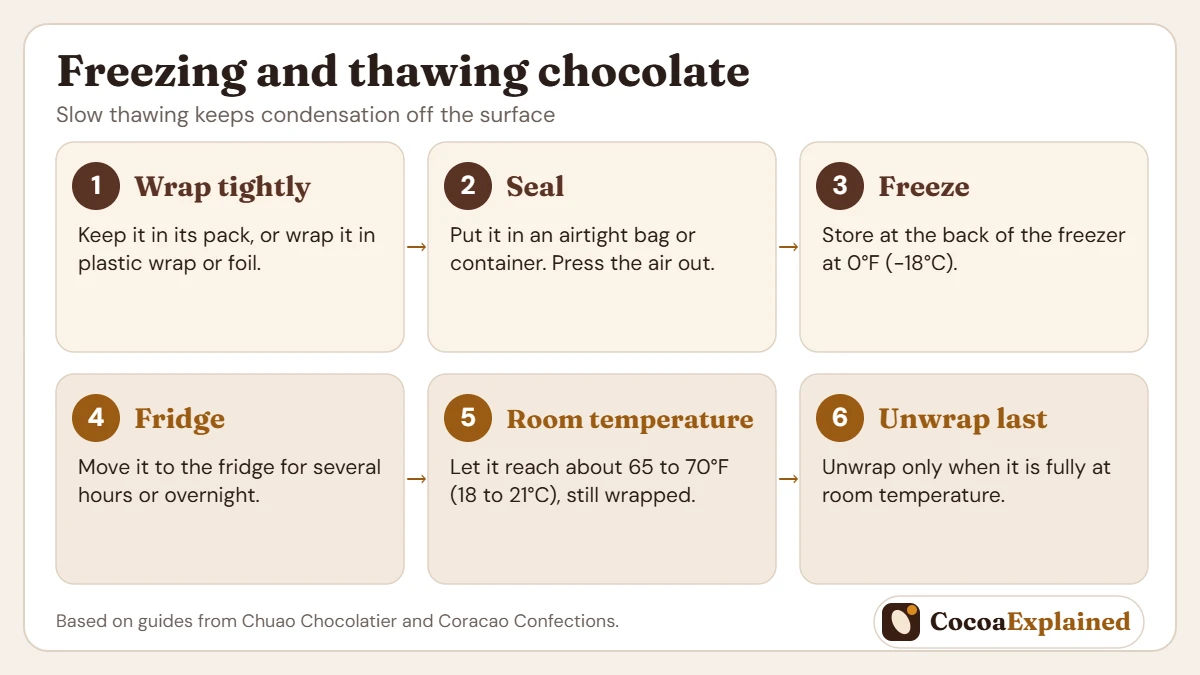
- Keep unopened chocolate in its packaging. Wrap opened pieces tightly in plastic wrap or foil.
- Put it in an airtight bag or container. Press out as much air as you can.
- Label it with the date, so you know how long it has been there.
- Store it at the back of the freezer, at about 0°F (-18°C), away from strong-smelling foods. Try not to open the freezer door too often.
Chocolate takes on smells easily, so a good seal matters as much as the cold. Truffles and bonbons do best in an airtight container, which also protects the delicate shell.
How to thaw chocolate the right way
This is the step that matters most. If cold chocolate meets warm, humid air, water forms on the surface. That moisture is what causes sugar bloom and a grainy texture. The sources we checked give the same simple rule: thaw slowly and keep it wrapped.
- Move the wrapped chocolate from the freezer to the fridge.
- Leave it there for several hours or overnight. One guide suggests about 24 hours.
- Take it out and let it come up to room temperature, roughly 65 to 70°F (18 to 21°C), while it is still wrapped.
- Only unwrap it when it has fully reached room temperature.
Do not leave frozen chocolate on the counter in a warm kitchen, and do not microwave it to thaw it. Fast changes in temperature make condensation and bloom more likely. If you plan to melt the chocolate for baking, thaw it fully first. Our guide on how to melt chocolate shows how, and why chocolate seizes explains why even a little water is a problem.
How long does frozen chocolate last?
Chocolate does not become unsafe in the freezer, but the quality drops over time. The figures differ by maker. One guide gives up to 2 years for dark chocolate, 8 to 12 months for milk, 6 to 8 months for white and 3 to 6 months for filled chocolates. Another says to plan to eat frozen bars within a few months. If in doubt, use the shorter time for the best taste and texture.
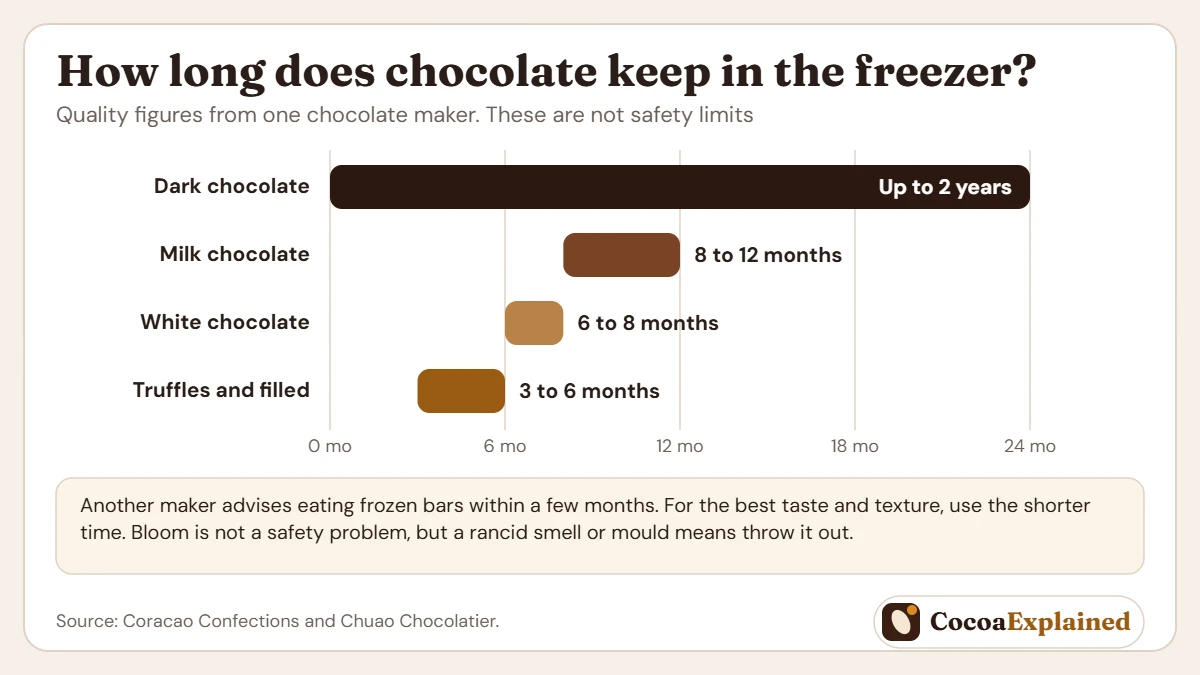
| Type | Freezer time (one maker’s guide) | Notes |
|---|---|---|
| Dark chocolate | Up to 2 years | Listed as the longest-lasting type. |
| Milk chocolate | 8 to 12 months | Contains milk solids. |
| White chocolate | 6 to 8 months | Shortest time among the plain types. |
| Truffles and filled chocolates | 3 to 6 months | Fillings can change after thawing. |
Our guide on whether chocolate expires explains how the date on the pack relates to quality and safety.
What can go wrong? Bloom and condensation
Two kinds of white or grey marks can show up on chocolate that has been frozen or stored badly.
- Fat bloom: cocoa butter melts and sets again unevenly, leaving a dull, grey or white streaky layer.
- Sugar bloom: moisture dissolves some sugar on the surface. It then dries as a gritty, spotty layer. Poor thawing is a common cause.
Both kinds look odd and change the texture, but neither one makes chocolate unsafe. Our guide on why chocolate turns white goes through the details. Real signs that chocolate has gone off are a rancid smell, a sour or waxy taste or fuzzy mould.
Which chocolates freeze best?
- Truffles and bonbons: a ganache centre usually freezes well. Thaw them slowly in the fridge to protect the shell. The centre can become slightly less smooth.
- Plain bars: these can lose some of their glossy snap and smooth melt, so freeze them only when you need to.
- Bark with nuts, dried fruit or marshmallows: these add moisture, which raises the risk of bloom.
- Drinking chocolate powder: it does not need freezing.
Fridge, freezer or cupboard: which should you pick?
| Where | Best for | Watch out for |
|---|---|---|
| Cool cupboard | Plain bars you will eat in the next few weeks | Heat, light and strong smells |
| Fridge | Hot weather and short storage, and the middle step when thawing | Smells from other food, so wrap it well |
| Freezer | Stocking up and storing for months | Condensation when thawing, so thaw slowly and keep it wrapped |
Can you use frozen chocolate for baking?
Yes. Once chocolate has been thawed fully and has reached room temperature, you can chop it and melt it like fresh chocolate. Make sure it is completely dry before it goes near a warm bowl. Moisture is the main enemy when melting chocolate. If the surface looks bloomed, the chocolate is still safe to eat, but the texture may have changed. If you plan to temper it, our guide on how to temper chocolate at home explains the process.
It is best to freeze chocolate in portions you will use in one go. That way you do not need to freeze, thaw and refreeze the same piece, which gives moisture more chances to reach it. A few small packs are easier to manage than one large block.
Should you refrigerate chocolate instead?
The fridge can work for short storage if your kitchen is very warm. The same rules apply: wrap it well so it does not take on smells, and let it come to room temperature before you unwrap it. For regular storage advice, read how to store chocolate properly.
Common mistakes to avoid
- Putting unwrapped chocolate in the freezer, where it picks up smells and moisture.
- Unwrapping it straight from the freezer, which invites condensation.
- Thawing it on a warm counter or in the microwave.
- Freezing, thawing and refreezing it more than once.
- Leaving it in the freezer for years and expecting the same taste.
Frequently asked questions
Can you freeze chocolate?
Yes. Wrap it tightly, put it in an airtight bag or container and freeze it. Thaw it slowly in the fridge and keep it wrapped until it reaches room temperature.
How do you thaw frozen chocolate without it going white?
Move it to the fridge for several hours or overnight, then let it come to room temperature while still wrapped. Unwrapping too early lets condensation form, which can cause sugar bloom.
How long can you keep chocolate in the freezer?
It stays safe, but quality drops over time. One maker suggests up to 2 years for dark chocolate and 8 to 12 months for milk chocolate. Another advises eating frozen bars within a few months.
Does freezing ruin chocolate?
Not if you wrap and thaw it carefully. Poor thawing can cause bloom, a streaky or gritty surface. Bloomed chocolate is safe to eat, but the look and texture may change.
Can you freeze chocolate truffles?
Yes, and ganache-filled truffles are among the better types to freeze. Keep them in an airtight container and thaw them slowly in the fridge. The filling can become slightly less smooth.
Is white chocolate safe to eat after freezing?
Yes, as long as it smells normal and shows no mould. White streaks are usually bloom and are not a safety problem.
Key points to remember
- You can freeze chocolate, but plain bars usually do not need it.
- Wrap it tightly, seal it in an airtight bag or container and store it at the back of the freezer.
- Thaw slowly: fridge first, then room temperature, and unwrap last.
- Freezer times vary by maker, from a few months to 2 years for dark chocolate.
- Bloom looks odd but is not a safety problem. Rancid smell or mould means throw it out.
Related guides
- How to Store Chocolate Properly
- Does Chocolate Expire?
- Why Does Chocolate Turn White?
- How to Melt Chocolate
Sources
- Can You Freeze Chocolate? Here’s What Really Happens, Chuao Chocolatier.
- Can You Freeze Chocolate?, Coracao Confections.
Last updated: October 2026. This guide is educational and is not medical or nutrition advice. See our editorial policy.