Semisweet vs Bittersweet Chocolate: Which Should You Use?
You open a recipe and it asks for bittersweet chocolate. The shop only has semisweet. Or the other way round. Many bakers stop right there and wonder if the cookies or brownies will fail. The good news is that the two are close cousins, and in most recipes you can swap them with a small adjustment. This guide explains what the labels really mean, where they differ and how to swap them without ruining your bake.
Short answer: both are dark chocolate. Semisweet is usually a little sweeter and bittersweet a little more bitter, but US rules do not set a firm line between them. Check the cocoa percentage on the pack, and swap them one for one, cutting a little sugar if you use semisweet in place of bittersweet.
What the labels mean
In the United States, “sweet chocolate” is a legal term. Under the Code of Federal Regulations (21 CFR 163.123), sweet chocolate must contain at least 15% chocolate liquor and less than 12% milk solids. Chocolate liquor is the paste made from ground cacao nibs. It is not alcohol. The same rule says the labels “semisweet” and “bittersweet” are both allowed names for a type of sweet chocolate with at least 35% chocolate liquor.
The key point is that the law treats the two names as the same group. No US rule says exactly where semisweet ends and bittersweet begins. That is why two brands can print different percentages on products with the same name.

How semisweet and bittersweet usually differ
In practice, brands tend to follow a pattern. Semisweet chocolate usually sits around 35% to 65% cocoa. Bittersweet chocolate usually sits around 65% to 80%. These are typical ranges, not legal limits, and they overlap. A bar labelled semisweet from one brand can have the same percentage as a bar labelled bittersweet from another.
Semisweet tends to be sweeter and to carry a little more cocoa butter, so it often melts more easily. Bittersweet tends to be less sweet, with a stronger and sometimes drier cocoa taste. Note that rules differ outside the US. Some sources say that in Europe, semisweet means more sugar and less cocoa liquor than bittersweet, which is a different way of drawing the line.
| Semisweet | Bittersweet | |
|---|---|---|
| Typical cocoa range | About 35% to 65% | About 65% to 80% |
| Taste | Sweeter, milder | Less sweet, stronger cocoa |
| Legal status in the US | Dark sweet chocolate, at least 35% liquor | Same legal group as semisweet |
| Melts | Usually more easily | Can be a little firmer |
| Best for | Cookies, chips, everyday baking | Brownies, mousse, ganache, rich desserts |
Which one should you use?
Start with the recipe. If it gives a percentage, such as 60% or 70%, buy chocolate in that range and ignore the name. The name only hints at the taste, but the percentage tells you the real cocoa content. Our guide on what cocoa percentage means explains how to read it.
- Cookies and chips: semisweet is the classic choice. It keeps a gentle sweetness that most people expect.
- Brownies and cakes: either works. Bittersweet gives a deeper, less sweet result.
- Ganache, mousse and sauces: bittersweet works well because the cream and sugar balance the bitterness.
- Melting and dipping: pick a bar or wafers made for melting. Our guide on how to melt chocolate shows the steps.
Can you swap one for the other?
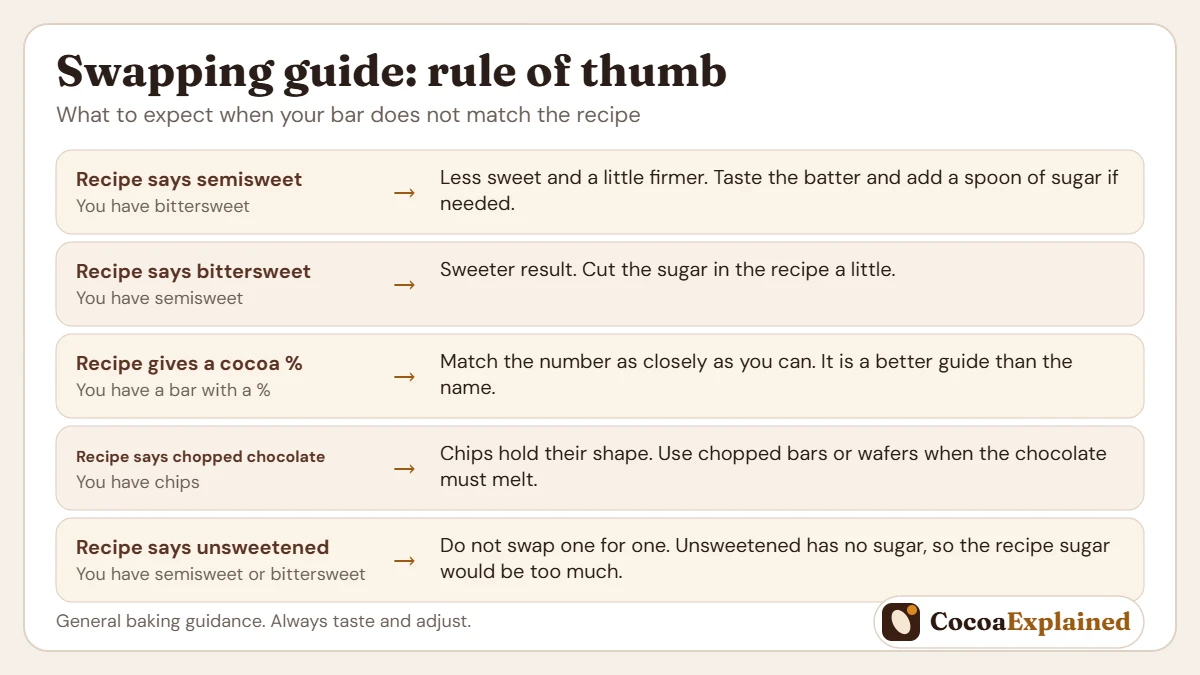
Yes, in most recipes. Use the same weight of chocolate. If a recipe calls for bittersweet and you use semisweet, the result will be a little sweeter, so you can cut a small amount of sugar from the recipe. If a recipe calls for semisweet and you use bittersweet, the result will be slightly less sweet and more bitter, which is usually fine. If the recipe is very sweet already, try a higher-percentage bar.
Keep an eye on the form too. Chips are made to hold their shape in the oven, so they can behave differently from a chopped bar. For batters and for melting, many bakers prefer chopped bars or wafers. See chocolate chips vs baking chocolate for the difference.
What about unsweetened, dark and milk chocolate?
Unsweetened chocolate is almost pure chocolate liquor, at about 99%, with no sugar. It is not a swap for semisweet or bittersweet without adding a lot of sugar, so only use it if the recipe is written for it. Milk chocolate has milk solids and a lot more sugar, so it behaves very differently. Our guide to dark, milk and white chocolate covers the main types.
If a recipe uses cocoa powder rather than chocolate, that is a different product. You can read about the two common kinds in natural vs Dutch-process cocoa.
Quick guide by recipe
| Recipe | Good choice | Why |
|---|---|---|
| Chocolate chip cookies | Semisweet, about 50% to 60% | Gentle sweetness that most people expect |
| Fudgy brownies | Semisweet or bittersweet | Bittersweet gives a deeper, less sweet taste |
| Chocolate mousse | Bittersweet, about 65% to 70% | Strong flavour that holds up to cream and eggs |
| Ganache or glaze | Semisweet or bittersweet | Pick by how sweet you want the finish |
| Dipping and coating | Chocolate made for melting | Smooth flow matters more than the name |
These are starting points, not rules. Taste is personal, and a recipe that works with one brand may need a small tweak with another. When in doubt, follow the percentage the recipe names, and change one thing at a time so you know what made the difference.
How to choose a bar at the shop
Flip the pack and read the front and the back. The front may say semisweet, bittersweet, dark or just a percentage. The back lists the ingredients in order of weight. For a good baking bar, you want to see chocolate liquor (sometimes written as cocoa mass or cacao), sugar and cocoa butter near the top, and only a short list after that. A short list usually means a simpler, cleaner chocolate flavour.
If you are unsure, buy one bar at around 60% and one at around 70%. These two cover most recipes. Taste a small square of each before baking. If a square tastes too bitter to enjoy on its own, it will taste bitter in your brownies too. If it tastes too sweet, it will make the bake sweeter than the recipe expects.
A simple taste test at home
- Break a small piece off each bar and let it sit on your tongue for a few seconds instead of chewing at once.
- Notice the first taste. Is it sweet, bitter, fruity or nutty?
- Notice how it melts. A smooth, even melt points to a good amount of cocoa butter.
- Notice the aftertaste. A long, dry bitterness suggests a higher cocoa percentage.
- Write down the percentage next to your notes, so you can match it next time.
This takes five minutes, and it teaches you more than the name on the front of the pack. Over time you will learn which percentage you like in cookies and which in desserts. If you want to learn how makers get these flavours, read how cacao beans become chocolate.
Common mistakes to avoid
- Picking by name only. Look at the percentage, since two “semisweet” bars can taste very different.
- Using chips in a recipe that needs melted chocolate. Chips hold their shape, so they may not melt as smoothly.
- Swapping unsweetened chocolate for either without adding sugar.
- Going far above the recipe’s percentage in a delicate cake. Very dark chocolate can taste dry and bitter.
Frequently asked questions
Is semisweet chocolate the same as bittersweet?
Not exactly, but they are very close. In the US, both are names for dark sweet chocolate with at least 35% chocolate liquor. Brands usually make semisweet a little sweeter than bittersweet.
Can I substitute bittersweet for semisweet chocolate?
Yes, in most recipes. Use the same weight. The result will be a bit less sweet and a bit more bitter. If you go the other way, you can cut a little sugar.
What percentage is semisweet chocolate?
Brands typically sell semisweet at about 35% to 65% cocoa, but there is no fixed legal range for the name. Always check the label.
What percentage is bittersweet chocolate?
Bittersweet is usually about 65% to 80% cocoa. It overlaps with semisweet, so a percentage is more useful than the name.
Is bittersweet chocolate the same as dark chocolate?
Bittersweet is a type of dark chocolate. Semisweet is too. Dark chocolate is the wider group that includes both.
Is unsweetened chocolate the same as bittersweet?
No. Unsweetened chocolate is about 99% chocolate liquor with no sugar. It is far more bitter, so it is not a direct swap.
Key points to remember
- Semisweet and bittersweet are both dark sweet chocolate, and US rules do not set a firm line between them.
- Typical brand ranges are about 35% to 65% for semisweet and 65% to 80% for bittersweet, and they overlap.
- Follow the percentage in your recipe, not just the name.
- You can swap them one for one, and cut a little sugar when using semisweet for bittersweet.
- Do not swap in unsweetened or milk chocolate without changing the recipe.
Related guides
- Chocolate Chips vs Baking Chocolate
- What Does Cocoa Percentage Mean?
- Dark, Milk and White Chocolate Differences
- Natural vs Dutch-Process Cocoa
Sources
- 21 CFR 163.123, Sweet chocolate, Legal Information Institute, Cornell Law School.
- Baking chocolate, Wikipedia, on bittersweet, semisweet and unsweetened types.
- Semi-Sweet Vs Bittersweet Chocolate: What’s The Difference?, Tasting Table, for typical percentage ranges and swapping advice.
- What Is The Difference Between Bittersweet And Semisweet Chocolate?, Chowhound, for baking form advice.
Last updated: October 2026. This guide is educational and is not medical or nutrition advice. See our editorial policy.