Is Dark Chocolate Vegan? What to Check on the Label
Dark chocolate can be vegan, but it is not always vegan. Some bars add milk ingredients, and many are made on the same equipment as milk chocolate, so a trace of milk can still end up in the bar.
That matters if you avoid animal products, and it matters even more if you have a milk allergy. In this guide we explain what is in dark chocolate, why milk sometimes shows up, what the US Food and Drug Administration (FDA) found when it tested bars, and how to read a label in under a minute.
Short answer: plain dark chocolate is made from cocoa, cocoa butter and sugar, which are all plant-based. But the word “dark” is not a promise of “no dairy”. Read the ingredient list for milk words, and check for a vegan or dairy-free claim. If you have a milk allergy, a label is a starting point and not a guarantee.
What is dark chocolate made of?
Dark chocolate is mostly cocoa solids, cocoa butter and sugar. Our guide on what chocolate is explains how these parts come from the cacao bean. One vegan food site points out that cocoa butter is completely plant-based, and so is cocoa powder. It says dark chocolate usually has 55 to 100 percent cacao, and the rest is mostly sugar and flavorings.
Here is the catch. US rules for sweet, semisweet and bittersweet chocolate, the groups that dark bars usually fall into, set a minimum amount of chocolate liquor. That is 15 percent for sweet chocolate and 35 percent for semisweet and bittersweet. The same rules also list optional dairy ingredients that makers may add. These include cream, butterfat, whole and skim milk, dried milk and buttermilk solids, as long as total milk solids stay under 12 percent.
In plain words, a bar can be sold as dark chocolate and still contain a little milk. This is why the ingredient list matters more than the name on the front. To learn how the cocoa percentage on a pack works, see what the cocoa percentage means.
Why some dark chocolate contains milk
Milk gets into dark chocolate in two ways: on purpose and by accident.
On purpose. A vegan food site says some makers add a small amount of dairy to dark chocolate, especially in bars with a lower cacao percentage. The words to look for are milk, milkfat, butterfat, butteroil, whey, casein and lactose.
By accident. One chocolate maker explains that dark chocolate is often made on the same equipment as milk chocolate, which can pass milk to the dark bar. This is called cross-contact. The FDA reached a similar view. After it found milk in some dairy-free bars, its follow-up inspections suggested the milk came from supplier ingredients or from shared equipment used for milk chocolate.
The first cause is easy to spot because it is on the label. The second is harder, because the bar may list no milk at all.
What the FDA found when it tested dark chocolate
The FDA has run more than one study on this. We have put the main numbers in the chart and table below. The FDA did not name brands in these studies, so the results are about the market and not about one product.

| Study | What was tested | What the FDA found |
|---|---|---|
| Survey of products bought Sept 2013 to Sept 2014 | 94 dark chocolate products | 6 listed milk as an ingredient. 88 did not list milk in the ingredients or a “Contains” line. 59 carried advisory statements such as “may contain milk”. |
| Sampling in 2018 and 2019 | 119 samples of 52 dairy-free dark chocolate products made in the US (88 bars and 31 packs of chips) | Milk was found in 13 samples. Twelve samples from four products had 600 to 3,100 ppm, and one sample from a fifth product had 90 ppm. Four products were recalled. |
“ppm” means parts per million. A higher number means more milk was found.
The FDA calls the first survey a “snapshot” and says it has limits. News reports of that survey said about 60 percent of the bars tested positive for milk. In the second study, the FDA said about 90 percent of the tested products could be considered safe for people with a milk allergy. In other words, most dairy-free bars were fine, but a meaningful few were not. Both studies are several years old, and recipes and factory practices change. They show why checking the label every time is a good habit.
How to read a dark chocolate label
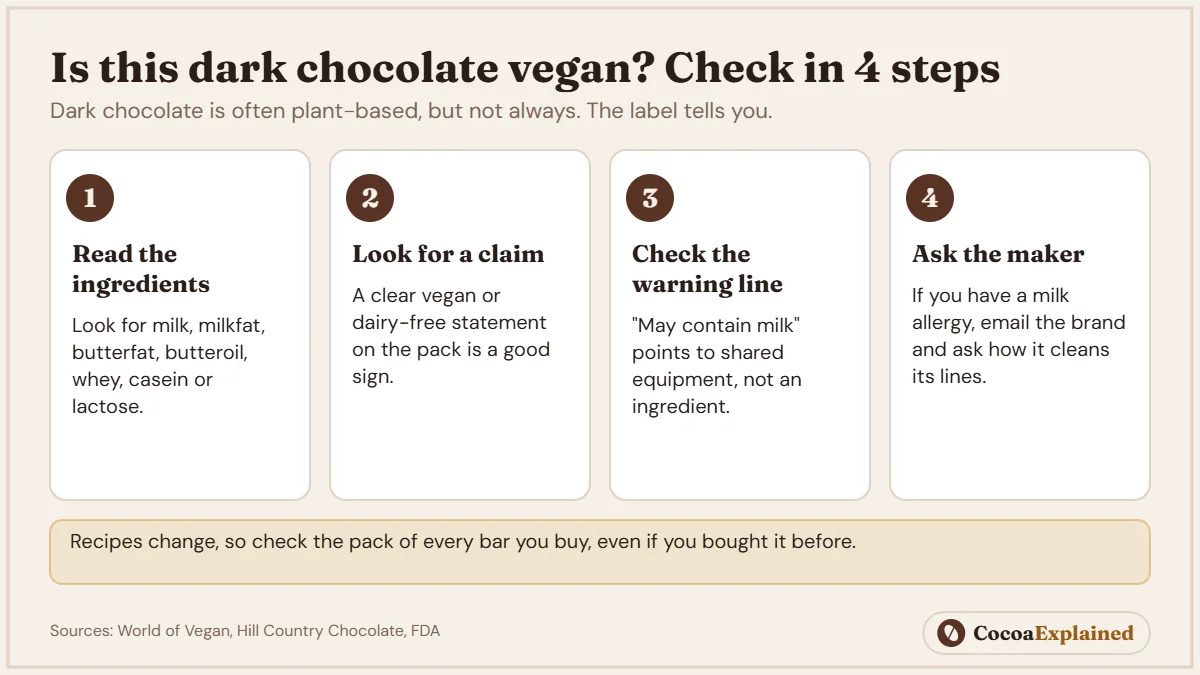
You can check a bar in under a minute. Follow these steps in order.
- Read the ingredients. Look for milk, skim milk, milk powder, milkfat, butterfat, butteroil, whey, casein or lactose.
- Look for a claim. A clear “vegan” or “dairy-free” statement on the pack is a good sign.
- Check the warning line. Statements such as “may contain milk” or “made in a facility that also processes milk” are about shared equipment.
- Ask the maker if it matters. If you have a milk allergy, email the brand and ask how it cleans its production lines.
Some words on the label look scary but are fine. The table below shows how to read the most common ones.
| On the label | What it means | Dairy-free? |
|---|---|---|
| Milk, skim milk, milk powder | Milk ingredient | No |
| Milkfat, butterfat, butteroil | Fat that comes from milk | No |
| Whey, casein, lactose | Milk proteins and milk sugar | No |
| Cocoa butter | Natural fat from the cacao bean | Yes |
| Soy lecithin, vanilla | An emulsifier and a flavor. One maker says they do not add dairy | Yes |
| “May contain milk” | A warning about shared equipment | Not guaranteed |
If you like to keep a handy reference, our chocolate label cheat sheet covers the other words you will meet on a pack.
“May contain milk” and “vegan”: what is the difference?
A “may contain milk” line is a precaution. It says milk could be present in tiny amounts because of how the bar was made. It does not mean milk is an ingredient. So a bar can have a vegan recipe and still carry the warning.
How you treat that line depends on why you avoid milk. Some vegans are happy to eat a bar with a recipe that has no animal ingredients, even if it was made near milk. Others prefer to avoid the bar completely. This is a personal choice.
If you have a milk allergy, the answer is simpler. Treat the warning as real. In the FDA’s second study, every bar and chip pack carried a dairy-free or similar claim, and some still contained milk. If you have an allergy, talk to your doctor or allergist, and contact the maker before you eat the product.
Does a higher cocoa percentage help?
A little. One chocolate maker says dark chocolate with 70 percent cocoa or more is less likely to contain milk. A vegan food site says the opposite end is riskier: bars with a lower cacao percentage are more likely to have dairy added. Both fit with the idea that a plain, high-percentage bar is a good place to start.
But it is only a hint. Cross-contact can happen at any percentage, and the FDA’s second study looked at dark chocolate products that were already labeled dairy-free. If you want to compare dark, milk and white chocolate more closely, read how dark, milk and white chocolate differ.
Examples of brands reported as vegan
One vegan food site listed these examples when we read it. Treat the list as a starting point only, because recipes change.
| Brand | What the site reported |
|---|---|
| Lindt | Only some Excellence bars are vegan, including the 85 percent, 99 percent and 70 percent Mild bars |
| Ghirardelli | Only the 72 percent Cacao Twilight Delight bar and Intense Dark 72 percent squares |
| Hershey’s Special Dark | Not vegan, because all include milk and dairy derivatives |
| Smaller makers | Conscious Bar, Dandelion (bars only), Taza and Sjaaks were listed as vegan options |
Always check the pack in your hand. A bar that was vegan last year may have a new recipe or a new factory today.
Common mistakes
- Assuming dark chocolate is always dairy-free.
- Reading only the front of the pack and skipping the ingredient list on the back.
- Ignoring “may contain milk” when you have an allergy.
- Trusting a bar you bought last year without checking the new pack.
- Treating a high cocoa percentage as proof of no milk.
- Forgetting chocolate chips and baking bars. The FDA tested chips too, so check them the same way. Our guide to chips and baking chocolate explains the difference.
Some vegans also ask about how sugar is processed and about glazes on some sweets. The sources we checked did not cover these, so ask the maker if they matter to you.
Frequently asked questions
Is dark chocolate vegan?
Often, but not always. Check the ingredients for milk, milkfat, butterfat, butteroil, whey, casein or lactose. If none are listed, the bar is usually plant-based.
Is 70 percent dark chocolate always vegan?
No. One maker says bars at 70 percent cocoa or higher are less likely to contain milk, but a higher percentage is not a guarantee. Milk can also get into a bar through shared equipment.
What does “may contain milk” mean on dark chocolate?
It is a warning that traces of milk may be present because the bar is made on shared equipment. It is not an ingredient. People with a milk allergy should take it seriously, and some vegans choose to avoid these bars.
Is dairy-free the same as vegan?
Not exactly. Dairy-free means no milk ingredients. Vegan is a wider rule that means no animal-derived ingredients at all, so check the pack for a vegan claim if that matters to you.
Can dark chocolate trigger a milk allergy?
Yes, it can. In FDA sampling of dairy-free dark chocolate, some products contained milk, and four products were recalled. If you have a milk allergy, talk to your doctor or allergist and contact the maker before you eat a bar.
Is cocoa butter dairy?
No. Cocoa butter is the natural fat from the cacao bean and is plant-based. Butterfat is different: it comes from milk.
Key points to remember
- Dark chocolate can be vegan, but “dark” does not guarantee “no dairy”.
- Cocoa, cocoa butter and sugar are plant-based. Milk, milkfat, butterfat, whey, casein and lactose are not.
- Milk can get in on purpose or through shared equipment.
- The FDA found undeclared milk in some dark chocolate, and four dairy-free products were recalled after its 2018 and 2019 sampling.
- Check the ingredients, look for a claim and read the warning line. If you have an allergy, ask the maker.
Related guides
- How to Choose Good Chocolate
- What Is Cocoa Butter?
- Is Dark Chocolate Healthy?
- What Is Milk Chocolate Made Of?
Sources
- Survey of Milk in Dark Chocolate Products, US Food and Drug Administration.
- FY18/19 Sample Collection and Analysis: Domestically Manufactured Dairy-Free Dark Chocolate Products, US Food and Drug Administration.
- 21 CFR 163.123, Sweet chocolate, Legal Information Institute, Cornell Law School.
- FDA: 25 Percent of Vegan Chocolate Bars Contain Milk, VegNews, 2015.
- Does Dark Chocolate Have Dairy in It?, Hill Country Chocolate.
- Is Dark Chocolate Vegan?, World of Vegan.
Last updated: November 2026. This guide is educational and is not medical or nutrition advice. See our editorial policy.