What Is Cocoa-Free Chocolate? How It Is Made and Sold
Cocoa-free chocolate is a chocolate-like product made without cocoa. Instead of cacao beans, makers use seeds, grains and other plants such as sunflower seeds, oats and grape seeds, and process them to taste and look like chocolate.
In 2026 the idea moved from startups to big brands. Nestlé has put a ChoViva product on shelves in Germany, and Cargill has announced NextCoa for the US. In this guide we explain what these products are, what they are made from, why companies are making them, and whether they can be called chocolate.
Short answer: cocoa-free chocolate is a plant-based alternative that contains no cocoa. It is not chocolate under the legal rules we checked, and most makers do not claim it is. Many of the claims about taste and the environment come from the makers themselves, so we label them as such.
What is cocoa-free chocolate?
Real chocolate starts with cacao beans, which are fermented, dried, roasted and ground. Our guide on what chocolate is walks through that process, and cacao vs cocoa explains the names.
Cocoa-free products skip the cacao bean. They are made to look, melt and taste like chocolate, and they come in dark, milk, white and vegan styles. A cocoa-free chocolate reference page says they are usually built on a plant base and then treated much like cocoa beans: fermented, roasted and ground into a flavorful concentrate, then mixed with sugar and plant fats.
This is different from compound chocolate. Compound chocolate swaps cocoa butter for other fats but still contains cocoa. See couverture vs compound chocolate for that comparison.
Why are companies making it now?
The short reason is cocoa. Prices rose to a record, supply was hit by weather and farming problems, and makers looked for ways to reduce the risk. Our guide on why chocolate is so expensive covers the price story in detail.
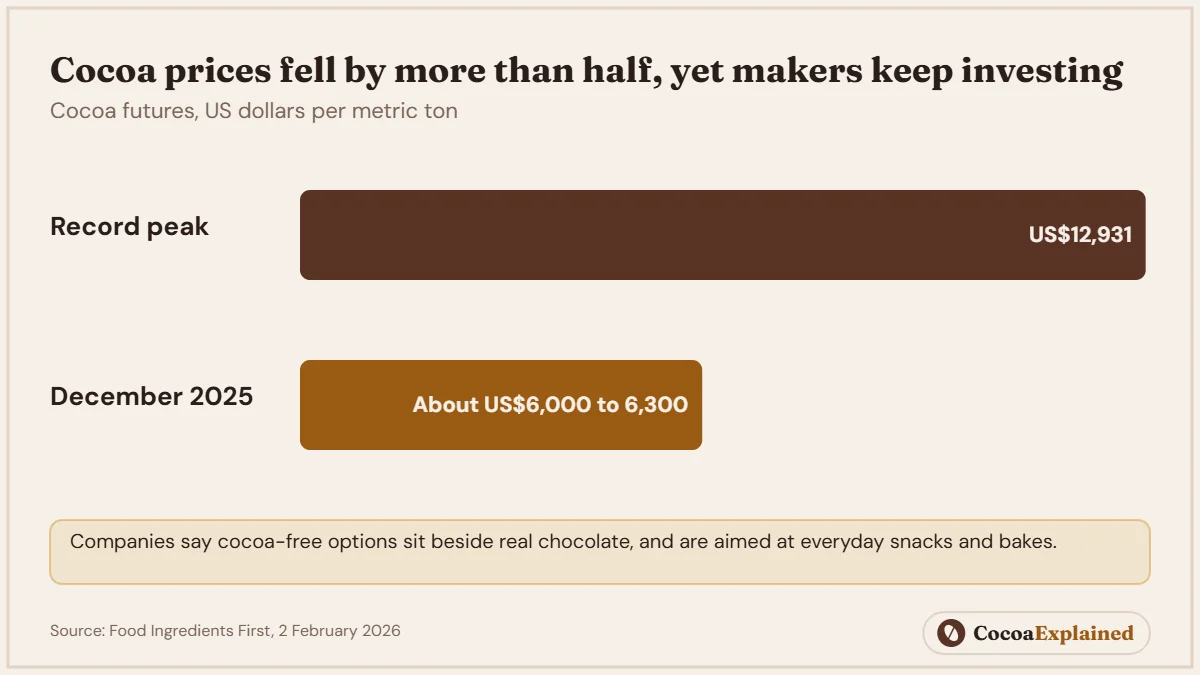
The trade press says cocoa futures reached US$12,931 per metric ton at the peak. By December 2025 they traded at about US$6,000 to 6,300, which is a fall of more than half. You might expect the interest in alternatives to fade. It has not. Companies showed new cocoa-free products at a major trade fair in Cologne in early 2026, and one report says patent activity is growing among Voyage Foods, WNWN Food Labs, Nukoko and Planet A Foods.
There is another reason. Cocoa remains hard to predict. One report notes that Barry Callebaut’s group sales volumes fell 9.9 percent in its first quarter of fiscal 2025/26, even though bean prices were 16 percent lower than a year before. A Rabobank view cited in the trade press is that cocoa prices are not expected to return to their historic levels. For a big food company, a steady, cheaper ingredient is attractive.
What is cocoa-free chocolate made from?
There is no single recipe. Each company uses its own base. The cards and table below show the main ones.

| Company | Product | Main base |
|---|---|---|
| Planet A Foods (Germany) | ChoViva | Fermented, roasted sunflower seeds and oats, with plant fats and sugar |
| Voyage Foods with Cargill (US) | NextCoa | Roasted grape seeds and sunflower seeds |
| Win-Win (UK) | Cocoa-free chocolate | Carob, barley, sunflower flour and tiger nuts, fermented |
| Nukoko (UK) | Cocoa-like powder | Fava beans, fermented |
| Endless Food Co (Denmark) | This Isn’t Chocolate | Brewer’s spent grain |
| Foreverland (Italy) | Choruba | Carob byproduct, grains, sugar and vegetable fats |
A separate group of startups makes cell-based cocoa. Companies such as California Cultured and Celleste Bio grow cells from cacao plants in tanks. That is a different approach, because it starts from the cacao plant itself and not from other seeds.
How cocoa-free chocolate is made
Planet A Foods describes ChoViva in steps that mirror how chocolate is made.
- Ferment the sunflower seeds, as cacao beans are fermented.
- Roast them to build a chocolate-like aroma.
- Grind them into a concentrate.
- Mix the concentrate with sugar, plant fats and, in the standard recipe, milk powder. The vegan version uses sunflower seed flour instead of milk.
- Conche the mix, which is the long mixing step that makes chocolate smooth.
Cargill says its grape seeds can go through a processing step similar to the one used for cocoa beans, which it says gives a chocolate-like look, smell, texture and taste. It also says NextCoa runs on standard production lines.
Which big brands are using it?
| When | What happened |
|---|---|
| February 2026 | At the ISM and ProSweets fair in Cologne, Planet A Foods showed about 125 ChoViva products in 10 countries, and Cargill presented NextCoa. Barry Callebaut said it would roll out ChoViva internationally. |
| March 2026 | Nestlé Germany announced it would expand its Choco Crossies “Snack Vibes” range with ChoViva, due in April 2026, in classic, hazelnut and salted popcorn caramel flavors. |
| May 2026 | Cargill said it plans to bring NextCoa to North America, starting with the US. No launch date was given. |
Nestlé is careful with its words. It says it wants “distinctive” taste experiences and does not compare the product with real chocolate. It also says it is still committed to cocoa, and the original Choco Crossies recipe is unchanged. The new range is aimed at younger snackers in Germany.
Can it be called chocolate?
Almost certainly not. Chocolate has legal definitions that depend on cocoa. In the US, the rule for sweet chocolate requires at least 15 percent chocolate liquor, which is ground cacao. A product with no cocoa cannot meet that. A reference page on cocoa-free alternatives also says they cannot legally be labeled chocolate, because the minimum cocoa share varies by country.
The trade press shows how seriously this is taken. One report says Nestlé and Pladis dropped the word “chocolate” from some UK products after new recipes fell below the legal cocoa minimums. The articles we read do not say exactly how ChoViva or NextCoa products will be named on the pack in every country, so check each label.
How does it compare with real chocolate?
The honest answer is that independent comparisons are still thin. We have not tasted these products, and our sources give mainly the makers’ own claims. Here is what the makers say.
- Taste. Nestlé says internal studies show its product performs strongly on taste. Planet A Foods says its main message is a chocolatey taste.
- Carbon and water. Planet A Foods claims about 80 percent fewer CO2 emissions and up to 94 percent less water than cocoa. Cargill claims a 67 percent lower carbon footprint for NextCoa. Neither claim was independently checked in the articles we read.
- Supply and price. Cargill says sunflower seeds are less volatile in price than cocoa and that NextCoa offers steadier supply.
- Position. Planet A Foods compares premium cocoa to fine wine and sees alternatives suiting everyday products. Both companies say alternatives complement chocolate and do not replace it.
What to check on the label
If you want to know whether a product is real chocolate, a few checks help. Our chocolate label cheat sheet and guide to choosing good chocolate cover the basics.
- Look at the name. “Chocolate” in the name should mean real cocoa. Names such as “chocolate-flavored” or “cocoa-free” are different.
- Read the first ingredients. Look for cocoa, cocoa mass, cocoa butter or chocolate liquor.
- Spot the alternative bases. Sunflower seeds, grape seeds, oats, carob or fava beans in place of cocoa point to a cocoa-free product.
- Check the allergens. These products can include sunflower, oats, soy or milk powder, so read the allergen line.
Common mistakes
- Assuming “chocolatey” on the pack means there is cocoa inside.
- Treating the makers’ environmental claims as proven facts.
- Assuming every cocoa-free product is vegan. The standard ChoViva recipe includes milk powder.
- Mixing up cocoa-free products with cell-based cocoa, which starts from cacao cells.
- Expecting it to be cheaper on the shelf. Our sources do not give consumer prices.
Frequently asked questions
Is cocoa-free chocolate real chocolate?
No. It contains no cocoa. One reference says these products cannot legally be labeled chocolate, because chocolate labeling needs a minimum share of cocoa, and that share varies by country. In the US, sweet chocolate must contain at least 15 percent chocolate liquor.
What is cocoa-free chocolate made from?
Makers use seeds, grains and other plants. Examples include sunflower seeds, oats, grape seeds, carob, barley, fava beans and brewer’s spent grain. The base is usually fermented and roasted, then blended with sugar and plant fats.
Is cocoa-free chocolate vegan?
It depends on the product. ChoViva’s standard recipe includes milk powder, and its vegan version uses sunflower seed flour instead. Cargill says its NextCoa product is free from dairy. Check the label of each product.
Is cocoa-free chocolate healthier than chocolate?
Our sources do not say. Makers talk mostly about lower carbon emissions and steadier supply, not about nutrition. Compare the nutrition labels for sugar, fat and calories, as you would with any treat.
Will cocoa-free chocolate replace real chocolate?
Makers say no. Planet A Foods and Cargill both describe their products as a complement to chocolate, and Planet A Foods compares premium cocoa to fine wine. They see cocoa-free options as a fit for everyday snacks and baked goods.
Where can you buy cocoa-free chocolate?
ChoViva is used in more than 120 products across 10 countries, including Nestlé’s Choco Crossies Snack Vibes in Germany. Cargill said in May 2026 that NextCoa will come to the US first, but gave no date.
Key points to remember
- Cocoa-free chocolate contains no cocoa. It is made from seeds, grains and other plants.
- Nestlé and Cargill both moved into the area in 2026, and Barry Callebaut is rolling out ChoViva.
- It is not chocolate under the legal rules we checked, so look for cocoa on the ingredient list.
- Most taste and environmental claims come from the makers and were not independently verified.
- Makers say it complements chocolate and is aimed at everyday snacks.
Related guides
Sources
- Nestlé bets big on cocoa-free chocolate: Inside its new launch, FoodNavigator, March 2026.
- ISM 2026 live: Cocoa volatility reshapes chocolate innovation as alternatives go global, Food Ingredients First, February 2026.
- Nestlé adopts ChoViva as confectionery giants embrace cocoa-free solutions, Food Ingredients First, March 2026.
- Cargill to launch cocoa-free chocolate in US, Food Dive, May 2026.
- 14 Startups Making Cocoa-Free and Cell-Based Chocolate Alternatives, Green Queen.
- Cocoa-free chocolate alternative, Wikipedia.
- 21 CFR 163.123, Sweet chocolate, Legal Information Institute, Cornell Law School.
Last updated: November 2026. This guide is educational and is not medical or nutrition advice. See our editorial policy.