What Is Cocoa Butter? What It Does in Chocolate
You turn over a chocolate bar, read the label, and one ingredient sounds like it belongs in a skincare shelf: cocoa butter. Is it butter? Is it dairy? Is it the same as the fat in a milk bar from the corner shop?
Short answer: cocoa butter is the natural, pale-yellow fat of the cacao bean. It is pressed out of ground cocoa beans, contains no dairy, and it is the reason a good bar feels firm in your hand and then melts smoothly in your mouth. This guide explains what it is, how it is made, why it matters, and how to read the label so you know what you are really buying.
What cocoa butter actually is
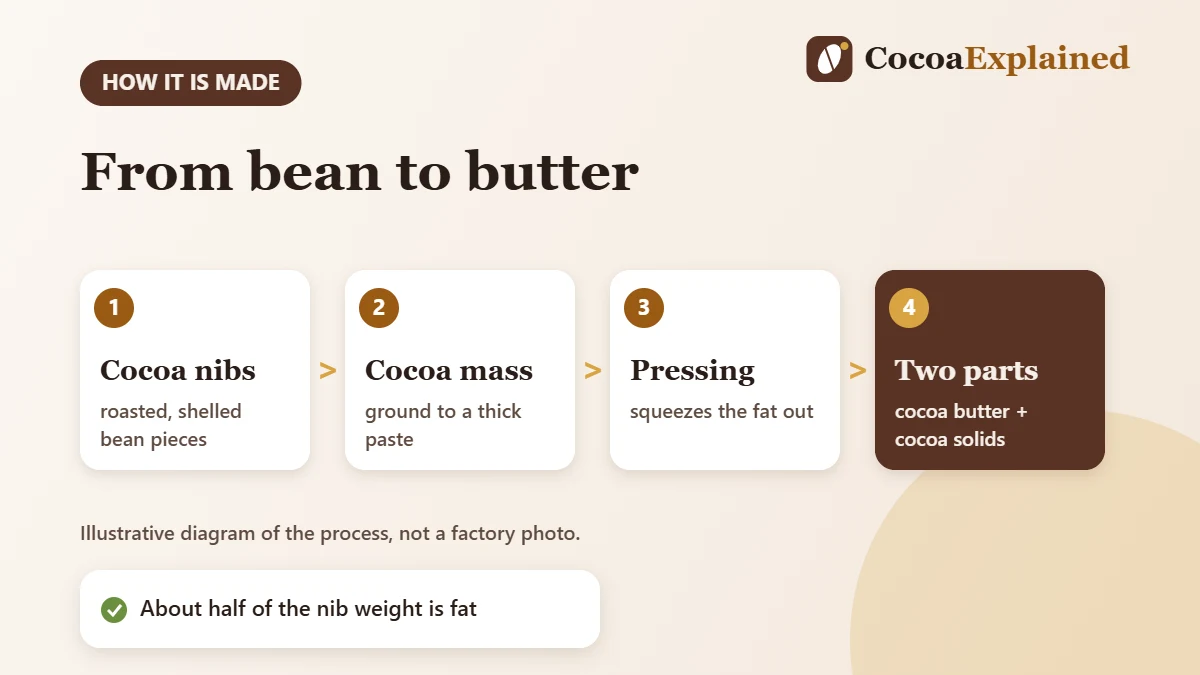
A cocoa bean is roughly half fat. After the beans are fermented, dried, roasted and shelled, the pieces (called nibs) are ground into a thick paste known as cocoa mass or cocoa liquor. Press that paste hard enough and it splits in two: the fat runs out as cocoa butter, and a dry cake of cocoa solids is left behind, which is later ground into cocoa powder. If you want the full path from pod to bar, our guide to how cacao beans become chocolate covers every step.
Reference sources put the fat share of the nibs at about 54 to 58 percent. The name is a little misleading. Nothing in cocoa butter comes from milk, so it is naturally dairy-free and vegan. It is called butter because it is a soft, creamy fat at warm room temperature, not because of how it is made.
You can watch cocoa butter being separated from cocoa liquor in our animated video, From Pod to Bar: How Chocolate Is Made (from 4:14).
Why chocolate needs it
Most fats are either soft and greasy or hard and waxy. Cocoa butter is unusual because it is hard and brittle at room temperature, yet it melts across a narrow range that sits just below body temperature. Published figures put the melting range at roughly 34 to 38 degrees Celsius (93 to 100 degrees Fahrenheit). That is why a bar snaps cleanly in the pantry and then turns to liquid on your tongue, with no waxy feel.
Chemically, it is mostly a small set of fatty acids: stearic acid (about 24 to 37 percent), palmitic acid (about 24 to 30 percent) and oleic acid (about 29 to 38 percent). Because the fat molecules are so uniform, they line up neatly when the chocolate cools. That tidy structure gives you the snap, the gloss and the clean melt.
The crystal story: why tempering exists
Cocoa butter can set in several crystal forms. Researchers describe six of them, each melting at a different temperature, from about 17 degrees Celsius for the least stable up to about 36 degrees for the most stable. Only one of them, known as Form V, gives chocolate the shine, the snap and the smooth melt people expect.
Tempering is simply the process of coaxing melted chocolate into Form V. If chocolate cools without being tempered, it sets in unstable forms. The result is dull, soft chocolate that can develop pale streaks later. If you want to try it, see how to temper chocolate at home.
| Crystal form | Approx. melting point | What it means for chocolate |
|---|---|---|
| Form I | about 17 C | Unstable, melts very easily |
| Form II | about 23 C | Unstable |
| Form III | about 25.5 C | Unstable |
| Form IV | about 27.5 C | Unstable |
| Form V | about 34 C | The target: glossy, snaps, melts smoothly |
| Form VI | about 36 C | Most stable, higher melting |

Figures are rounded from published reference values. Exact numbers shift a little between sources.
Cocoa butter in white, milk and dark chocolate
Every real chocolate contains cocoa butter, but the amount and the company it keeps differ. Dark chocolate gets its cocoa butter from the beans themselves plus, often, a little extra. Milk chocolate blends it with milk solids and sugar. White chocolate is the one where cocoa butter is the star: it contains cocoa butter, milk and sugar, and no cocoa solids at all. That is also why it tastes mild and creamy rather than bitter. We explain that debate in is white chocolate real chocolate, and the wider differences in dark, milk and white chocolate.
The rules set a floor. Under the US standard for white chocolate, a bar must contain at least 20 percent cocoa butter, at least 3.5 percent milkfat, and at least 14 percent total milk solids, with no more than 55 percent sugar. The European Union sets the same 20 percent cocoa butter minimum and the same milk solid and milkfat minimums for white chocolate.
| Type | Where the cocoa butter comes from | Notes |
|---|---|---|
| Dark chocolate | Beans, plus sometimes added cocoa butter | Cocoa percentage counts cocoa solids and cocoa butter together |
| Milk chocolate | Beans, plus added cocoa butter | Milk solids and sugar make up much of the rest |
| White chocolate | Added cocoa butter, no cocoa solids | At least 20 percent cocoa butter in both the US and the EU |
| Couverture | Extra cocoa butter added | Thinner when melted, favoured for coating and tempering |
If you are comparing cocoa percentages, our explainer on what cocoa percentage means shows how that number is calculated, and couverture and compound chocolate covers why extra cocoa butter matters for coating.
Deodorised or natural: the label word that changes flavour
Cocoa butter carries flavour from the beans it came from. Many makers deodorise it, a steam treatment that strips strong or unwanted flavours so the butter tastes neutral and behaves the same from batch to batch. Others keep it natural and unprocessed, so the fat adds its own character to the bar. One large ingredient supplier notes that natural cocoa butter is sometimes chosen on purpose to bring out specific flavours.
Neither is better by default. Deodorised butter suits white chocolate, fillings and baking where you want a clean taste. Natural butter shows up more in single-origin and craft bars where flavour is the point.
When the fat is not cocoa butter
This is the part worth reading on the label. Some products replace part or all of the cocoa butter with cheaper vegetable fats such as palm oil. Compound or “chocolate-flavoured” coatings do this. Real chocolate may also contain a limited amount of certain other fats.
In the European Union, chocolate may include added vegetable fats other than cocoa butter, up to 5 percent of the finished product, from a defined list: illipe, palm oil, sal, shea, kokum gurgi and mango kernel. The label must then say “contains vegetable fats in addition to cocoa butter”, in bold, near the ingredients. Those fats cannot reduce the minimum cocoa butter content. The rules differ by country, so always read the pack in front of you.
- Look for the words “cocoa butter” high on the ingredient list.
- Watch for palm oil, shea, vegetable fat or “cocoa butter equivalent” in the list.
- In the EU, look for the “vegetable fats in addition to cocoa butter” statement.
- A product called a “coating” or “compound” is not the same as chocolate.
Common mistakes people make
- Thinking it is dairy. It is a plant fat from the bean, so it is dairy-free.
- Assuming white chocolate has no chocolate in it. It has the bean’s fat, but not the cocoa solids.
- Calling bloom mould. The pale film on old chocolate is usually fat or sugar that has moved to the surface, not mould. See why chocolate turns white.
- Storing it warm. Heat melts the fat and lets it re-crystallise badly. How to store chocolate explains where to keep it.
- Buying by the front of the pack. The ingredient list tells you what the fat really is.
Is cocoa butter healthy?
Cocoa butter is a fat, and fat is energy dense: reference data put it at about 884 calories per 100 grams. It is mostly saturated fat, and, unlike cocoa powder, it contains only trace amounts of caffeine and theobromine. We do not make health claims about it. A chocolate bar is a treat whose nutrition depends on its sugar, milk and portion size too. If you have a health condition or dietary restriction, speak with a qualified professional. This is general information, not medical advice.
Cocoa butter outside chocolate
Because it is solid at room temperature and melts near body temperature, cocoa butter is also used in lotions, balms and soaps, and has historically been used as a base for some pharmaceutical products. Cosmetic-grade products are not the same as the food-grade butter used by chocolate makers, so check the label and intended use before eating anything sold as a body product.
Frequently asked questions
Is cocoa butter dairy?
No. Cocoa butter is a plant fat from the cacao bean, so it contains no milk. The word butter refers to its soft, creamy texture. Always check the label for milk added elsewhere in the product.
Is cocoa butter the same as cocoa powder?
No. When cocoa mass is pressed, it splits into cocoa butter (the fat) and a dry cake of cocoa solids, which is ground into cocoa powder. They are two separate parts of the same bean.
Why does cocoa butter melt in your mouth?
It melts across a narrow range just below body temperature, roughly 34 to 38 degrees Celsius. That means it stays solid in your hand but turns liquid on your tongue.
Is white chocolate really chocolate if it has no cocoa solids?
Under the US and EU standards, white chocolate is its own legal category and must contain at least 20 percent cocoa butter, plus milk solids and sugar. It does not contain cocoa solids, which is why it tastes mild.
What is deodorised cocoa butter?
Deodorised cocoa butter has been steam treated to remove strong flavours so it tastes neutral. Natural cocoa butter keeps more of the bean’s own flavour. Both are cocoa butter.
Can cocoa butter be replaced with other fats?
Some products do it. In the EU, chocolate may include up to 5 percent of certain vegetable fats and must say so on the label. Compound coatings may replace cocoa butter more heavily, so read the ingredient list.
Key points to remember
- Cocoa butter is the natural fat pressed from cocoa beans. It contains no dairy.
- It melts around 34 to 38 degrees Celsius, which gives chocolate its snap and clean melt.
- Tempering exists to set cocoa butter in its best crystal form (Form V).
- White chocolate must contain at least 20 percent cocoa butter in both the US and the EU.
- Check the label: palm oil or other vegetable fats mean the fat is not only cocoa butter.
Related reading: what is in milk chocolate and hot chocolate vs hot cocoa.
Related guides
- What Is Chocolate, Exactly?
- Is White Chocolate Real Chocolate? What the Rules Say
- What Is Milk Chocolate Made Of?
- How to Temper Chocolate at Home: Step-by-Step Guide
- Start here: a beginner’s guide to chocolate
- Browse all chocolate guides
- What Is Ruby Chocolate? The Pink Chocolate Explained
Sources
- Cocoa butter, Wikipedia, reference summary of composition, melting forms, yield and uses.
- 21 CFR 163.124, White chocolate, US Code of Federal Regulations, Cornell Legal Information Institute.
- Directive 2000/36/EC on cocoa and chocolate products, European Parliament and Council, 2000, via legislation.gov.uk.
- What is cocoa butter?, Puratos knowledge base.
Last updated: October 2026. This guide is educational and is not medical or nutrition advice. See our editorial policy.