Why Does Chocolate Turn White? Chocolate Bloom Explained
You unwrap a bar you bought a few weeks ago and the surface is streaked with a pale, dusty film. Maybe it looks like a grey cloud, maybe like faint white swirls. The first thought is usually “it has gone off”, and the second is “can I still eat it?”.
In nearly every case that film is chocolate bloom, and it is a cosmetic and texture problem rather than a safety one. It is also one of the most common questions people have about chocolate, so it is worth understanding properly: what bloom is, the two different kinds, how to tell it apart from mould, and what you can do about it. If you want the wider story of how chocolate is made first, what chocolate is made of is a good place to start.
What chocolate bloom actually is
Chocolate is a delicate balance of tiny solid particles of cocoa and sugar suspended in cocoa butter. Cocoa butter is unusual because it can set in several different crystal forms. When chocolate is made properly, through a step called tempering (we go into this in how cacao beans become a chocolate bar), the cocoa butter sets in a stable form that gives the bar its gloss, its snap and its smooth melt.
Bloom is what happens when that balance is disturbed. Either fat or sugar ends up on the surface where it should not be, and it crystallises there as a visible white or greyish layer. There are two types, and they have different causes.
Fat bloom
Fat bloom happens when cocoa butter moves to the surface and recrystallises. The usual triggers are:
- Temperature swings. A bar that warms up slightly and then cools again, for example in a car, a sunny window or a warm kitchen, lets some of the fat melt and migrate. When it sets again it forms those pale streaks.
- Poor tempering. If chocolate was not tempered well at the factory, or was melted and re-set at home without tempering, the cocoa butter sets in an unstable form and tends to bloom faster.
- Filling migration. In filled chocolates, oils from nut pastes, pralines or other fillings can migrate into the chocolate shell and push cocoa butter to the surface.
- Age. Even well-kept chocolate can bloom eventually, particularly if it has been stored for a long time.
Fat-bloomed chocolate looks dull, with a whitish or greyish haze or streaks. It may feel slightly greasy or soft, and it melts straight away on your fingers. Texture can turn a bit crumbly or grainy, and the flavour can seem flatter than it should.
Sugar bloom
Sugar bloom is the other type and it comes from moisture. If water touches the surface of chocolate, it dissolves some of the sugar. When the water evaporates, the sugar stays behind as fine crystals on the surface.
This is common when chocolate goes from a cold fridge into a warm room and condensation forms, or when it is stored somewhere humid. Sugar-bloomed chocolate has a dry, rough, powdery or speckled surface. If you rub it, it feels gritty rather than greasy, and it does not melt on contact the way fat bloom does.
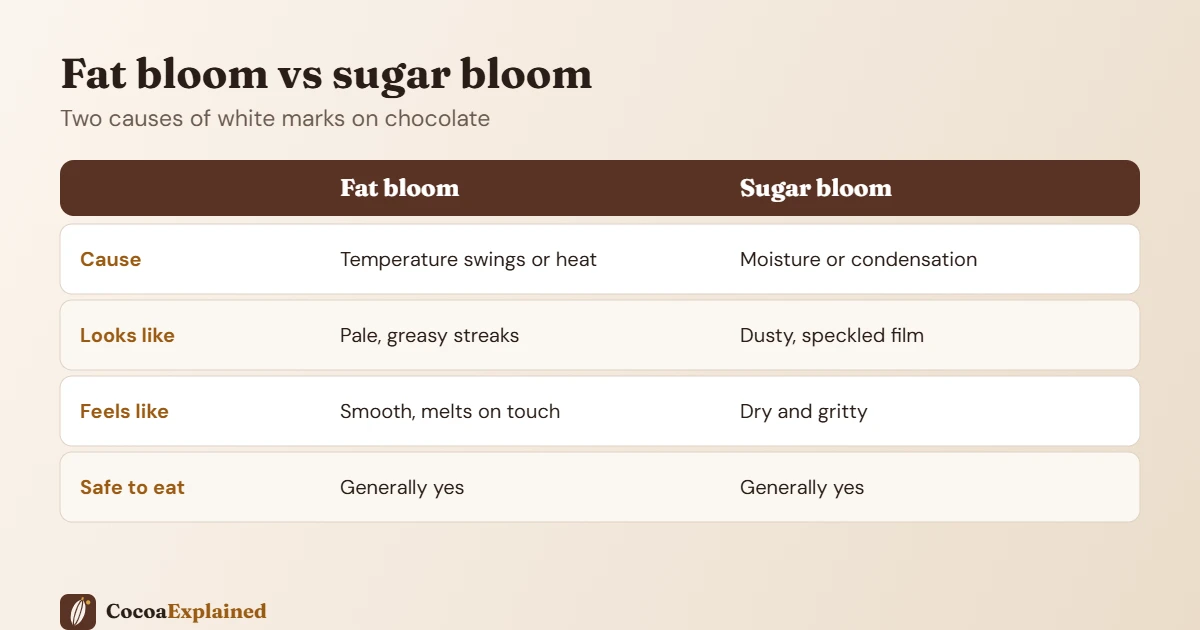
| Fat bloom | Sugar bloom | |
|---|---|---|
| What it is | Cocoa butter on the surface | Sugar crystals on the surface |
| Main cause | Temperature changes, poor tempering, filling oils | Moisture and humidity, condensation |
| Look | Dull, whitish or greyish streaks or haze | Dry, rough, powdery or speckled |
| Feel | Smooth, slightly greasy; melts on touch | Gritty; does not melt on touch |
| Safe to eat? | Generally yes | Generally yes |
Is bloomed chocolate safe to eat?
In general, yes. Bloom is a change in how the fat or sugar is arranged, not a sign of spoilage. Chocolate has very low water activity, which makes it hard for bacteria to grow, so a bloomed bar that has otherwise been stored normally is usually perfectly safe.
What changes is the eating experience. The texture is less smooth, the snap is weaker and the flavour can taste duller. If you are eating a good bar for pleasure, the difference is noticeable. If you are putting it in a cake, a sauce or hot chocolate, you will probably never taste it.
How to tell bloom from mould
This is the one thing worth checking carefully, because the two can look superficially similar at a glance. Mould on chocolate is rare, but it can happen, especially in damp conditions or on chocolates with moist fillings.
| Bloom | Mould | |
|---|---|---|
| Texture | Flat, smooth or dusty; part of the surface | Fuzzy, raised or spotty |
| Colour | White, grey or pale tan | Can be white, green, blue or black patches |
| Smell | Normal chocolate smell | Musty, sour or off |
| When rubbed | Smears or melts (fat) or feels gritty (sugar) | Comes away as fuzz or leaves a stain |
| What to do | Safe to eat or bake | Throw it away |
If you see anything fuzzy, patchy in colour or smelling musty, bin it. If it just looks pale and streaky and smells like chocolate, it is bloom.
Can you fix bloomed chocolate?
You cannot restore the original appearance by simply wiping it. But you do have some options.
- Melt it and use it in cooking. Bloomed chocolate melts and behaves normally in baking, ganache, sauces and hot chocolate. This is the best use of it.
- Re-temper it. If you want it to set glossy again, you can melt it and temper it properly. We show how in how to temper chocolate at home.
- Do not just re-melt and set it. Melting it and letting it set without tempering usually produces dull, soft chocolate that blooms again soon.
How to prevent bloom
Prevention is mostly about steady conditions.
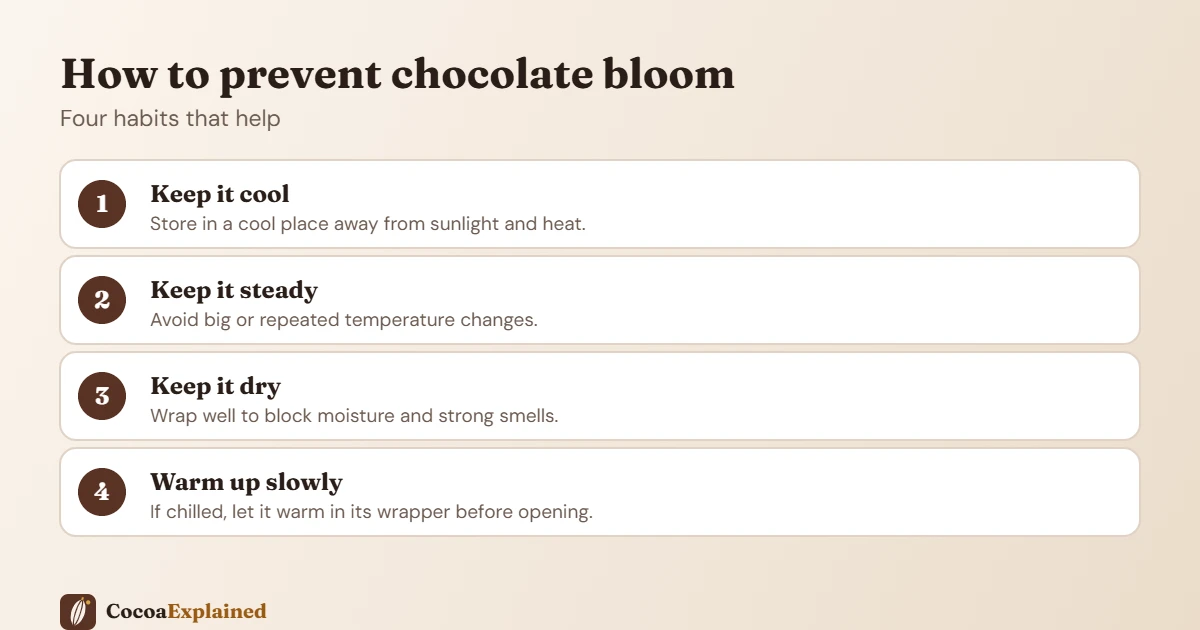
- Keep it cool and stable. The ideal storage temperature is roughly 15 to 18°C (60 to 65°F). Avoid warm shelves, sunny windows and hot cars.
- Keep it dry. Humidity is the enemy of sugar bloom. A cupboard away from the kettle and cooker is better than a bathroom or a steamy kitchen.
- Wrap it well. An airtight container or a sealed bag stops it absorbing moisture and strong smells.
- Be careful with the fridge. If you must refrigerate chocolate in hot weather, wrap it tightly first and let it come back to room temperature in its wrapper before unwrapping, so condensation forms on the wrapper rather than the chocolate.
- Eat it within a sensible time. Good chocolate does not last forever. Dark chocolate keeps longest, milk chocolate less so, and filled chocolates shortest.
Does bloom mean the chocolate is low quality?
Not necessarily. Bloom tells you about storage and handling more than about the original quality. A very good bar can bloom if it has been stored badly, and a cheap bar can stay glossy for months if conditions are stable. That said, if a brand-new bar arrives already bloomed, it probably spent time somewhere warm or damp before you got it.
The short version
Pale streaks or a dusty film on chocolate are almost always bloom. Fat bloom comes from cocoa butter moving to the surface and is linked to temperature swings; sugar bloom comes from moisture dissolving the sugar. Both are normally safe, just less pleasant to eat. Check for fuzz or a musty smell to rule out mould, melt bloomed chocolate into recipes, and store your chocolate cool, dry and wrapped. For more on keeping it at its best, see our full guide on how to store chocolate.
Frequently asked questions
Is the white stuff on chocolate mould?
Usually not. White streaks or a dusty film are most often fat bloom or sugar bloom. Mould looks fuzzy or coloured and often smells musty. If you see fuzz, throw the chocolate away.
Is bloomed chocolate safe to eat?
Generally yes. Bloom changes appearance and texture but is not spoilage. Check for mould and an off smell, and discard the chocolate if either is present.
Does bloom mean the chocolate is old?
Not necessarily. Bloom can appear on fresh chocolate that has been exposed to heat or temperature swings, and old chocolate stored well may stay perfect.
Can I put chocolate in the fridge?
You can, but it risks condensation and sugar bloom. If you do, wrap it airtight and let it warm up in its wrapper before opening.
Can I bake with bloomed chocolate?
Yes. It melts normally and works well in baking, sauces and drinks. Its look matters less once it is melted into a recipe.
Key points to remember
- White marks on chocolate are usually bloom, not mould.
- Fat bloom comes from cocoa butter; sugar bloom comes from moisture.
- Bloomed chocolate is generally safe, with a change in texture.
- Fuzzy spots or a musty smell mean mould: throw it away.
- Cool, steady, dry storage prevents most bloom.
Related guides
- What Is Chocolate, Exactly?
- Dark, Milk and White Chocolate: The Real Differences
- What Does Cocoa Percentage Mean on Chocolate?
- How Cacao Beans Become a Chocolate Bar
- Does Chocolate Expire? How Long It Really Lasts
- Start here: a beginner’s guide to chocolate
- Browse all chocolate guides
- Why Does Chocolate Seize? How to Fix It
- Can You Freeze Chocolate?
Sources
- HowStuffWorks: Why does chocolate turn white?
- Prestat: The science of chocolate bloom
- Hill Country Chocolate: Why does chocolate turn white?
- Whitakers Chocolates: Why does chocolate go white?
Last updated: October 2026. This guide is educational and is not medical or nutrition advice. See our editorial policy for how we research and write.