Couverture vs Compound Chocolate: Key Differences
Two blocks of “chocolate” sit side by side in a baking shop. One is priced like a treat. The other is half the price and is described as “compound” or “chocolate coating”. They both look dark and shiny in the packet. They both say they are for melting. So what exactly are you paying extra for?
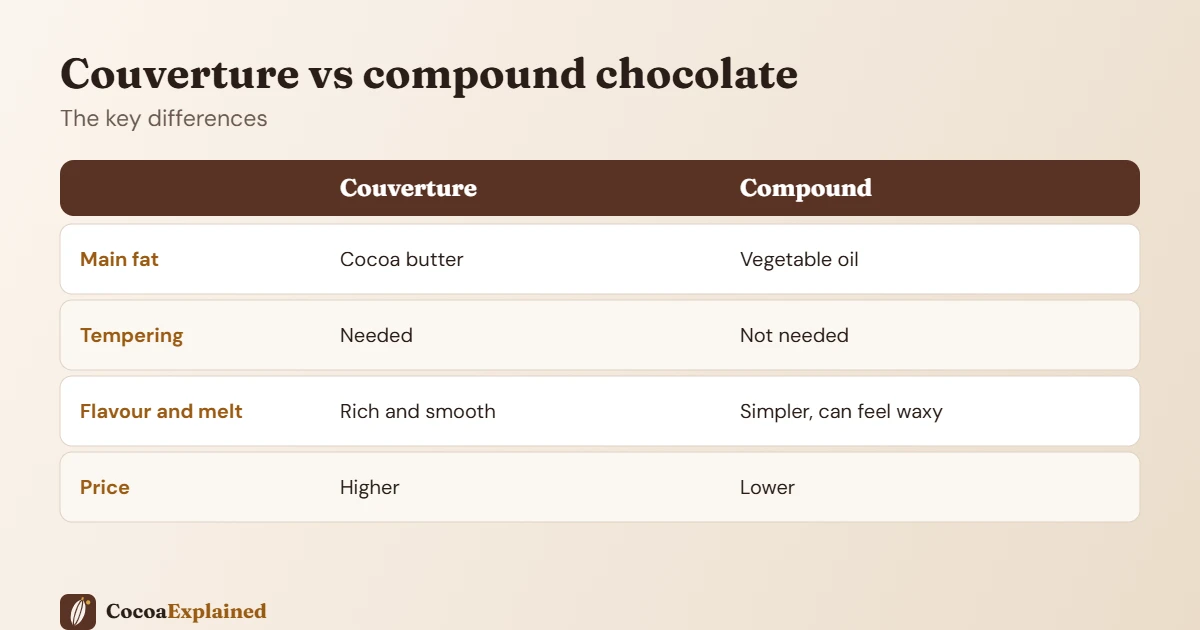
The difference comes down to one ingredient: the fat. Couverture is made with real cocoa butter, which gives it a high-quality flavour and mouthfeel but means it must be tempered. Compound chocolate swaps most or all of the cocoa butter for cheaper vegetable fat, which makes it easy to use but changes the taste and texture. This guide explains how to tell them apart, what each is best for, and which one to buy for the job in front of you. For the broader question of what counts as chocolate at all, see what chocolate is made of.
What couverture chocolate is
“Couverture” is a French word meaning “covering”. It is real chocolate that contains a higher proportion of cocoa butter than regular eating bars, which makes it very fluid when melted. That fluidity is the point: it flows into thin, even coats on truffles and moulded chocolates and sets with a crisp snap.
There is no single worldwide legal definition, but a commonly cited standard for couverture is a minimum total of around 35 per cent cocoa solids, with at least about 31 per cent of that as cocoa butter. Many professional couvertures go well beyond that. You will often see the cocoa percentage printed on the pack, along with fluidity ratings in professional ranges.
Because the cocoa butter has to set in its stable crystal form to look glossy and snap cleanly, couverture needs to be tempered when you use it for coating or moulding. We walk through the method in how to temper chocolate at home.
What compound chocolate is
Compound chocolate, sometimes called compound coating, baking coating or “chocolate-flavoured coating”, is made with cocoa powder or a reduced amount of cocoa solids and vegetable fats such as palm kernel oil, coconut oil or hydrogenated fats in place of cocoa butter. Sugar and milk solids are usually included as in ordinary chocolate, with flavouring added.
Because those fats do not form the delicate crystals that cocoa butter does, compound chocolate does not need tempering. You melt it, dip or pour it, and it sets firm and shiny on its own at room temperature. That convenience, along with a lower price, is why it is so popular with home bakers and for decorating.
The trade-off is flavour and texture. Vegetable fats melt at a different temperature to cocoa butter, which means compound chocolate does not melt as pleasantly in the mouth. It can feel waxy, a little greasy or flat, and the chocolate flavour is usually milder.
Couverture vs compound at a glance
| Couverture | Compound | |
|---|---|---|
| Main fat | Cocoa butter | Vegetable fats such as palm kernel or coconut oil |
| Needs tempering? | Yes, for a glossy snap | No |
| Flavour | Rich, complex chocolate flavour | Milder, sometimes flat or sweet |
| Mouthfeel | Melts smoothly in the mouth | Can feel waxy or greasy |
| Melted behaviour | Very fluid, thin coat | Thicker, sets quickly |
| Price | Higher | Lower |
| Can be called “chocolate”? | Yes | Often not; may be sold as “coating” |
How to tell which one you are holding
The ingredient list is the most reliable guide. Look at it before you look at the front of the pack.
- Couverture lists cocoa butter near the top, along with cocoa mass or cocoa solids and sugar. There is no added vegetable oil.
- Compound lists vegetable fat, palm kernel oil, coconut oil or hydrogenated fat, and often cocoa powder rather than cocoa mass.
- The name on the front can also give it away. Words like “coating”, “melts”, “candy wafers” or “chocolate-flavoured” often signal compound.
- The price is a clue. Real couverture is considerably more expensive per kilo.
In many countries, a product that replaces cocoa butter with other fats is not allowed to be sold simply as “chocolate”. The rules differ between regions, and some allow a small percentage of other vegetable fats in products still labelled chocolate, so always rely on the ingredient list.
What each one is best for
Couverture is better for
- Moulded chocolates and bars where you want gloss and snap.
- Dipping and enrobing fruit, truffles and sweets for a thin crisp shell.
- Ganache, mousse, chocolate sauces and desserts where flavour matters.
- Anything where you want the real chocolate taste to shine.
Compound is better for
- Quick dips and drizzles that need to set fast without tempering.
- Cake pops, cake drips, decorations and children’s baking projects.
- Large-scale decorating where cost matters.
- Warm kitchens where tempering is difficult.
If you are making something where people will taste the chocolate on its own, such as a bar, a filled chocolate or a truffle, couverture is worth the extra cost. If it is a coating that sits next to cake, sprinkles and icing, compound will usually do the job.

Can you mix or substitute them?
You can use compound chocolate in recipes that call for melted chocolate, such as ganache or brownies, but the result will taste less like chocolate and may set differently. You can also use couverture in place of compound for coating, but then you must temper it, or the coating will be dull and soft.
Do not mix the two in the same melt if you plan to temper it. The vegetable fats interfere with cocoa butter crystallisation and will make tempering unreliable.
Couverture by the numbers
Couverture is chocolate with a higher cocoa butter content than ordinary baking or eating chocolate, usually about 32 to 39 percent. The word is legally regulated in the EU but not in the US, so on a US pack it is a marketing term unless the maker explains it.
| Type | What the EU rules say (as summarised by Wikipedia) |
|---|---|
| Dark couverture | At least 35% total dry cocoa solids, including at least 31% cocoa butter and at least 2.5% dry non-fat cocoa solids |
| Milk couverture | At least 25% dry cocoa solids |
| Compound chocolate | Lower in cocoa solids and made with non-cocoa fats, so it is not couverture |

Which one should you use?
| Job | Better choice | Why |
|---|---|---|
| Dipping, coating and moulding with a glossy finish | Couverture, tempered | Tempering gives sheen, a firm snap and a creamy mouthfeel |
| Quick coating or drizzle with no tempering | Compound | Sets firmly without tempering, but tastes less rich |
| Baking brownies, cakes and cookies | Either | The flavour matters more than the finish, but real chocolate tastes better |
| Ganache, sauces and fillings | Couverture or good baking chocolate | Cocoa butter gives a smooth texture and real chocolate flavour |
Some couverture is sold pre-tempered and some is not, so check the pack before you start. If you need to temper, follow how to temper chocolate at home, and learn the basics of melting in how to melt chocolate.
Buying tips
- Read the ingredients first. It takes five seconds and tells you what you really have.
- Check the cocoa percentage on couverture, and choose a type that suits the recipe. See what the cocoa percentage means.
- Buy only what you need. Couverture comes in buttons or callets that are easy to weigh and melt, and they store well if kept cool and dry. See how to store chocolate.
- Do not confuse it with chips. Baking chips are made to keep their shape in the oven, which is a different goal. See chocolate chips vs baking chocolate.
The short version
Couverture is real chocolate rich in cocoa butter. It tastes better and sets with a snap, but you have to temper it. Compound uses vegetable fat instead, so it is cheaper and easier but less rich and a little waxy. Check the ingredient list, use couverture where flavour matters and compound where convenience matters, and you will get the right result without overspending.
Frequently asked questions
Is compound chocolate real chocolate?
Not in the strict sense. It replaces cocoa butter with vegetable fat, and in many countries it cannot be labelled simply as chocolate. It is often sold as coating or candy melts.
Can I use couverture without tempering?
Yes, for ganache, baking and sauces. Tempering is only needed when you want a glossy, snappy finished surface.
Is couverture always better than compound?
It tastes better and melts more smoothly, but compound is easier and cheaper for quick decorations. The better choice depends on the job.
How can I tell which one I have?
Read the ingredient list. Cocoa butter points to real chocolate. Vegetable fat or oil points to compound.
What does couverture mean?
It comes from the French word for covering. It describes chocolate made to coat other things, which is why it has extra cocoa butter.
Key points to remember
- Couverture is real chocolate with extra cocoa butter and needs tempering.
- Compound replaces cocoa butter with vegetable fat and needs no tempering.
- Check the ingredient list to tell them apart.
- Use couverture for shine and flavour, compound for quick, easy decoration.
Related guides
- How to Temper Chocolate at Home: Step-by-Step Guide
- What Does Cocoa Percentage Mean on Chocolate?
- Dark, Milk and White Chocolate: The Real Differences
- What Is Chocolate, Exactly?
- How to choose good chocolate
- Dubai-Style Chocolate: Which Brands Make It in 2026?
- Does Chocolate Expire? How Long It Really Lasts
- Start here: a beginner’s guide to chocolate
- Browse all chocolate guides
- Free cheat sheet: how to read any chocolate label
- Why Does Chocolate Seize? How to Fix It
Sources
- Baker’s Authority: Couverture vs compound chocolate
- Bake with Shivesh: Best baking chocolate, compound or couverture
- EUR-Lex: Directive 2000/36/EC on cocoa and chocolate products
- Couverture chocolate, Wikipedia.
Last updated: October 2026. This guide is educational and is not medical or nutrition advice. See our editorial policy for how we research and write.