Why Is Chocolate So Expensive Right Now?
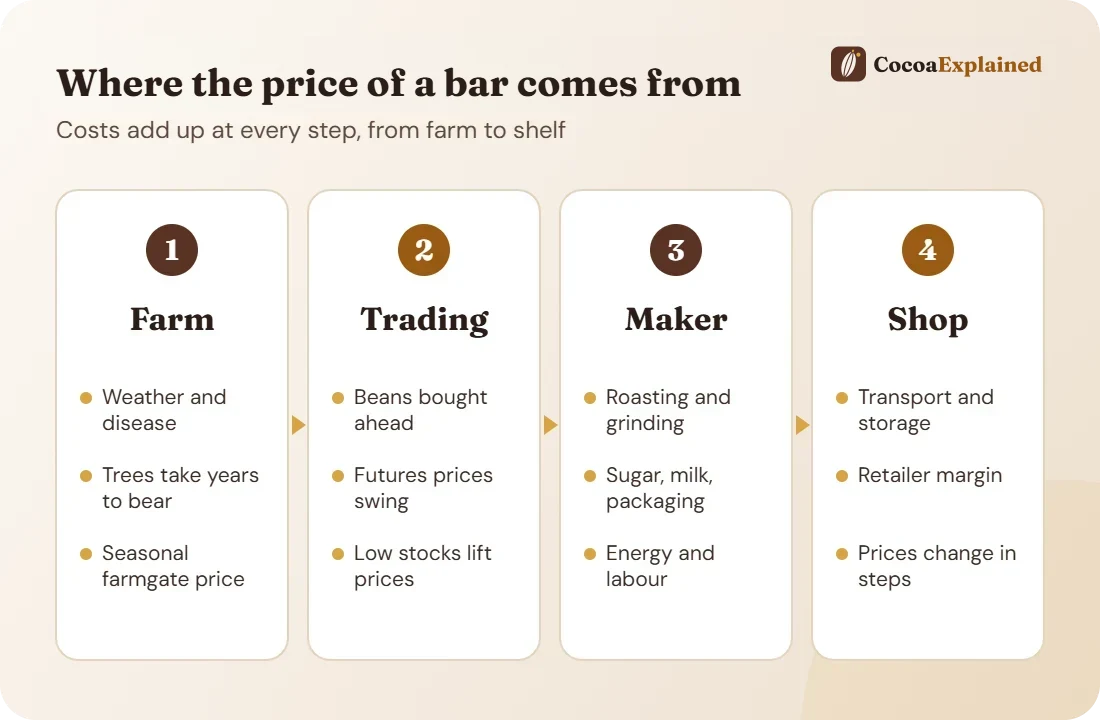
A bar of chocolate costs noticeably more than it did a few years ago, and the shelf price has not always fallen even when the news says cocoa has become cheaper. The reason is that the price on the label is the end of a long chain, and several links in that chain have moved at once. This guide walks through what actually goes into the price, why it moves slowly on the way down, and what you can do at the shelf.
The short answer
Cocoa beans became far more expensive after poor harvests in West Africa, where most of the world’s cocoa is grown. Makers pay more for beans, but they also pay more for sugar, milk, packaging, energy and transport, and they often buy ingredients months ahead. So retail prices rise quickly when costs jump and fall slowly when costs ease.
Where most of the world’s cocoa comes from
Ivory Coast and Ghana together grow well over half of the world’s cocoa, with Cameroon, Nigeria, Ecuador, Brazil and Indonesia adding smaller shares. That concentration is the root of the volatility: when weather or disease hurts the crop in one region, the whole market feels it. Cacao is also a tree crop, so a farmer cannot simply plant more and have a bigger harvest next season. New trees take several years to bear fruit.
If you want a refresher on the crop itself, our guide to cacao vs cocoa explains the names, and how cacao beans become chocolate shows the steps between pod and bar.
What pushed cocoa prices up
- Weather. Heavy rain, dry spells and hot conditions in West Africa reduced yields over several recent seasons.
- Plant disease and ageing trees. Swollen shoot virus and old orchards lower output per hectare.
- Low stocks. When warehouses hold little spare cocoa, any shortfall moves the price sharply.
- Market activity. Cocoa is traded on futures markets, so traders’ expectations can push prices up or down faster than the physical crop changes.
Cocoa futures reached record highs, above $12,000 per tonne, around the end of 2024, a multiple of what they cost a few years earlier. Prices have since swung widely. By July 2026, market analysts were reporting futures back above $5,000 per tonne after a sharp rebound from February lows, partly on fears that a strong El Niño could bring hotter, drier weather to West Africa. These are market prices that change daily, so treat any figure as a snapshot.
Cocoa prices over time: the numbers
The swings were huge, so a timeline helps. These figures come from World Bank and market data quoted by Food Dive and Confectionery News. Monthly averages smooth out the daily spikes, so futures prices briefly went higher than the monthly figures below.
| When | Approximate cocoa price per tonne | What was happening |
|---|---|---|
| January 2025 | About $10,750 (peak monthly average) | Extreme weather in major growing regions cut supply |
| January 2026 | About $4,970 | Prices falling as harvests recovered |
| 13 February 2026 | About $3,430 | Fell below $4,000 for the first time since November 2023 |
| March 2026 | About $3,240 (low) | Strong production rebound in Ivory Coast and Ghana |
| June 2026 | About $4,360 | Partial recovery, with El Niño still a risk |
Why did cocoa prices fall?
Two things changed. First, supply recovered. Ivory Coast and Ghana together produce about 60 percent of the world’s cocoa, and better weather there brought a strong production rebound. Second, demand weakened, with buyers holding back as prices were high. StoneX projected a global surplus of about 287,000 tonnes for 2025/26 and 267,000 tonnes for 2026/27.
The World Bank has warned that a stronger-than-expected El Niño could cause new price shocks, so the market is not yet stable.
Why you still pay high prices
| Reason | What it means for the price on the shelf |
|---|---|
| Inventory lag | Many makers bought cocoa at high prices during the crisis, and that stock is still moving through production. |
| Other costs | Packaging, transport, labour and energy are still above pre-pandemic levels. |
| Retailer caution | Retailers prefer steady shelf prices instead of changing them with every market move. |
| Wait and see | Many companies are waiting to see whether lower cocoa prices hold before changing prices or recipes. |
| Smaller packs | Some brands cut pack sizes during the crisis and are still deciding whether to bring the old sizes back. |

How big chocolate makers are responding
- Mondelez says it wants to become less reliant on cocoa. It is working on supply chain productivity, and in April 2026 it became the first major food company to make cell-cultured chocolate. It is also developing filled bars, such as nougat, caramel or nut fillings, that use less chocolate.
- Hershey has spread its cocoa buying across more regions so it depends less on any single one, and it has improved how it tracks factors such as weather, pod counts and fertiliser use.
- Across the industry food companies are reorganising supply chains and cutting costs to protect profits if prices rise again.
How to compare chocolate prices fairly
Pack sizes keep changing, so the sticker price alone can mislead. Always compare the price per 100 grams.
- Find the weight on the pack in grams.
- Divide the price by the weight.
- Multiply by 100 to get the price per 100 g.
| Example (illustrative prices) | Price | Weight | Price per 100 g |
|---|---|---|---|
| Bar A | 240 | 80 g | 300 |
| Bar B | 280 | 100 g | 280 |
In this example Bar B looks dearer but is actually cheaper per gram. Our guide on how to choose good chocolate explains what else to check, and what cocoa percentage means helps you compare bars fairly.
Why chocolate did not get cheaper when cocoa eased
- Hedging. Large makers buy cocoa months or even a year ahead at fixed prices, so a fall in the market takes time to reach their costs.
- Other costs. Sugar, dairy, packaging, labour, energy and shipping all contribute, and many of them have not fallen.
- Rebuilding margins. Companies that absorbed higher costs for a while may keep prices steady to recover profit.
- Price stickiness. Retailers and shoppers resist frequent changes, so prices tend to be adjusted in occasional steps.

How makers have responded
Industry reports describe three common reactions. Some reduce pack sizes, a practice often called shrinkflation. Some reformulate recipes to use less cocoa, for example more milk powder, nuts or fillers, which is worth watching on the label. Some cut orders and wait for prices to settle. Reports on 2026 grindings, the amount of cocoa processed by factories, showed weaker demand in Europe and North America, which is consistent with makers and shoppers pulling back.
Farmers do not automatically benefit from high market prices. In Ivory Coast and Ghana the government sets a farmgate price for the season, and Ghana reduced its farmgate price by nearly 30 percent for 2025/26 as market conditions changed. The gap between world prices and farmer income is one reason sustainability schemes exist.
Why quality chocolate costs more than the cheapest bars
Not all of the price difference is about cocoa markets. Bars made with cocoa butter, higher cocoa content, careful sourcing and small-batch processing cost more to make. Our guide to bean-to-bar chocolate explains why craft makers have higher costs, and couverture vs compound chocolate shows why two bars that look alike can differ in price.
How to spend less without buying worse chocolate
- Compare the price per 100 grams, not the price per bar, because pack sizes have changed.
- Read the ingredient list. If sugar or fillers come first and cocoa butter is replaced with other fats, you are paying for less chocolate. See how to choose good chocolate.
- For baking, plain baking bars or chips can be enough. Our guide to chocolate chips vs baking chocolate covers when to spend more.
- Buy larger blocks of couverture or baking chocolate and portion them, rather than many small premium bars.
- Store it well so nothing is wasted. See how to store chocolate and why chocolate turns white.
What to expect next
Nobody can reliably predict cocoa prices, because they depend on weather, disease, stocks and market sentiment. Some analysts argue that another broad retail price increase is less likely if the coming harvest is not badly damaged, while others point to risks from El Niño. If you want a rule of thumb, retail prices usually follow cocoa with a delay of several months, and they rarely return fully to old levels.
Frequently asked questions
Why is chocolate so expensive right now
Mainly because cocoa beans became much more expensive after poor harvests in West Africa, and because sugar, dairy, packaging, energy and transport also cost more. Makers also buy ahead, so price changes take months to reach the shelf.
Will chocolate prices go down
They can ease if cocoa harvests recover, but retail prices usually fall more slowly than cocoa prices and may not return to earlier levels. Nobody can predict this reliably.
Is shrinkflation happening with chocolate
Some brands have reduced pack sizes or changed recipes while keeping prices similar. Compare price per 100 grams and read the ingredient list to spot it.
Do cocoa farmers earn more when chocolate costs more
Not automatically. In the biggest producing countries the farmgate price is set by the government each season, so farmers do not receive the full movement in world prices.
What is the cheapest way to buy good chocolate
Compare the price per 100 grams, choose bars with cocoa butter and a short ingredient list, and buy baking chocolate in larger blocks for recipes.
Will chocolate get cheaper?
Cocoa prices have fallen a lot, and forecasts point to a surplus, which could ease costs for makers. But shop prices tend to lag, other costs are still high, and a new weather shock could push cocoa up again, so nobody can promise cheaper chocolate.
What is shrinkflation in chocolate?
It means the price stays the same or rises while the pack gets smaller. Some chocolate brands cut pack sizes during the cocoa price spike and are still deciding whether to restore them.
Key points to remember
- Cocoa prices rose sharply after poor harvests in West Africa, where most of the world’s cocoa is grown.
- Chocolate did not get cheaper when cocoa fell, because makers buy months ahead at fixed prices and other costs such as sugar, dairy, packaging, labour, energy and shipping also count.
- Some makers have cut pack sizes or changed recipes to use less cocoa.
- Farmers do not automatically benefit from high market prices, because governments in Ivory Coast and Ghana set the farmgate price.
- Bars with cocoa butter, higher cocoa content and careful sourcing cost more to make.
Related guides
- How to Choose Good Chocolate: What to Check Before You Buy
- What Is Actually in a Feastables Bar? Ingredients Decoded
- Dark, Milk and White Chocolate: The Real Differences
- Dubai-Style Chocolate: Which Brands Make It in 2026?
- Start here: a beginner’s guide to chocolate
- Browse all chocolate guides
- What Is Cocoa-Free Chocolate?
Sources
- XTB market analysis: cocoa prices are rising again (1 July 2026)
- International Cocoa Organization
- World Cocoa Foundation
- How chocolate makers are defending themselves against cocoa price swings, Food Dive.
- Cocoa prices collapse following record highs, Confectionery News, 13 February 2026.
- Cocoa prices fall in 2026, yet shoppers still face higher costs, Chocolate Affairs Magazine.
Prices and market figures are a snapshot and change often. Last updated: October 2026. This article is educational and is not financial advice.