Does Dark Chocolate Have Caffeine? How Much vs Coffee
You
About 22.7 mg of caffeine per ounce in 70 to 85 percent dark chocolate means you would need roughly 5 to 11 ounces to match a 12 oz brewed coffee. A single espresso shot is closer to about 2.8 ounces of dark chocolate. A small piece contains far less caffeine than coffee, but people react differently. If you are sensitive to caffeine, choose a lower cocoa percentage, a small portion or white chocolate in the evening.How many squares of dark chocolate equal a cup of coffee?
Is it okay to eat dark chocolate at night?
This guide gives you realistic numbers for different kinds of chocolate and for coffee, tea and cola, explains the second stimulant in chocolate that people rarely hear about, and covers who should be careful, including pet owners. It builds on our guides to the cocoa percentage and cacao vs cocoa.
Where the caffeine in chocolate comes from
Caffeine occurs naturally in the cacao bean. When beans are processed into chocolate, it ends up in the cocoa solids, the dark non-fat part. It is not in the cocoa butter. That has a simple consequence: the more cocoa solids a chocolate contains, the more caffeine it tends to have.
So a bar labelled 85 per cent cocoa carries more caffeine than a 50 per cent bar of the same size, milk chocolate carries less again, and white chocolate, which has no cocoa solids, has almost none. Beans vary by variety, origin and harvest, so figures are always approximate.
How much caffeine is in chocolate?
These are rough averages for typical servings. Different brands will vary, so treat them as ballpark figures:
| Item | Approximate caffeine |
|---|---|
| Brewed coffee, one cup (about 240 ml) | About 80 to 100 mg |
| Black tea, one cup | About 25 to 50 mg |
| Cola, one can (about 330 ml) | About 30 to 40 mg |
| Dark chocolate (70 to 85%), 30 g | About 15 to 30 mg |
| Milk chocolate, 30 g | About 3 to 8 mg |
| White chocolate | Little or none |
| Hot chocolate made with cocoa powder, one mug | About 5 to 15 mg |
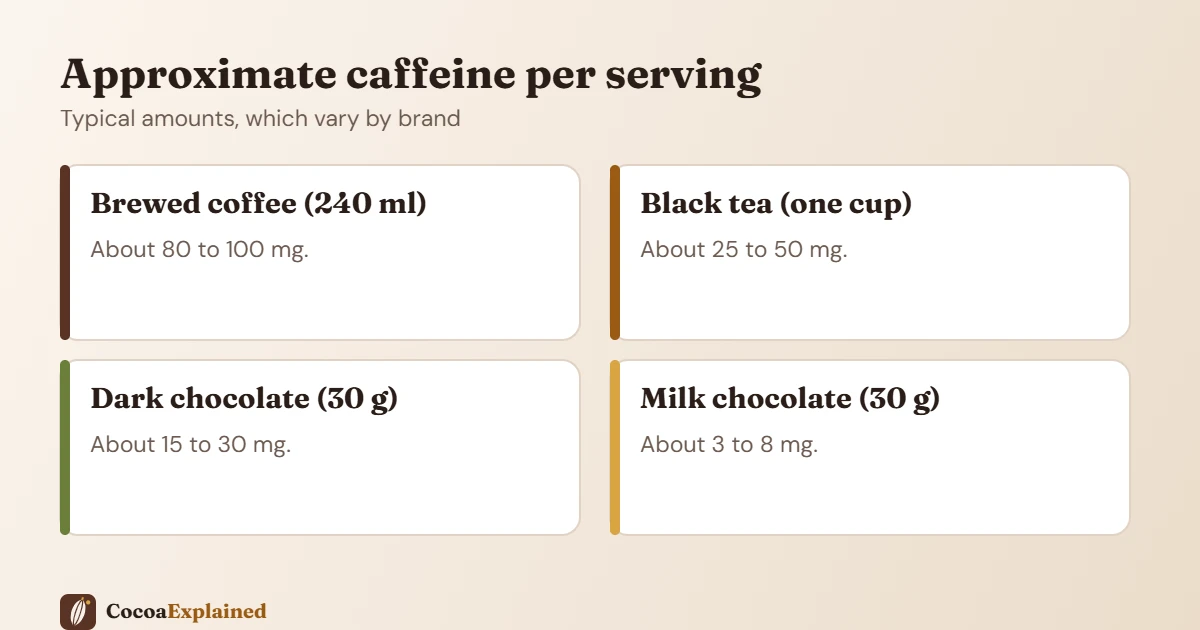
In other words, you would need to eat the equivalent of several average dark chocolate bars to match one cup of strong coffee. For most healthy adults, chocolate is a minor source of caffeine. Data on foods can be found in the USDA’s FoodData Central database if you want to look up specific products.
What is theobromine?
Dark chocolate contains a second stimulant, theobromine, which is chemically related to caffeine and is actually present in much larger amounts. Theobromine gives a gentler, longer-lasting lift than caffeine. It can mildly widen blood vessels and act as a mild diuretic, and it is usually described as less jittery than caffeine.
Because it comes from cocoa solids too, dark chocolate and cocoa powder contain far more of it than milk chocolate, and white chocolate has almost none. If you notice that you feel slightly wired after a lot of dark chocolate but do not get the sharp spike of coffee, theobromine is probably part of the reason. We touch on how white chocolate lacks both in is white chocolate real chocolate?.
Caffeine in chocolate compared with coffee
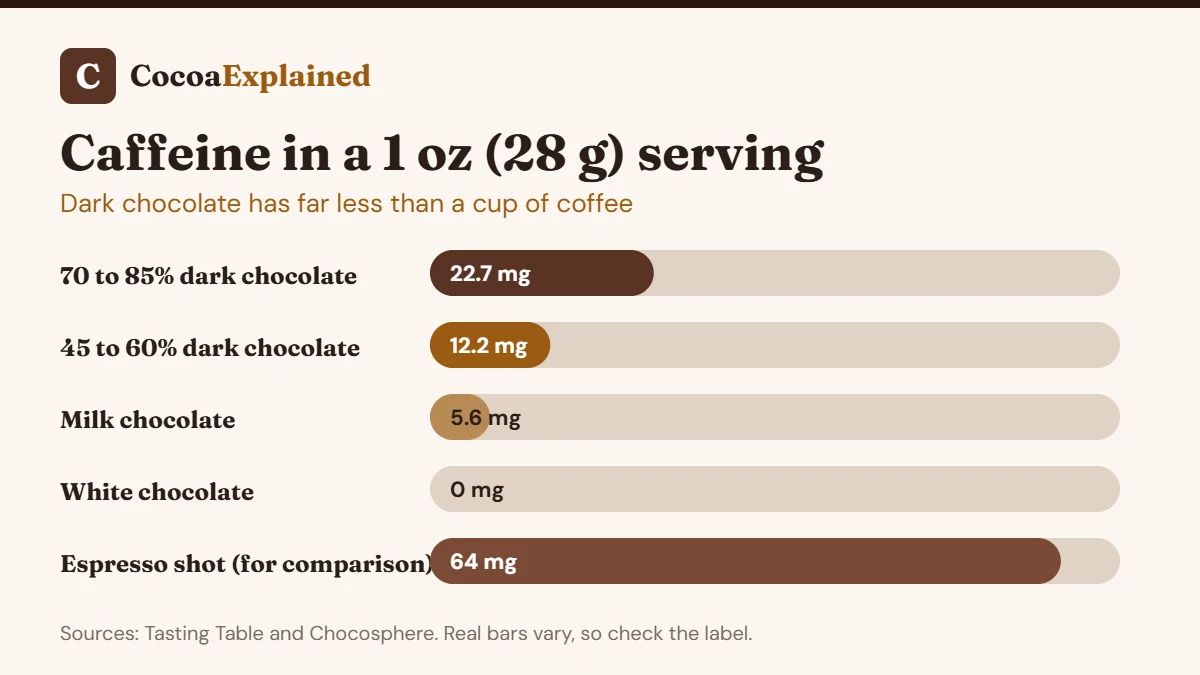
The easiest way to see where chocolate sits is to compare servings of the same size. These are typical figures for a 1 ounce (28 g) piece.
| Chocolate | Caffeine per 1 oz (28 g) |
|---|---|
| Dark chocolate, 70 to 85% cocoa | About 22.7 mg |
| Dark chocolate, 45 to 60% cocoa | About 12.2 mg |
| Milk chocolate | About 5.6 mg |
| White chocolate | 0 mg, because it contains no cocoa solids |
| Hot chocolate | About 5 mg a serving, up to about 25 mg in richer versions |
How much chocolate equals one cup of coffee?
A lot. Using about 22.7 mg per ounce for 70 to 85 percent dark chocolate, you would need to eat well over a bar to match a coffee.
| Drink | Caffeine | Dark chocolate (70 to 85%) needed to match |
|---|---|---|
| Espresso shot | About 64 mg | About 2.8 oz (80 g) |
| Brewed coffee, 12 oz | About 113 to 247 mg | About 5 to 11 oz (140 to 310 g) |
These numbers are calculated from the figures above, so they are estimates. The FDA has said 400 mg of caffeine a day, about two to three 12 oz cups of coffee, is not generally linked to serious side effects for most healthy adults. Pregnant or breastfeeding women and people with some health conditions may need to eat or drink less, so ask a doctor if that applies to you.
When to eat chocolate if you are sensitive to caffeine
- Have dark chocolate earlier in the day rather than just before bed.
- White chocolate has no caffeine, so it is the easiest evening choice.
- Milk chocolate and hot chocolate have small amounts, usually well below a cup of coffee.
- Remember that caffeine from chocolate adds up with tea, cola and coffee through the day.
How much caffeine is too much?
The US Food and Drug Administration says that up to about 400 mg of caffeine a day is not generally associated with negative effects for most healthy adults. That is roughly four or five cups of coffee. Sensitivity differs enormously between people, depending on body weight, genetics, habits and medications. Some people feel jittery after one cup; others can drink several without noticing.
Authorities typically recommend lower limits in certain situations, for example during pregnancy, where many guidelines suggest keeping caffeine to around 200 mg a day or less. If that applies to you, your doctor or midwife can give personalised advice.
Who should be careful with chocolate?
- People sensitive to caffeine, or who have trouble sleeping. Caffeine can stay in your system for hours, so a dark chocolate dessert late in the evening may affect some people.
- Children. They are more sensitive and have lower limits, so keep portions small and avoid giving dark chocolate close to bedtime.
- People who are pregnant or breastfeeding, or who have been advised to limit caffeine. Count chocolate along with coffee, tea and cola.
- People with conditions such as heart rhythm problems, anxiety or reflux may be advised by a doctor to limit caffeine and chocolate. Ask your healthcare provider what is right for you.
- Anyone taking medication that interacts with caffeine.
This guide is general information and not medical advice.

A serious warning for pet owners
Chocolate is dangerous for dogs and cats because they cannot process theobromine and caffeine the way we do. The risk depends on the animal’s size and the type of chocolate: dark chocolate, baking chocolate and cocoa powder are the most dangerous because they contain the most theobromine, while milk chocolate is less concentrated and white chocolate far less.
Signs of chocolate poisoning in dogs can include vomiting, diarrhoea, restlessness, rapid breathing, increased heartbeat, tremors and, in serious cases, seizures. If your pet has eaten chocolate, contact a veterinarian or an animal poison helpline immediately. Do not wait for symptoms to appear, and tell them the type and amount of chocolate and the size of your pet.
Practical tips for managing your intake
- If you are sensitive, eat chocolate earlier in the day and choose lower-percentage or milk chocolate in the evening.
- If you want chocolate without the stimulant effect, white chocolate or carob-based products contain very little or none.
- Keep a rough tally. A small piece of chocolate plus a coffee and a cola can still add up.
- Remember that chocolate drinks, desserts and baking cocoa count too. Hot chocolate made with cocoa powder is a small source of caffeine; a rich dark chocolate mousse is a larger one.
- Read labels on products that add caffeine, such as energy bars or some chocolate-coated coffee beans, which are very different from plain chocolate.
The short version
Dark chocolate has caffeine, but typically about 15 to 30 mg in a 30 g serving, much less than a cup of coffee. Higher cocoa percentages contain more, milk chocolate contains less and white chocolate almost none. Dark chocolate also contains theobromine, a milder stimulant. Most healthy adults can enjoy chocolate comfortably within the FDA’s 400 mg daily guide, but people who are sensitive, pregnant or caring for children should be more careful, and chocolate must always be kept away from pets.
Frequently asked questions
Does white chocolate have caffeine?
Very little or none, because caffeine and theobromine come mainly from cocoa solids, which white chocolate does not contain.
Will dark chocolate keep me awake?
It can for people who are sensitive to caffeine or eat it close to bedtime. The amount in a few squares is small, but sensitivity varies.
Does 85% chocolate have more caffeine than 70%?
Generally yes. A higher cocoa share usually means more caffeine and theobromine, although amounts vary by bean and brand.
Is dark chocolate safe for children?
In small amounts it is usually fine, but children are more sensitive to caffeine. Keep portions small and avoid it close to bedtime.
How much caffeine is too much?
The US FDA says up to 400 mg a day is not generally associated with negative effects for most healthy adults. Needs differ, so ask a healthcare provider if you are unsure.
Can dogs eat chocolate?
No. Theobromine is toxic to dogs. Dark chocolate and baking chocolate are the most dangerous. Contact a vet quickly if a pet eats some.
Key points to remember
- Dark chocolate contains a small amount of caffeine, much less than coffee.
- Caffeine and theobromine come from cocoa solids.
- Higher cocoa percentage usually means more; white chocolate has little or none.
- The FDA cites up to 400 mg a day as generally safe for most healthy adults.
- Chocolate is toxic to pets.
Related guides
- What Does Cocoa Percentage Mean on Chocolate?
- Cacao vs Cocoa: What Is the Difference?
- Is White Chocolate Real Chocolate? What the Rules Say
- Dark, Milk and White Chocolate: The Real Differences
- Is Dark Chocolate Actually Healthy?
- Hot Chocolate vs Hot Cocoa: What Is the Difference?
- Start here: a beginner’s guide to chocolate
- Browse all chocolate guides
- Can Dogs Eat Chocolate?
Sources
- U.S. FDA: Spilling the beans, how much caffeine is too much?
- USDA FoodData Central
- Wikipedia: Theobromine
- Just how much caffeine is in dark chocolate vs a cup of coffee?, Tasting Table.
- How much caffeine is in dark, milk, and white chocolate?, Chocosphere.
Last updated: October 2026. This guide is educational and is not medical or nutrition advice. See our editorial policy for how we research and write.