Natural vs Dutch-Process Cocoa Powder: Which to Use?
You are halfway through a brownie recipe, you reach for the cocoa, and the recipe says “natural unsweetened cocoa”. The tin in your cupboard says “Dutch-process”. Is it going to matter? Sometimes it will, sometimes it will not, and knowing which is the difference between a tray of fudgy brownies and a flat, oddly metallic one.
Natural cocoa powder and Dutch-process cocoa powder both come from the same roasted, pressed cocoa solids. What separates them is one extra step: Dutch-process cocoa is treated with an alkali, and that step changes the colour, the flavour and, importantly, how the powder behaves with leavening agents like baking soda. Here is how each one works and how to choose without guessing. If you want the wider background on the cocoa-versus-cacao naming first, see cacao vs cocoa.
What natural cocoa powder is
Natural cocoa is the straightforward version. Cocoa beans are fermented, dried and roasted, then ground into a paste. Most of the cocoa butter is pressed out, and the remaining cake is milled into a fine powder. Nothing else is done to it.
Because nothing has been done to neutralise the bean’s own acidity, natural cocoa is acidic, usually measuring somewhere around pH 5 to 6. It is lighter in colour, a reddish-tan brown rather than a deep dark brown, and the flavour is sharp, fruity and bright, sometimes a little bitter. If you taste a pinch on its own it can make you wince.
What Dutch-process cocoa is
Dutch-process cocoa, also called alkalized cocoa, gets an extra step. The cocoa is washed or treated with a mild alkaline solution, commonly potassium carbonate, which raises its pH towards neutral, often around 7 to 8. The process is named after the Dutch chemist Coenraad van Houten, whose family firm patented a method of pressing cocoa and treating it with alkali in the early 1800s.
The effect is easy to see and taste. The powder turns darker, sometimes nearly black, and the flavour becomes smooth and mellow with less of that sharp, fruity edge. It also mixes into liquids more easily, which is why it is a favourite for hot chocolate and smooth ice cream. The trade-off is that some of the bean’s more complex flavour notes, and some of its natural plant compounds, are reduced by the treatment.
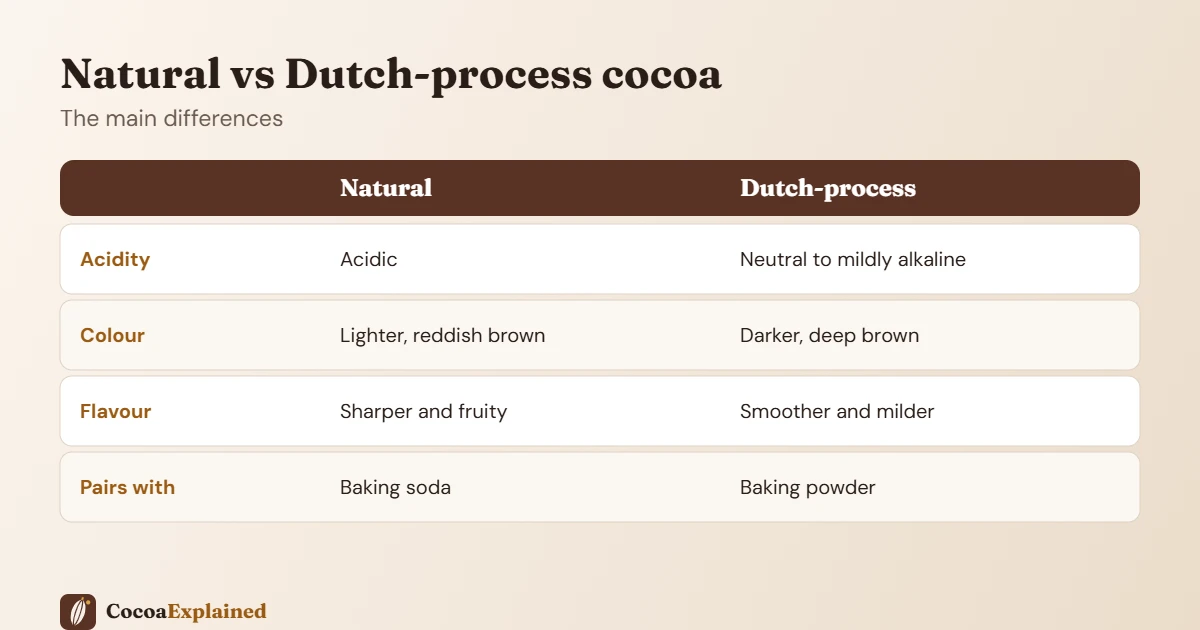
| Natural cocoa | Dutch-process cocoa | |
|---|---|---|
| Treatment | None | Treated with alkali |
| Acidity | Acidic (about pH 5 to 6) | Neutral to slightly alkaline (about pH 7 to 8) |
| Colour | Lighter, reddish brown | Darker, from deep brown to near black |
| Flavour | Sharp, fruity, more bitter | Smooth, mellow, rounder |
| Reacts with baking soda | Yes | No |
| Good for | Brownies, cakes using baking soda, rustic bakes | Hot chocolate, ice cream, dark cakes, frostings |
Why it matters in baking: the leavening problem
This is the part that actually trips people up. Baking soda (sodium bicarbonate) needs an acid to react with in order to release the gas that makes a cake rise. Natural cocoa is that acid. So many classic recipes, especially older ones, rely on the cocoa to activate the baking soda.
Dutch-process cocoa is neutral, so it does not set off that reaction. If you swap it into a recipe that depends on the acidity of natural cocoa and baking soda, the batter may rise less and the crumb can turn out dense. Recipes written for Dutch-process cocoa usually lean on baking powder instead, because baking powder already contains its own acid and does not need the cocoa’s help.
That is why a recipe that lists both baking soda and baking powder is a tell. The soda is balancing some acidity in the mix, such as buttermilk, yogurt or natural cocoa, and the powder gives additional lift.
Can you substitute one for the other?
Often you can, with a little care.
- In a recipe with baking powder only, you can usually swap cocoa types without any change to the leavening, though the colour and flavour will differ.
- In a recipe with baking soda and an obvious acid (buttermilk, yogurt, lemon juice, brown sugar in quantity), natural cocoa is the safer choice.
- If you only have Dutch-process cocoa and the recipe wants natural, replacing part of the baking soda with baking powder is a common fix, although you may need to experiment.
- If you only have natural cocoa and the recipe wants Dutch-process, the cake will likely rise fine, but expect a lighter colour and a sharper flavour.
When a recipe simply says “cocoa powder” without saying which, it is a good sign that it does not depend heavily on acidity, so either should work. When in doubt, look at the leavening agents and the other ingredients, as above.
Which one tastes better?
Neither is better in absolute terms. They are different tools.
Natural cocoa gives a more assertive, chocolatey punch with a fruity brightness that shines in brownies and rich, moist cakes. Dutch-process cocoa gives a darker, smoother, more rounded cocoa flavour that people often describe as classic “chocolate cookie” taste. Many bakers keep both in the cupboard for exactly that reason.
If you are drinking it, Dutch-process is usually the more pleasant option because the lower acidity and fine texture make it dissolve and taste smoother. If you want maximum flavour complexity in a bake and the recipe calls for it, natural is worth reaching for.
How to tell which one you have
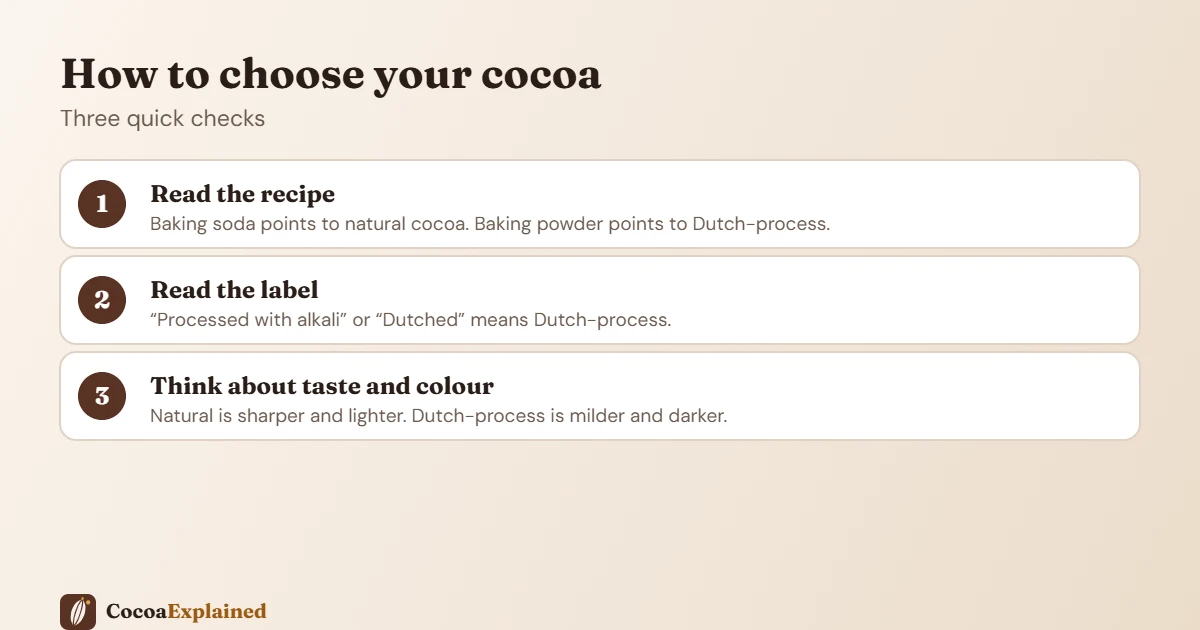
- Check the ingredient list. Dutch-process cocoa should say “processed with alkali”, “alkalized” or “Dutch-processed”. Natural cocoa usually lists only cocoa.
- Look at the colour. If it is very dark, almost black, it is probably alkalized. A lighter reddish brown suggests natural.
- Do a quick pinch test. Stir a little into warm water. Natural cocoa gives a lighter, redder liquid, while Dutch-process looks darker and more brown.
- Taste a tiny amount. Natural cocoa tastes sharper and more tart; Dutch-process tastes smoother.
If the pack says nothing at all, assume it is natural. Alkalizing has to be disclosed in the ingredients in most markets, because it is a processing step.
A quick note on “black cocoa” and fat content
You may also meet “black cocoa”, which is very heavily alkalized and gives the near-black colour you see in sandwich cookies. It has a strong, slightly bitter flavour and is often used in small amounts alongside regular cocoa. You may also see cocoa described by fat content. Standard cocoa powder is often around 10 to 12 per cent cocoa butter, while some premium or “high-fat” powders contain noticeably more, which gives a richer, creamier result. If a recipe specifies a fat percentage, follow it.
The practical takeaway
Use natural cocoa when the recipe relies on baking soda and acid, or when you want a sharper, fruitier chocolate flavour. Use Dutch-process cocoa for hot chocolate, ice cream and recipes written around baking powder. If you are not sure, read the leavening agents in the recipe, and keep a small tin of each if you bake regularly. For more on cocoa and how it is made from the bean, see how cacao beans become a chocolate bar.
Frequently asked questions
Can I substitute Dutch-process cocoa for natural cocoa?
Sometimes. In recipes that use baking powder it usually works. In recipes that rely on baking soda reacting with natural cocoa, the swap can reduce rise, so adjust the leavening or keep to the type the recipe names.
Which cocoa is better for brownies?
Both work. Natural cocoa gives a sharper, more traditional chocolate flavour, while Dutch-process gives a darker, smoother brownie. Follow the recipe’s leavening.
How do I know which cocoa I have?
Read the ingredients. “Processed with alkali” means Dutch-process. If there is no mention of alkali, it is usually natural cocoa.
Is Dutch-process cocoa healthier?
Alkalising is known to reduce the level of some natural compounds called flavanols. Cocoa powder in baking is not a health food either way, so choose on flavour and how the recipe works.
Why is it called Dutch-process?
It is named after the Netherlands and the Dutch chemist Coenraad van Houten, who developed the alkali treatment in the early 1800s.
Key points to remember
- Natural cocoa is acidic and sharper; Dutch-process cocoa is neutral and milder.
- Natural cocoa reacts with baking soda; Dutch-process cocoa usually pairs with baking powder.
- Check the label for “processed with alkali” to spot Dutch-process cocoa.
- When a recipe just says cocoa powder, either usually works.
- Match the cocoa to the recipe’s leavening for the best rise.
Related guides
- Cacao vs Cocoa: What Is the Difference?
- How Cacao Beans Become a Chocolate Bar
- What Does Cocoa Percentage Mean on Chocolate?
- What Is Chocolate, Exactly?
- Hot Chocolate vs Hot Cocoa: What Is the Difference?
- Start here: a beginner’s guide to chocolate
- Browse all chocolate guides
Sources
- Iowa State University Extension: Natural vs Dutch-processed cocoa
- Sally’s Baking Addiction: Dutch-process vs natural cocoa powder
- Sugar Spun Run: Natural vs Dutch-process cocoa
- Tasting Table: Are Dutch-process and natural cocoa powder the same?
Last updated: October 2026. This guide is educational and is not medical or nutrition advice. See our editorial policy for how we research and write.