What Is Milk Chocolate Made Of?
Milk chocolate is the bar most people grew up with, so it is a little odd that so few of us could say what is actually in it. The label lists a handful of ingredients, the front of the pack shows a cocoa percentage, and the taste is sweet, creamy and familiar. But what is the recipe, and what do the rules say a bar has to contain before it can be called milk chocolate?
Short answer: milk chocolate is made from cocoa mass (ground cocoa beans), cocoa butter, sugar and milk, usually dried milk powder, often with an emulsifier such as lecithin and a little flavouring such as vanilla. The legal minimums differ by country, but the idea is the same everywhere: cocoa gives the chocolate flavour, milk makes it creamy, and sugar makes it sweet. This guide goes through each ingredient, what the rules require, and how to read a milk chocolate label.
The basic recipe in plain words
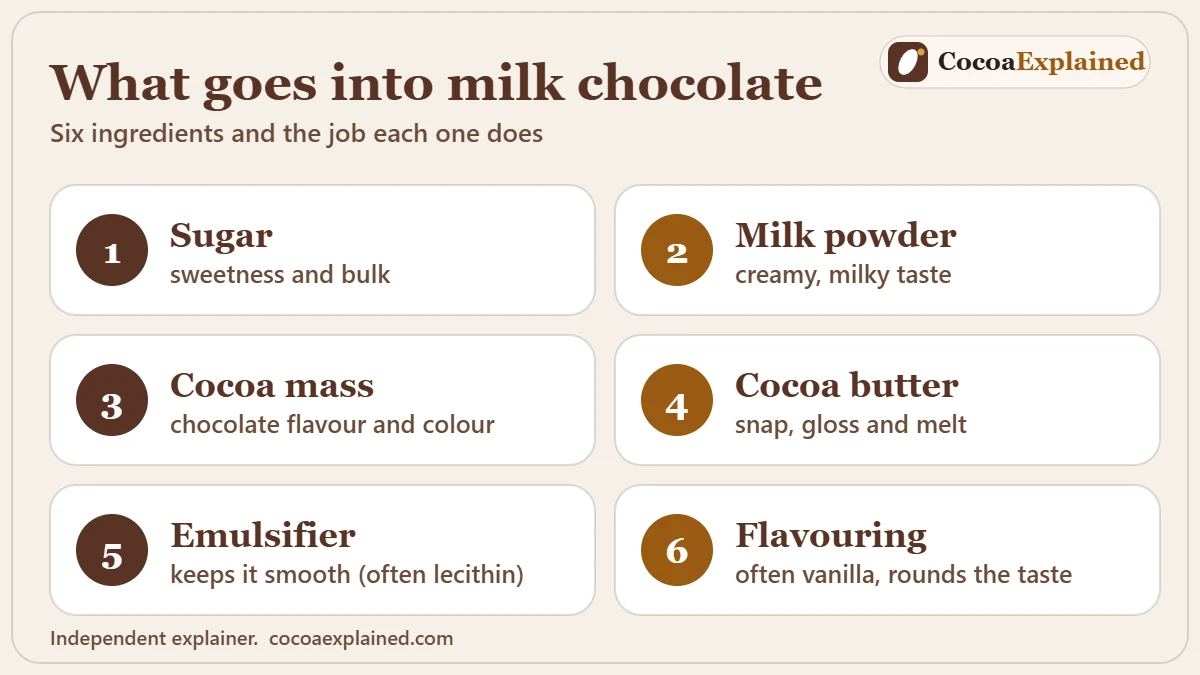
A typical milk chocolate bar has six main ingredients. Ingredients on the label are listed by weight, heaviest first, which is the quickest way to see what a bar is mostly made of.
| Ingredient | What it is | What it does |
|---|---|---|
| Sugar | Sweetener | Sweetness and bulk. In most milk chocolate it is one of the largest ingredients by weight |
| Milk (powder or similar) | Dried milk solids | Creamy, milky flavour and a softer, rounder taste than dark chocolate |
| Cocoa mass | Ground cocoa beans, also called chocolate liquor | The core chocolate flavour and colour |
| Cocoa butter | The natural fat of the cocoa bean | Snap, gloss and the clean melt in the mouth |
| Emulsifier (often lecithin) | A helper that blends fat and solids | Helps the chocolate flow smoothly and stay blended |
| Flavouring (often vanilla) | A small flavour addition | Rounds off the taste |
If cocoa mass and cocoa butter are new terms, our guides to cocoa butter and what cocoa percentage means explain where each comes from. For the full path from pod to bar, see how cacao beans become chocolate.
Where the milk comes from
Most milk chocolate uses powdered milk, also called dried milk solids, rather than liquid milk. Water would ruin chocolate, which is a fat-based mixture, so the milk has to be dry. In the US, milk chocolate must contain at least 12 percent milk solids by weight, and there is no upper limit, so brands can add more for a creamier, milder bar.
Some makers use other dried dairy forms or a pre-made milk, sugar and cocoa mix. The label tells you which: look for words like milk powder, whole milk powder, skimmed milk powder or milk solids. Because milk is a main ingredient, milk chocolate is not vegan, and anyone with a milk allergy must read the allergen line on the pack.
What the rules say milk chocolate must contain
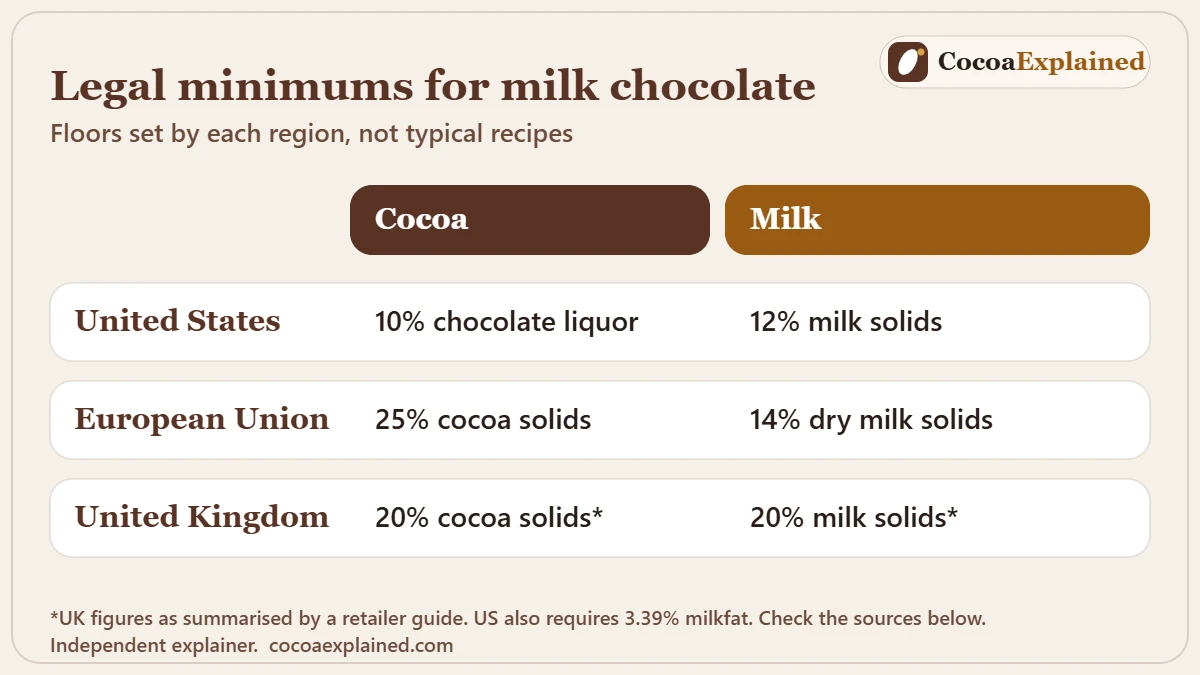
Countries set minimum amounts so that a product called milk chocolate really is one. The numbers below are minimums, not typical recipes, and many bars contain more than the minimum.
| Region | Cocoa requirement | Milk requirement |
|---|---|---|
| United States | At least 10 percent chocolate liquor | At least 12 percent milk solids and at least 3.39 percent milkfat |
| European Union | At least 25 percent total cocoa solids | At least 14 percent dry milk solids |
| United Kingdom | At least 20 percent cocoa solids, as summarised by a retailer guide | At least 20 percent milk solids, as summarised by a retailer guide |
Rules are updated from time to time, so treat this table as a guide and check the source for your country. Two things stand out. First, the cocoa minimum is low compared with dark chocolate, which is why milk chocolate tastes so much milder. Second, the rules set a floor for cocoa and milk but do not cap sugar, which is why comparing sugar per 100 grams between bars is so useful.
One more detail from the EU rules: milk chocolate there may contain up to 5 percent vegetable fats other than cocoa butter, but the label must say so clearly. That is why it is worth reading the ingredient list for palm oil or other fats. Our cocoa butter guide explains how to spot a bar that is not made only with cocoa butter.
How milk chocolate differs from dark and white
The difference is mostly in what is left out or added. Dark chocolate has no milk solids in a standard recipe and a higher share of cocoa. White chocolate has cocoa butter and milk but no cocoa solids at all. Milk chocolate sits in the middle: it has cocoa solids for flavour, and milk and sugar to soften them. For a side-by-side view, read dark, milk and white chocolate compared, and for the white chocolate question see is white chocolate real chocolate.
Reading a milk chocolate label
- Read the first ingredient. If it is sugar, the bar is mostly sugar by weight, which is common in milk chocolate.
- Find the cocoa ingredients: cocoa mass, chocolate liquor or cocoa butter. A short, recognisable list usually means a simpler recipe.
- Check the fats. Cocoa butter is the classic fat. Palm oil, shea or other vegetable fat means the fat is not only cocoa butter.
- Look at the cocoa percentage if the pack shows one. It tells you how much of the bar comes from cocoa beans, including cocoa butter.
- Note the emulsifier and the allergen line. Lecithin is common, and it may be made from soy or sunflower.
- Compare sugar per 100 grams, not per bar, because bar sizes differ.
If you want a worked example, our Feastables ingredients guide goes through one popular milk chocolate label ingredient by ingredient. And if you are comparing brands in a shop, how to choose good chocolate shows what to look for beyond the front of the pack.
Common mistakes
- Thinking the percentage tells you everything. A cocoa percentage does not show how much sugar or milk is in the bar.
- Assuming all milk chocolate is the same. Recipes differ by brand and by country, so two bars with the same name on the front can taste very different.
- Confusing milk chocolate with a milk chocolate flavoured coating. Compound coatings may replace cocoa butter with other fats. See couverture vs compound chocolate.
- Ignoring the allergen line. Milk is always present, and soy or nuts may be too.
- Judging price alone. The reasons chocolate costs what it does are covered in why chocolate is so expensive.
A note on health
Milk chocolate is a treat made of sugar, fat, milk and cocoa. Its nutrition depends on the recipe and the portion. We do not make health claims here. If you have a health condition, an allergy or a dietary restriction, check the label and speak with a qualified professional. This is general information, not medical advice.
Curious about a brand people argue over? Read why Hershey’s chocolate tastes sour to some people.
Frequently asked questions
What is milk chocolate made of?
Milk chocolate is made from cocoa mass, cocoa butter, sugar and milk, usually as dried milk powder. Many bars also contain an emulsifier such as lecithin and a small amount of flavouring such as vanilla.
How much cocoa is in milk chocolate?
It depends on the country and the brand. The US requires at least 10 percent chocolate liquor, the EU at least 25 percent total cocoa solids, and the UK at least 20 percent cocoa solids as summarised by a retailer guide. Many bars contain more than the minimum, and the pack may show a percentage.
How much milk is in milk chocolate?
The US requires at least 12 percent milk solids by weight, and the EU at least 14 percent dry milk solids. Most milk chocolate uses dried milk rather than liquid milk.
Is milk chocolate real chocolate?
Yes. Milk chocolate contains cocoa mass and cocoa butter, and it is a recognised category with legal standards. It simply contains less cocoa and more milk and sugar than dark chocolate.
Is milk chocolate vegan?
No. Milk is a main ingredient, so standard milk chocolate is not vegan. Some brands make dairy-free chocolate bars that use plant-based milk alternatives, which are a different product.
Why is sugar the first ingredient in many milk chocolate bars?
Ingredients are listed by weight, heaviest first, and sugar is often the largest single ingredient in milk chocolate. The rules set minimums for cocoa and milk but do not cap sugar, so it is useful to compare sugar per 100 grams between bars.
Key points to remember
- Milk chocolate is made from cocoa mass, cocoa butter, sugar and dried milk, usually with an emulsifier and a little flavouring.
- Minimums differ by region: for example 10 percent chocolate liquor and 12 percent milk solids in the US, and 25 percent cocoa solids and 14 percent dry milk solids in the EU.
- The rules set minimums for cocoa and milk but do not limit sugar, so compare sugar per 100 grams.
- Check the label for the fat type and the allergen line.
- Milk chocolate is not vegan because milk is a main ingredient.
Related guides
- Dark, Milk and White Chocolate: The Real Differences
- What Does Cocoa Percentage Mean on Chocolate?
- Why Does Hershey’s Chocolate Taste Sour? Explained
- Is White Chocolate Real Chocolate? What the Rules Say
- Is Dark Chocolate Actually Healthy?
- Start here: a beginner’s guide to chocolate
- Browse all chocolate guides
- Free cheat sheet: how to read any chocolate label
- What Is Ruby Chocolate? The Pink Chocolate Explained
Sources
- 21 CFR 163.130, Milk chocolate, US Code of Federal Regulations, Cornell Legal Information Institute.
- What is the legal definition of chocolate (European Union)?, Cocoa Supply, summary of Directive 2000/36/EC.
- How Much Milk Is In Milk Chocolate?, Tasting Table.
- How Much Cocoa Is in Milk Chocolate?, Hill Country Chocolate, retailer summary including UK figures.
Last updated: October 2026. This guide is educational and is not medical or nutrition advice. See our editorial policy.