Is Dark Chocolate Actually Healthy?
Dark chocolate has a reputation as the healthy chocolate, and some of that is deserved. It contains more cocoa solids and less sugar than milk chocolate, and cocoa is a source of plant compounds called flavanols. But it is still a calorie-dense treat, and recent testing has raised questions about lead and cadmium in some bars. This guide sets out what is known, what is uncertain and how to enjoy dark chocolate sensibly.
The short answer
Dark chocolate can fit into a balanced diet in small amounts. It is not a health food, the research on benefits is mixed, and because it is high in calories and fat and can contain trace heavy metals, moderation and brand choice matter more than the cocoa percentage on the front of the pack.
What makes dark chocolate different
Dark chocolate is made from cocoa solids, cocoa butter and sugar, without the milk solids found in milk chocolate. The cocoa percentage on the label tells you how much of the bar comes from cocoa ingredients, and the rest is mostly sugar. Our guide to what cocoa percentage means explains this, and dark, milk and white chocolate compares the types.
Flavanols: the potential benefit
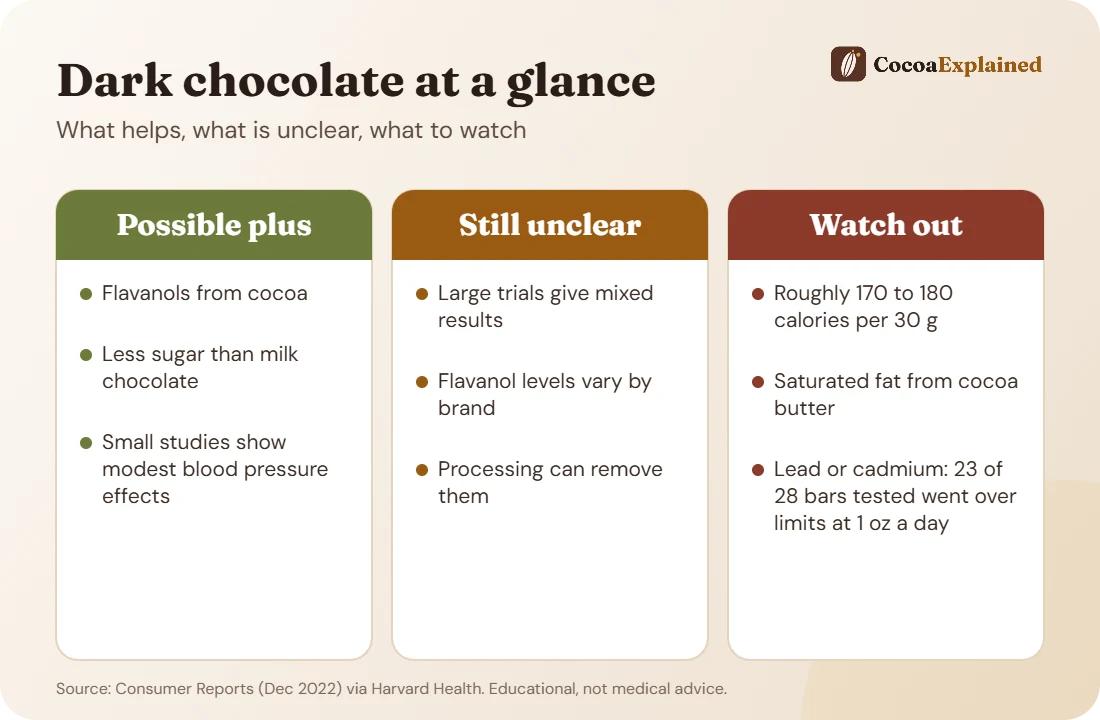
Cocoa contains flavanols, a group of plant compounds studied for effects on blood vessels and blood pressure. Small studies have reported modest improvements in blood pressure and blood vessel function with flavanol-rich cocoa. However, the amount of flavanols in a bar varies widely and processing can destroy much of it. Dutch-processed cocoa, for example, usually keeps fewer flavanols, as explained in our guide to natural vs Dutch-process cocoa.
Large trials are less clear-cut. The COSMOS trial gave older adults a high-dose cocoa flavanol supplement, not chocolate bars, and did not find a significant reduction in total cardiovascular events overall, although it reported fewer deaths from cardiovascular causes in the supplement group. That result is interesting but does not show that eating chocolate prevents heart disease.
Dark chocolate nutrition at a glance
Numbers help cut through the health talk. The table below uses the US government (USDA) figures for dark chocolate with 70 to 85 percent cocoa solids. Different brands vary, so check the label on your own bar.
| Nutrient | Per 100 g | Per 25 g (about 4 squares) |
|---|---|---|
| Calories | 598 kcal | about 150 kcal |
| Total fat | 42.6 g | about 10.7 g |
| Saturated fat | 24.5 g | about 6.1 g |
| Carbohydrate | 45.9 g | about 11.5 g |
| Sugars | 24.0 g | about 6.0 g |
| Fibre | 10.9 g | about 2.7 g |
| Protein | 7.8 g | about 1.9 g |
| Iron | 11.9 mg | about 3.0 mg |
| Magnesium | 228 mg | about 57 mg |
| Potassium | 715 mg | about 179 mg |
Two things stand out. Dark chocolate does contain real fibre, iron and magnesium, which is part of its good reputation. But it is also very energy dense, and a lot of the fat is saturated. It is a treat with some useful nutrients, not a vegetable.
What do different portions add up to?
| Portion | Calories | Sugars | Saturated fat |
|---|---|---|---|
| 10 g (about 2 small squares) | about 60 kcal | about 2.4 g | about 2.5 g |
| 25 g (about 4 squares) | about 150 kcal | about 6 g | about 6 g |
| 28 g (1 ounce) | about 170 kcal | about 6.7 g | about 6.9 g |
| 56 g (2 ounces) | about 335 kcal | about 13.4 g | about 13.7 g |
Harvard Health has suggested keeping dark chocolate to one or two ounces a day (about 28 to 56 g). Those two ounces carry roughly 335 calories, so many people who watch their weight choose a smaller amount. These figures are calculated from the USDA values above.
How strong is the evidence?
| Type of evidence | What has been reported | How much weight to give it |
|---|---|---|
| Small, short studies | Modest improvements in blood pressure and blood vessel function | Interesting, but small and often use high flavanol doses |
| Large trials | Less clear-cut results, often testing a cocoa flavanol supplement rather than chocolate bars | Stronger design, but not the same as eating a bar |
| Heart health overview (Harvard Health) | Dark chocolate may help prevent heart disease over the long term, mainly through flavonoids that help artery linings respond better | Encouraging, but it also stresses that chocolate is high in calories and saturated fat |
Common dark chocolate myths
| Myth | The facts |
|---|---|
| Dark chocolate is a health food | It has useful nutrients, but it is high in calories and saturated fat. Treat it as a treat. |
| A higher percentage is always healthier | More cocoa means less sugar, but cocoa solids are also where much of the cadmium sits, so higher is not automatically better. |
| Dark chocolate has no sugar | A typical 70 to 85 percent bar still has about 24 g of sugars per 100 g. |
| You can eat as much as you like | Because it is energy dense, portions matter more than the percentage on the pack. |

What you also get: calories, fat and sugar
- A typical 70 to 85 percent dark chocolate bar provides roughly 600 calories per 100 grams, so a 30 gram portion is around 170 to 180 calories.
- A large share of the fat is saturated, mainly from cocoa butter.
- Sugar is lower than in milk chocolate but still present, and gets higher as the percentage falls.
- Caffeine and theobromine are present in small amounts. See does dark chocolate have caffeine.
The heavy metals question
In December 2022, Consumer Reports tested 28 dark chocolate products and found that 23 of them contained lead, cadmium or both at levels that would put an adult over California’s maximum allowable dose level if eaten at one ounce (about 28 grams) per day. Five bars exceeded the limits for both metals. Harvard Health summarised the findings and noted that long-term exposure to these metals, even at low levels, has been linked to health problems including cardiovascular disease.
Cadmium is taken up from the soil by cacao trees, while lead is mostly picked up after harvest, from dust during drying and handling. Because dark chocolate contains more cocoa, it generally carries more of these metals than milk chocolate. Brands differ a great deal, and the same testing found products that stayed within the limits. Regulators also set cadmium limits for chocolate that rise with cocoa content, for example in the European Union.
How much is sensible
There is no official recommended amount of dark chocolate. Many dietitians suggest treating it like any other treat: a small square or two on most days, or a larger portion occasionally. Harvard Health advises enjoying it occasionally rather than frequently and choosing brands that tested better for metals. If you eat chocolate daily, eating a variety of brands and origins reduces the chance of relying on one high-metal product.
How to choose a better dark chocolate
- Read the ingredients. Cocoa ingredients and cocoa butter should come first, with a short list. See how to choose good chocolate.
- A higher percentage means less sugar but not automatically a healthier bar, because cocoa solids are where much of the cadmium sits.
- Check whether the maker publishes heavy metal test results or origin details. Our guide to single-origin chocolate explains why origin can matter.
- Look at independent tests such as the Consumer Reports results and choose brands that performed better.
- Pair it with a balanced diet rather than expecting it to offset a poor one.

Who should be careful
People who are pregnant, children and anyone advised to limit caffeine, sugar, saturated fat or certain metals should ask a doctor or dietitian how much dark chocolate suits them. People with migraines or reflux sometimes find that chocolate triggers symptoms.
Frequently asked questions
Is dark chocolate actually healthy
It contains flavanols and less sugar than milk chocolate, but it is also high in calories and saturated fat, and evidence for health benefits is mixed. It can fit into a balanced diet in small amounts.
How much dark chocolate can I eat a day
There is no official amount. Many dietitians suggest a small portion, around 20 to 30 grams, and eating it occasionally rather than every day if you are concerned about heavy metals.
Does dark chocolate contain lead and cadmium
Some bars do. Consumer Reports found that 23 of 28 tested dark chocolate products could exceed California’s limits for at least one metal at one ounce per day. Levels vary by brand.
Is 85 percent chocolate healthier than 70 percent
It has less sugar, but it is not automatically healthier. It is still high in calories and fat, and higher cocoa content can mean more cadmium.
Is white chocolate or milk chocolate healthier
Neither is a health food. Milk and white chocolate contain more sugar and less cocoa, so they provide fewer flavanols.
How many calories are in a square of dark chocolate?
A 70 to 85 percent dark chocolate has about 598 calories per 100 g. A 10 g piece, roughly two small squares, is about 60 calories, and a 25 g serving is about 150 calories.
Is dark chocolate good for blood pressure?
Some small studies have reported modest improvements in blood pressure and blood vessel function, but results from larger trials are less clear. Dark chocolate is not a treatment for high blood pressure. Speak to a doctor about managing it.
Key points to remember
- Dark chocolate can fit into a balanced diet in small amounts, but it is not a health food.
- It has more cocoa solids and less sugar than milk chocolate.
- Cocoa flavanols are studied for effects on blood vessels and blood pressure, but the research is mixed and large trials are less clear-cut.
- It is high in calories and fat and can contain trace heavy metals, so keep portions small.
Related guides
- Dark, Milk and White Chocolate: The Real Differences
- What Does Cocoa Percentage Mean on Chocolate?
- Does Dark Chocolate Have Caffeine? How Much vs Coffee
- What Is Single-Origin Chocolate? Meaning and How to Buy
- How to Choose Good Chocolate: What to Check Before You Buy
- Why Is Chocolate So Expensive Right Now?
- Start here: a beginner’s guide to chocolate
- Browse all chocolate guides
- Can Dogs Eat Chocolate?
- Is Dark Chocolate Vegan?
Sources
- Harvard Health: Heavy metals found in popular brands of dark chocolate
- NIH Office of Dietary Supplements
- USDA FoodData Central
- Chocolate, dark, 70-85% cacao solids, USDA FoodData Central record 170273 (nutrition per 100 g).
- Dark chocolate protects arteries, Harvard Health Publishing (published 2012).
This article is educational and is not medical or nutrition advice. Talk to a doctor or registered dietitian about your own needs. Last updated: October 2026.